
TL;DR:
- Creating a solid business budget requires accurate financial data, the right tools, and clear timeframes.
- Regularly reviewing and adjusting your budget and cash flow plans is essential for SME financial health.
- Zero-based budgeting and proactive cash flow management help UK SMEs control costs and avoid liquidity issues.
How to create a business budget for UK SME growth
Unexpected costs land without warning. A supplier raises prices, a client pays late, and suddenly your cash reserves are stretched thin. For many UK small and medium-sized enterprises (SMEs), this is not a rare crisis but a recurring pattern. Without a solid business budget in place, you are essentially flying blind through an increasingly turbulent economic environment. This article walks you through every practical step needed to build a business budget that actually works, covering the tools you need, common traps to avoid, and how to integrate cash flow planning so your business stays resilient when the pressure builds.
Table of Contents
- What you need before you start: key requirements and setup
- Step-by-step process: building your business budget
- Integrating cash flow and managing timing gaps
- Review, adjust, and avoid common mistakes
- A fresh take: why traditional budgeting isn’t enough for UK SMEs
- How Concorde helps you streamline your business budgeting
- Frequently asked questions
Key Takeaways
| Point | Details |
|---|---|
| Prepare before budgeting | Assemble expense, income, and forecasting data before you build your budget. |
| Follow key budgeting steps | Apply a step-by-step method, including contingency funds and regular reviews, to stay on track. |
| Integrate cash flow planning | Always include cash flow forecasting to protect your business against late payments. |
| Adapt and improve | Update your budget often and consider modern methods like zero-based budgeting. |
What you need before you start: key requirements and setup
Before you build anything, you need the right raw materials. Think of budgeting like constructing a building: no matter how skilled you are, you cannot get far without a solid foundation. For a business budget, that foundation is accurate financial data, the right tools, and a clear sense of your time frame.
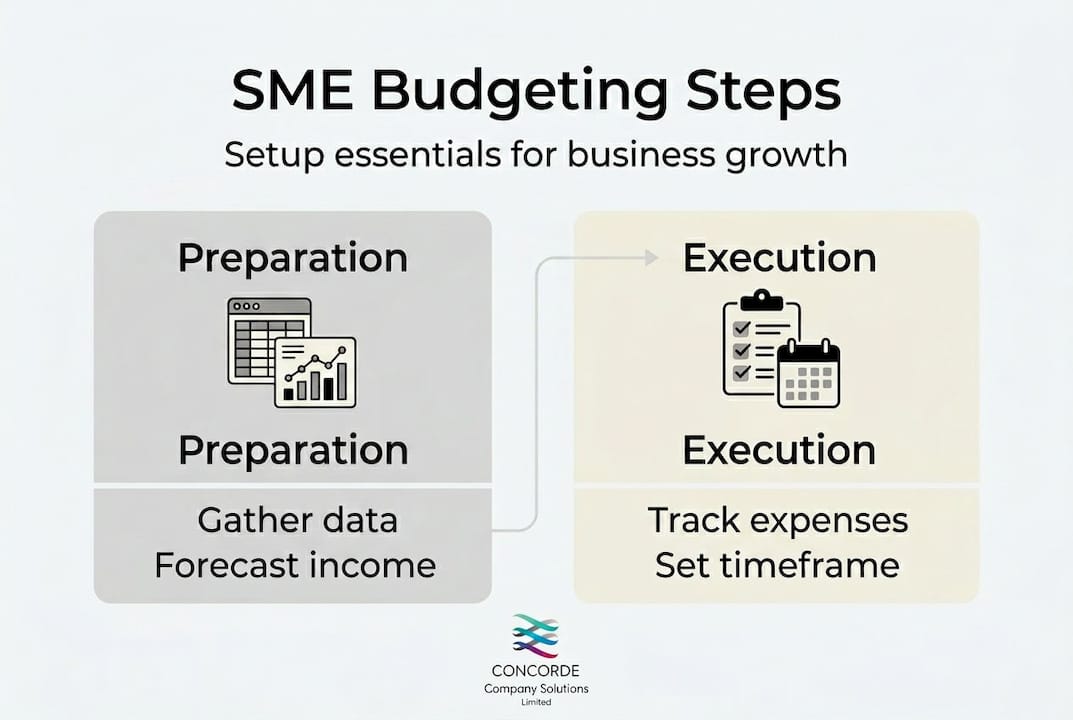
The core steps to create a business budget begin well before you open a spreadsheet. You need to gather your fixed expenses such as rent and wages, your variable costs like materials and utilities, and any one-off costs such as equipment purchases. You also need at least 12 months of income records, or conservative projections if you are a newer business. If you have run a budget before, dig it out too. Past budgets, even imperfect ones, reveal spending patterns that pure guesswork cannot.
| Requirement | What to gather | Where to find it |
|---|---|---|
| Fixed expenses | Rent, salaries, insurance, subscriptions | Bank statements, payroll records |
| Variable expenses | Stock, utilities, marketing spend | Purchase ledgers, invoices |
| One-off costs | Equipment, refurbishments, legal fees | Receipts, contracts |
| Income records | Sales, grants, other revenue | Accounting software, bank records |
| Previous budgets | Targets vs actuals | Accounting files, spreadsheets |
| Tax obligations | VAT, Corporation Tax estimates | HMRC records, calculating business taxes |
Once your data is assembled, choose the right tools. Many UK SMEs rely on software that automates much of the heavy lifting:
- Xero for cloud-based bookkeeping and budget tracking
- QuickBooks for invoicing, expenses, and profit and loss overviews
- Sage for more complex SME financial management needs
- Google Sheets or Excel for lightweight, customisable budget templates
- Float or Dryrun for dedicated cash flow and budget forecasting
When in doubt about your figures, look at valuing a business to understand how financial data feeds into broader business health assessments. Also consider reviewing a business forecasting guide to sharpen your income projections before you finalise your figures.
Pro Tip: Always overestimate your expenses and underestimate your income when building your first budget. This conservative approach gives you a financial buffer and prevents nasty surprises from derailing your plans mid-year.
Finally, decide on your time frame from the outset. Monthly budgets offer precision and quick feedback loops. Annual budgets give you the big picture but can lose accuracy over time. Most UK SMEs benefit from building an annual budget and then reviewing it monthly so adjustments can be made before small gaps become serious problems.

Step-by-step process: building your business budget
With all the essentials assembled, you are ready to build your budget step by step. The budgeting process is straightforward once you break it into discrete stages. Here is how to do it with realistic UK SME figures as a guide.
-
Set your time frame. Decide whether you are budgeting monthly, quarterly, or annually. Most SMEs start with a 12-month view broken into monthly segments.
-
Estimate your income. Use historical sales data where possible. If you are a newer business, use conservative market benchmarks. For example, a small retail business might project £8,500 per month in revenue based on prior trading records. Avoid optimistic assumptions here.
-
List all fixed expenses. For a small Leeds-based service business, fixed monthly costs might include £1,200 in rent, £6,000 in wages, £150 in software subscriptions, and £300 in insurance. These do not fluctuate and form your baseline.
-
List all variable expenses. These shift with activity levels. Materials might be £800 in a busy month and £400 in a quieter period. Utilities, delivery costs, and marketing spend also fall here. Budget these as an average with room for seasonal variation.
-
Calculate your projected profit or loss. Subtract total expenses from total income. If revenue is £8,500 and total costs are £7,200, your projected monthly profit is £1,300. If this figure is negative, adjustments are needed before trading.
-
Build your contingency fund. UK SME benchmarks suggest that 85% of small businesses report rising costs, with one-off startup expenses ranging from £15,000 to £70,000. Aim for a contingency of 10 to 15% of your total budget.
-
Plan your emergency reserve. Separate from contingency, an emergency fund covering three to six months of operating expenses is essential for absorbing major shocks.
-
Set your review schedule. Monthly business forecasting for SMEs checkpoints keep your budget honest and current.
Pro Tip: Build in a 10 to 15% contingency line from the start. UK cost pressures in energy, materials, and labour have made this not just sensible but necessary for most businesses.
Two broad approaches exist for how you structure your budget each period:
| Feature | Zero-based budgeting | Traditional budgeting |
|---|---|---|
| Starting point | Zero each period | Prior year figures adjusted |
| Expense justification | Every line justified anew | Incremental changes only |
| Best for | Efficiency focus, cost cutting | Stable, predictable businesses |
| Time required | High | Low to moderate |
| Risk of waste | Low | Higher over time |
| Flexibility | High | Lower |
Zero-based budgeting (ZBB) means starting each budget period from scratch and justifying every pound spent. It takes more effort but eliminates the creeping inefficiencies that build up in businesses that simply add a percentage to last year’s figures.
Integrating cash flow and managing timing gaps
After building the core budget, it is crucial to account for real-world timing by integrating cash flow. A budget tells you what should happen. Cash flow tells you what actually does happen, and when. These two things are often very different in practice, and the gap between them is where many UK SMEs run into serious trouble.
Include cash flow projections alongside your budget on a weekly or monthly basis to manage timing gaps, particularly when late payments are a recurring issue. For many UK businesses, the invoice goes out on time but the money arrives 60 or even 90 days later. In the meantime, your wage bill arrives on schedule.
Late payments contribute to 38 UK SME closures every single day, according to Parliament research on SME closures. Liquidity, not profitability, is the survival metric that matters most.
Here is what a robust cash flow plan alongside your budget should include:
- Timing mismatch management: Map when invoices are issued versus when payments are realistically received. Flag gaps of more than 30 days as risk periods.
- Credit control protocols: Set clear payment terms, send reminders before due dates, and follow up promptly on overdue accounts.
- Weekly cash flow projections: For businesses with tight margins, weekly snapshots are more useful than monthly summaries because they surface problems earlier.
- Monthly rolling forecasts: Update your cash flow forecast every month using actuals, not just budget assumptions.
- Buffer planning: Keep a minimum cash buffer equal to four to six weeks of fixed costs in your current account at all times.
A dedicated cash flow forecasting guide can help you set up the right structure. For ongoing support with cash flow management, having a clear process matters more than any single tool. You can also explore this cash flow manager guide for a broader view of managing liquidity across different business types.
The key insight is this: a business can be profitable on paper and still go under because the timing of cash movements was never planned. Integrating your cash flow into your budget is not an optional extra. It is the difference between a budget that looks good and one that actually protects your business.
Review, adjust, and avoid common mistakes
With your budget and cash flow integrated, regular review and course-correcting keep your business financially healthy. Many UK SMEs put real effort into building a budget in January and then barely look at it until December. That approach wastes the most valuable aspect of budgeting: its ability to guide decisions in real time.
Here is a practical review routine that works for most SMEs:
- Monthly check-in: Compare actual income and expenses against your budgeted figures. Note variances greater than 10% and investigate the cause before moving on.
- Quarterly adjustment: Revise your forward projections using actual data from the previous three months. If costs have risen across the board, update your variable expense estimates accordingly.
- Mid-year review: Reassess your annual targets. Have market conditions changed? Have you taken on new staff or contracts? Adjust the second half of your budget to reflect the current reality.
- Annual reset: At year end, use actuals to inform next year’s budget. Compare what you projected with what happened and document the lessons learned.
Regular reviews are essential because long-term budgets naturally lose accuracy as conditions shift. The FSB recommends using practical templates and involving an accountant in your annual review to support forecasting and ensure tax efficiency.
Common mistakes that undermine even well-constructed budgets include:
- Ignoring cash flow entirely and treating the budget as the whole financial picture
- Failing to update variable expenses when supplier costs or energy prices rise mid-year
- Not using your contingency fund when it is genuinely needed, then scrambling for credit instead
- Copying last year’s budget wholesale without questioning whether costs and revenue patterns still apply
- Skipping the review cycle because trading feels stable, which is exactly when inefficiencies quietly build up
Pro Tip: Use a simple spreadsheet template with actual versus budget columns for every month. Review it with your accountant at least once a year, and consider connecting your budgeting for tax planning to this cycle so nothing catches you off guard at year end.
For a wider view of how budgeting feeds into long-term planning, financial planning for businesses offers useful context on connecting annual budgets to strategic goals.
A fresh take: why traditional budgeting isn’t enough for UK SMEs
Having seen the practical how-to, it is worth challenging the standard advice and looking at better approaches for today’s SME leaders. Most budget guides tell you to gather your figures, build a spreadsheet, and check it quarterly. That advice is not wrong. It is just incomplete.
The reality for UK SMEs in 2026 is that costs are volatile, demand can shift rapidly, and the gap between a budget built in January and the world in July can be substantial. Traditional budgeting risks locking in inefficiencies by simply adjusting last year’s figures rather than questioning whether every line of spending still makes sense. In a high-inflation environment, that approach compounds waste year after year.
We have seen this repeatedly with clients who come to us after years of incremental budgeting. Their fixed cost base has quietly grown, their contingency fund has never been properly funded, and their annual review is more of a formality than a genuine financial health check. Zero-based budgeting and the Profit First method (which allocates revenue into separate accounts for profit, tax, and operating expenses before anything else is spent) offer genuinely different disciplines. They force intentionality. They make every pound justify its presence.
The cash basis accounting guide is worth reviewing alongside any budgeting overhaul, particularly if you are a sole trader or small limited company looking to simplify your financial tracking. The bottom line is this: budgeting is not a once-a-year administrative task. Treated properly, it is one of the most powerful management tools available to any SME owner.
How Concorde helps you streamline your business budgeting
Building a business budget is one thing. Maintaining it, connecting it to your tax obligations, and keeping it aligned with your actual cash position is another. That is where having the right professional support makes a genuine difference.

At Concorde Company Solutions, we work with UK SMEs across Leeds and beyond to bring structure and clarity to their financial management. Whether you need help setting up your initial budget, reviewing your figures, or managing payroll solutions that feed accurately into your cost planning, we are here to help. Our team understands the pressures facing small businesses and provides tailored support that goes beyond spreadsheets. Get in touch with us today to take the next step from planning to practice.
Frequently asked questions
What expenses should SMEs always include in a business budget?
SMEs should include fixed expenses such as rent and wages, variable costs like raw materials and utilities, and one-off or contingency items such as equipment and legal fees.
How often should I review and update my budget?
Budgets should be reviewed monthly or quarterly at minimum, with monthly reviews offering the most accurate and timely picture of your financial position.
Why is cash flow forecasting crucial for UK SMEs?
Cash flow forecasting helps manage the timing gaps caused by late payments. Including weekly or monthly projections alongside your budget reduces the risk of running out of cash even when your business is technically profitable.
What is zero-based budgeting and is it suitable for small businesses?
Zero-based budgeting means justifying every expense from scratch each period rather than adjusting last year’s figures. It reduces waste and improves efficiency, though it requires more time and discipline to implement.
No responses yet