TL;DR:
- Sole traders must master HMRC compliance, deadlines, and expense categorization to stay profitable.
- Effective cash flow management involves timely invoicing, late payment strategies, and saving 25-30% for taxes.
- Preparing for MTD in 2026 requires digital software, quarterly updates, and proactive record-keeping.
Running your own business as a sole trader in the UK means wearing every hat at once: salesperson, administrator, and finance director. Cash flow disruptions, looming Self Assessment deadlines, and a shifting HMRC regulatory landscape create genuine pressure that can undermine even profitable businesses. With Making Tax Digital expanding in 2026 and late payments remaining a persistent threat, getting your financial planning right is no longer optional. This guide walks you through the tools, processes, and strategies you need to stay solvent, compliant, and firmly in control of your finances.
Table of Contents
- Understanding the essentials: Tools, requirements and readiness
- Managing cash flow: Forecasting, invoicing, and tackling late payments
- Tax planning and compliance: MTD, Self Assessment and quarterly updates
- Avoiding common mistakes and optimising financial health
- A fresh perspective: What traditional advice misses about sole trader planning
- Find expert support for your sole trader needs
- Frequently asked questions
Key Takeaways
| Point | Details |
|---|---|
| Know your deadlines | Missing HMRC deadlines leads to penalties, so mark key dates early and plan ahead. |
| Optimise cash flow | Implement prompt invoicing and forecasting to prevent late payment disruptions. |
| Stay tax compliant | Adopt MTD-compatible software and submit quarterly updates to avoid fines and errors. |
| Avoid common pitfalls | Mis-categorising expenses and neglecting to save for tax are costly mistakes you can easily prevent. |
| Seek expert support | Professional accountants and payroll services ensure financial planning is both effective and stress-free. |
Understanding the essentials: Tools, requirements and readiness
Before you can plan effectively, you need to understand what HMRC actually requires of you. Many sole traders discover the rules only after receiving a penalty notice, which is precisely the wrong time to learn.
The Self Assessment deadlines are strict: register by 5 October, file your online return by 31 January, and pay any tax owed by 31 January. Miss the filing deadline and you face an automatic £100 fine, rising to £1,600 or more if the delay continues, plus interest on unpaid amounts. These are not negotiable.
Understanding allowable expenses is equally important. These are costs that are wholly and exclusively for your business, such as equipment, professional subscriptions, and a portion of home office costs. Subtracting them from your turnover gives you your taxable profit. The simpler your records, the easier this calculation becomes.
One of the smartest early decisions is choosing between digital software and manual record keeping. Here is how they compare:
| Feature | Digital software | Manual record keeping |
|---|---|---|
| Time to reconcile | Minutes per week | Hours per month |
| Error rate | Low (automated) | Higher (human entry) |
| MTD compatibility | Yes | No |
| Cost | Monthly subscription | Free but time-costly |
| HMRC-ready exports | Instant | Manual preparation |
For most sole traders, a sole trader accounting platform makes the choice straightforward. The time saved and error reduction far outweigh a modest monthly fee.
Before you do anything else, run through this readiness checklist:
- Register with HMRC for Self Assessment if you earn over £1,000 from self-employment
- Choose your accounting software and connect your business bank account
- Set up an expense tracking system from day one, not month three
- Store receipts digitally using your software’s mobile app
- Know your payment on account obligations if your bill exceeds £1,000
For more practical guidance, our accounting tips for sole traders cover the day-to-day habits that keep records clean. And if you are still unsure whether you need professional support, our guide to accountants for sole traders explains when it makes financial sense to bring in expert help.
Managing cash flow: Forecasting, invoicing, and tackling late payments
Once your essentials are in place, the next step is securing robust cash flow. This is where many sole traders struggle most, because profit on paper does not always mean money in the bank.

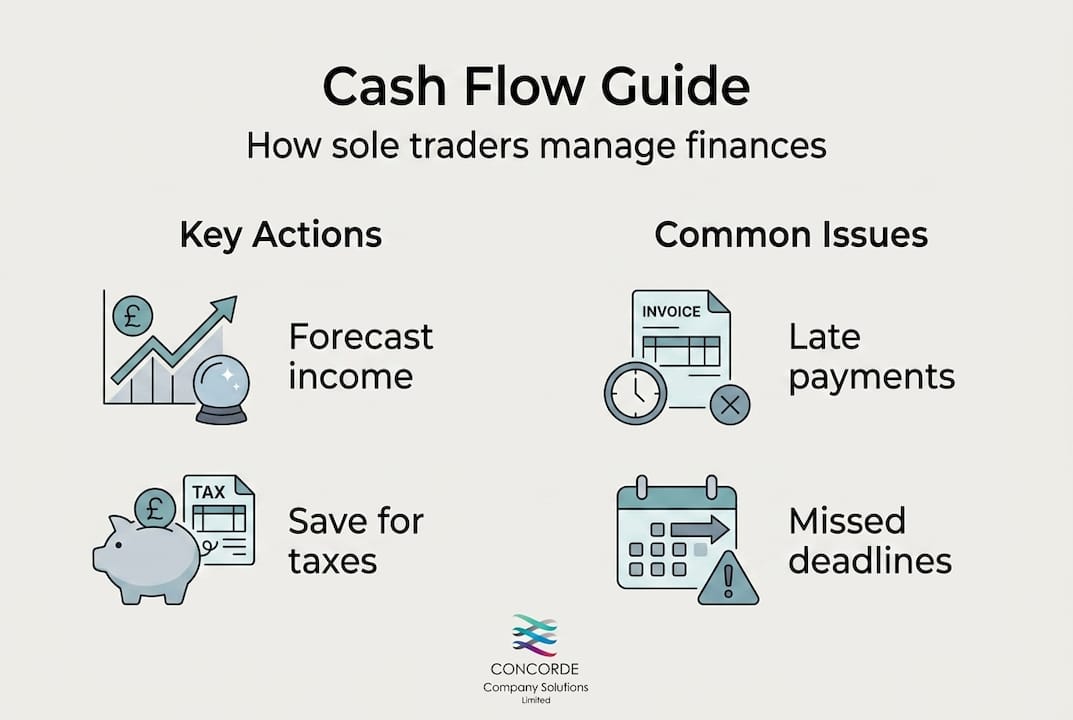
37% of small firms face cash flow problems directly caused by late payments. That is more than one in three businesses being put at risk not by poor sales, but by customers who simply do not pay on time. The solution starts with your invoicing process.
Issue invoices the same day you deliver goods or complete a service. Include clear payment terms on every invoice, typically 14 or 30 days, and state the consequences of late payment. Under the Late Payment of Commercial Debts Act, you are legally entitled to charge interest. Most clients pay faster when they know this.
For cash flow forecasting, keep these essentials in mind:
- List all expected income by week for the next 90 days
- List all known outgoings: software, insurance, materials, tax payments
- Identify the gaps where outgoings exceed income
- Plan cover for those gaps using a reserve fund or an invoice finance facility
- Review and update your forecast every two weeks
The table below shows common bottlenecks and how to address them:
| Cash flow bottleneck | Mitigation strategy |
|---|---|
| Clients paying late | Automated reminders, early payment discounts |
| Irregular income months | Build 3-month reserve fund |
| Unexpected tax bills | Quarterly tax pot (see below) |
| Seasonal slow periods | Spread payments with payment plans |
| Rapid growth costs | Invoice finance or business overdraft |
Pro Tip: Every time income lands in your account, immediately transfer 25 to 30 percent into a separate savings account labelled “tax pot.” The ICAEW recommends saving 25-30% of income for tax and holding a 3 to 6 month emergency fund. Doing this automatically removes the temptation to spend money that was never truly yours.
Our accounting tips for sole traders include invoice templates and scripts for chasing overdue payments professionally.
Tax planning and compliance: MTD, Self Assessment and quarterly updates
With cash flow under control, attention turns to proper tax planning and compliance. The rules changed significantly in 2026 and catching up late is costly.
From 6 April 2026, sole traders with gross income above £50,000 must use MTD-compatible software, maintain digital records, and submit four quarterly updates to HMRC, plus a final declaration by 31 January. This is not optional. HMRC estimates 864,000 sole traders and landlords fall into this group.
Here is how to prepare and stay compliant step by step:
- Check your income threshold. If gross income exceeds £50,000 you must comply now. The threshold drops to £30,000 in April 2027.
- Choose MTD-compatible software such as QuickBooks, Xero, or FreeAgent and connect it to your bank.
- Categorise every transaction as it happens rather than in a monthly catch-up session.
- Submit quarterly updates for each three-month period within one month of the period ending.
- File your final declaration by 31 January to confirm your annual income and claim any remaining allowances.
- Keep digital records for at least five years after the 31 January submission deadline.
The penalties for late quarterly submissions stack up quickly, so treating each deadline with the same seriousness as the annual return is essential. Our detailed guide to MTD requirements for sole traders explains exactly which software qualifies and what each quarterly update must contain.
Pro Tip: Use your MTD software’s VAT categorisation feature from the start. Mis-categorising transactions is the leading cause of VAT errors and subsequent HMRC inquiries. Correct categorisation at the point of entry costs seconds; fixing it later can cost hours and penalties.
If you are unsure about digital tax submission requirements or want a walkthrough of the filing process, our sole trader tax return guide covers every stage. For additional context on managing cashflow alongside your tax obligations, the ICAEW provides solid benchmarks.
Avoiding common mistakes and optimising financial health
Even with the right tools and process, mistakes can still happen. Here is how to avoid them.
The most frequent errors sole traders make tend to cluster around three areas: mis-categorising expenses, missing deadlines, and under-saving for tax. Each is avoidable with simple habits.
- Mis-categorising expenses: A home broadband bill is only partially deductible if you also use it personally. Claiming 100 percent is incorrect and triggers inquiries. Use HMRC’s allowable expense definitions as your reference.
- Missing deadlines: Set calendar reminders for every key date, not just 31 January. Include the quarterly MTD submission dates added in 2026.
- Under-saving for tax: Many sole traders treat their bank balance as available income. It is not. Your tax pot must be sacred.
- Ignoring late payments: Chasing invoices feels awkward. Not chasing them feels worse when your bank account runs dry in February.
- Failing to review finances monthly: A monthly review catches problems early. Quarterly is too infrequent for most sole traders.
A point worth highlighting: mixed income, where you combine employment income with self-employment earnings, can push you into a higher tax band or trigger the personal allowance taper above £100,000. Many sole traders with a part-time employment contract are unaware this affects their overall liability.
Seek professional accountant support for Self Assessment and MTD compliance, and consider an FCA-regulated financial adviser for pension and protection planning. Getting both right protects your business and your long-term financial wellbeing.
Technology helps considerably here. Software that flags unusual transactions, reminds you of deadlines, and auto-reconciles your bank feed reduces human error dramatically. For simple business finance tips that complement your digital tools, practical short guides can fill knowledge gaps quickly.
For tailored guidance on what an accountant can actually do for your situation, our page on accountant advice for sole traders is worth reading before you decide to go it alone.
A fresh perspective: What traditional advice misses about sole trader planning
Having covered practical guidance, let us explore what is often overlooked in sole trader financial planning.
Most advice stops at “save for tax and pay on time.” That is necessary but insufficient. The real gap in conventional guidance is the failure to address what happens when things go right. Rapid growth is a genuine cash flow threat. When your income jumps suddenly, your tax liability jumps with it, but your tax pot may not have kept pace. Sole traders who land a big contract in March often face a January tax bill they cannot meet, not because they failed, but because nobody warned them that success has a cash cost.
Mixed income is another blind spot. Combining employment and self-employment changes your effective tax bands in ways that standard sole trader advice rarely addresses. The interaction between PAYE deductions and Self Assessment liability can leave you with an unexpected underpayment at year end.
The MTD shift is not just a compliance change. It is a fundamental operational change. Quarterly reporting means your financial picture must be accurate four times a year, not once. This rewards sole traders who treat bookkeeping as a weekly habit rather than an annual scramble. Our real-world accounting advice reflects the habits that actually make a difference in practice, not just in theory.
Find expert support for your sole trader needs
Turning financial planning knowledge into day-to-day practice is where many sole traders get stuck. Reading the right guidance is one thing; applying it consistently while running your business is another.

At Concorde Company Solutions, we work directly with sole traders across the UK to handle Self Assessment, MTD compliance, bookkeeping, and payroll. Our payroll services are designed for the practicalities of running a small operation, without the overhead of a large firm. Whether you need help setting up MTD-compatible software, filing quarterly updates, or simply staying on top of deadlines, our team provides the kind of responsive, personal support that makes a genuine difference. Explore the full range of sole trader solutions and find out how we can take the financial admin off your plate.
Frequently asked questions
What are the key deadlines for sole trader tax returns in the UK?
Register for Self Assessment by 5 October, file your online return by 31 January, and pay any tax owed by 31 January. Late filing penalties start at £100 and can reach £1,600 plus interest.
How will Making Tax Digital (MTD) affect sole traders in 2026?
Sole traders with gross income above £50,000 must use MTD-compatible software and submit four quarterly updates to HMRC each year, plus a final declaration by 31 January.
What percentage of income should I save for taxes as a sole trader?
Save 25 to 30 percent of your income in a dedicated tax pot and aim to hold a 3 to 6 month emergency fund to cover unexpected gaps.
What are common financial mistakes sole traders make?
The most frequent errors include mis-categorising expenses, missing Self Assessment deadlines, failing to chase late payments, and neglecting to account for mixed income affecting tax band calculations.
Should I hire an accountant as a sole trader?
A professional accountant helps you meet Self Assessment and MTD obligations accurately and can identify tax efficiencies that often outweigh the cost of their fees.
No responses yet