
TL;DR:
- Many UK SMEs operate without a documented business continuity plan despite high failure risks.
- Effective plans are simple, tested, and focused on critical functions to ensure quick recovery.
- Regular review and practical preparation can significantly improve SME resilience and longevity.
Roughly 43% of businesses without a continuity plan shut down within two years of a major incident. That figure alone should stop any business owner in their tracks, yet the vast majority of UK SMEs still operate without a documented plan in place. Business continuity is not a boardroom luxury reserved for multinationals with dedicated risk teams. It is a practical, scalable discipline that any small or medium-sized business can adopt, and this guide will show you exactly what it involves, what is at stake if you ignore it, and how to get started without overcomplicating things.
Table of Contents
- Defining business continuity for UK SMEs
- Key risks and what can go wrong without a plan
- Core elements of an effective business continuity plan
- Business continuity in action: scenarios and edge cases
- Why simplicity wins: a fresh perspective on continuity for SMEs
- Get expert business continuity support for your SME
- Frequently asked questions
Key Takeaways
| Point | Details |
|---|---|
| Business continuity is essential | SMEs with no plan risk closure and major losses after disruptions. |
| Simple steps work best | Effective continuity plans for SMEs can be straightforward, scalable, and focused on core risks. |
| Test and update plans | Annual testing and review ensure SME continuity plans remain effective as threats evolve. |
| Cyber threats dominate | Over half of business disruptions for UK SMEs now come from cyber incidents. |
| Professional guidance pays off | External expertise and compliance alignment boost success and resilience for SMEs. |
Defining business continuity for UK SMEs
Business continuity is, at its core, about keeping your business running when something goes wrong. More formally, business continuity is a strategic framework that enables organisations, including UK SMEs, to maintain or quickly resume mission-critical operations following disruptions. That disruption might be a cyberattack, a flood, a key supplier going under, or even a prolonged staff illness. The plan exists so you are not scrambling to make decisions under pressure with no roadmap to follow.
Many SME owners conflate business continuity with insurance. Insurance compensates you after a loss. Continuity planning prevents or minimises that loss in the first place. Others confuse it with disaster recovery, which is specifically focused on restoring IT systems and data. Business continuity is broader. It covers people, processes, communications, suppliers, finances, and yes, technology too. Resilience, another term you will hear often, refers to the long-term capacity of your business to adapt and withstand ongoing change. Think of resilience as the destination and continuity planning as the road you travel to get there.
“Business continuity is not about predicting the future. It is about preparing intelligently so that when disruption arrives, your business responds rather than reacts.”
SMEs face distinct challenges that larger businesses do not. You are likely running a leaner operation with fewer redundancies built in. One absent member of staff can disrupt an entire process. One supplier going quiet can stall your whole production cycle. Larger companies have dedicated risk officers, sprawling IT departments, and legal teams. You probably do not. That is not a weakness, it is simply a reality that shapes how your continuity plan needs to be written.
The data confirms just how exposed most SMEs currently are. Only 58% of UK SMEs have a business continuity plan, and 65% lack robust strategies, often due to resource constraints and underestimation of risks. The irony is that SMEs arguably need continuity planning more than large enterprises, because they have far less capacity to absorb the financial and reputational shock of an unexpected incident.
Good continuity planning also feeds directly into SME compliance value and is increasingly relevant when tendering for contracts or negotiating business insurance. If you want to understand how broader financial compliance for SMEs connects to operational resilience, the two are more intertwined than most people realise. Regulatory continuity standards are also evolving across financial institutions, and the principles they follow are directly applicable to small businesses.
Common reasons UK SMEs lack effective plans include:
- Assuming continuity planning is too complex or expensive
- No dedicated person responsible for risk management
- Underestimating how quickly a disruption can escalate
- Believing their sector or size makes them low-risk
- Postponing planning because day-to-day operations feel more urgent
Key risks and what can go wrong without a plan
Once you understand what business continuity means, the next question is obvious. What actually goes wrong when you do not have a plan? The short answer is: more than most people expect, and faster than they anticipate.
The most common disruption types are cyber-related, accounting for 51% of all business disruptions. Supply chain failures, power outages, and extended staff absences round out the top four. Each one is disruptive on its own. In combination, they can be catastrophic, particularly for a business with no documented response procedures.
| Disruption type | Likelihood for SMEs | Average recovery time | Cost impact |
|---|---|---|---|
| Cyberattack / ransomware | High | 24+ days | £10,000 to £500,000+ |
| Key staff absence | Very high | Days to weeks | Lost revenue, errors |
| Supply chain failure | Moderate to high | Weeks to months | Revenue and contract loss |
| Power / technology outage | Moderate | Hours to days | Operational downtime |
| Flood or physical damage | Lower but severe | Weeks to months | Property and data loss |
The survival statistics are stark. Forty percent of businesses never fully recover from a major operational outage. That number is not an abstract warning. It translates directly to businesses that were trading one month and gone the next, leaving owners, employees, and clients without recourse.
“Every day a business operates without a continuity plan is a day it is betting its survival on nothing going wrong.”
Beyond closure, the cost of missed continuity shows up in several ways. Revenue stops during downtime. Customers take their business elsewhere and do not always come back. HMRC deadlines do not pause for emergencies, meaning compliance failures stack up alongside operational ones. Reputational damage in tight-knit industries can be long-lasting.
Here is a practical order in which most SME disruptions escalate:
- An incident occurs (cyberattack, outage, staff crisis)
- Operations stall because no documented response exists
- Communication to clients and suppliers breaks down
- Cash flow tightens as invoicing and payments are delayed
- Compliance deadlines are missed, triggering penalties
- Recovery costs spiral beyond initial estimates
- Client confidence erodes, and some relationships cannot be repaired
Pro Tip: Align your continuity risk planning with your financial forecasting and compliance cycles. If you can anticipate the quieter months in your business, those are the best periods to test your plan and update your risk register. Our forecasting for disruption guide explains how to build financial foresight into your planning. And if you want a structured starting point, the SME compliance checklist covers many of the operational and regulatory touchpoints that a continuity plan should address.
Core elements of an effective business continuity plan
Knowing what is at stake, you need to understand what an effective plan actually contains. The good news is that a solid continuity plan for an SME does not need to run to hundreds of pages. It needs to be clear, usable, and tested.
The internationally recognised standard for business continuity management is ISO 22301, which outlines a structured approach involving risk assessment, business impact analysis, implementation, testing, and continual improvement. You do not need to pursue formal certification to benefit from this methodology. The framework gives you a logical sequence to follow.
The core components of a continuity plan include a business impact analysis, defined recovery time and recovery point objectives, a designated crisis team, documented backup and restoration procedures, and a clear communication plan. Let us break each one down:
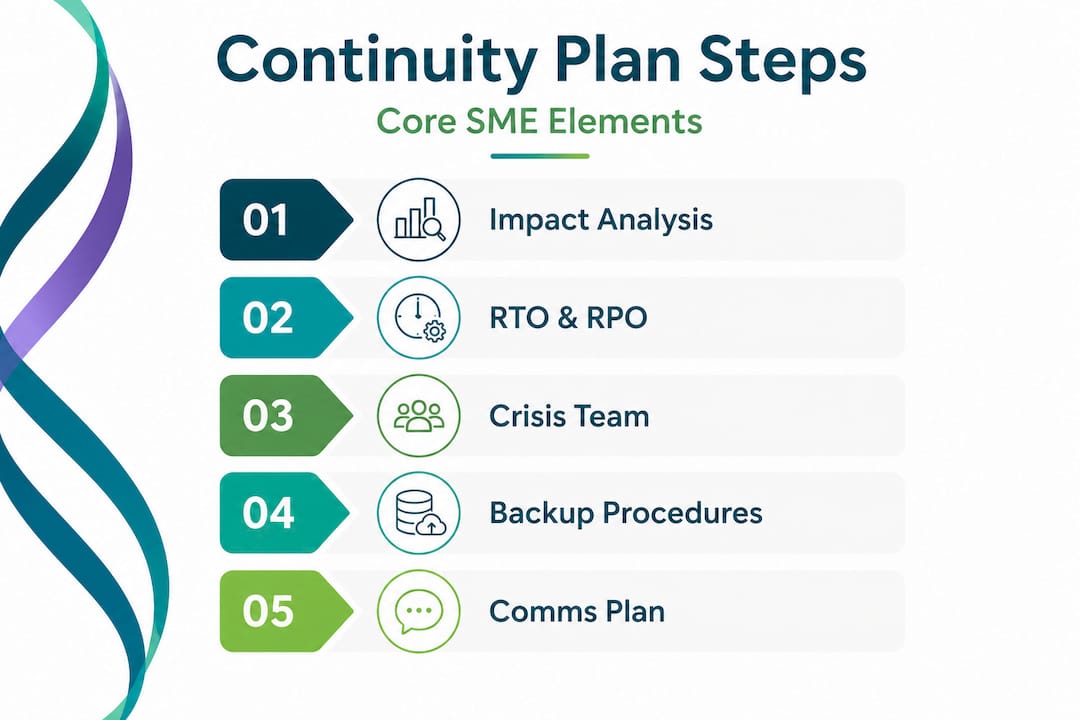
Business Impact Analysis (BIA): This is where you identify which functions are critical and what happens if each one fails. How long can you operate without access to your accounting software? What if your primary contact with your biggest client goes off sick? The BIA forces you to ask these uncomfortable questions before an incident forces them on you.
Recovery Time Objective (RTO) and Recovery Point Objective (RPO): RTO is the maximum time you can afford to have a system or process offline. RPO is the maximum amount of data loss you can tolerate, measured in time. For example, if your RPO is four hours, your backups need to run at least every four hours.
Crisis team and roles: Every continuity plan needs named individuals with defined responsibilities. Who contacts clients? Who liaises with suppliers? Who manages IT recovery? Without clear roles, everyone assumes someone else is handling it.
Backup and restoration procedures: These need to be documented in plain English, not just understood by your IT provider. What is backed up, where, how often, and who has access?
Communication plan: This covers internal communication with staff, external communication with clients and suppliers, and any regulatory notifications that may be required.
| Element | SME approach | Enterprise approach |
|---|---|---|
| Business Impact Analysis | Focused on top 5 to 10 critical functions | Full organisational mapping |
| Recovery objectives | Practical targets per process | Formally documented per department |
| Crisis team | 2 to 4 named individuals | Dedicated risk and comms departments |
| Testing frequency | Annual minimum, scenario-based | Quarterly, often third-party audited |
| Documentation | Concise, role-specific | Extensive governance frameworks |
If you are already working with tailored accounting support, the advantages of tailored accounting extend naturally into continuity planning because your financial records, supplier data, and cash flow projections are already organised in a way that feeds directly into a BIA. Understanding risk analysis in continuity planning gives further context on how structured risk thinking supports resilience.
Pro Tip: Document your supplier contact details, critical system credentials, and backup locations in a single secure file that at least two people can access. Then test your plan at least once a year. A plan that has never been rehearsed is just a document.
Business continuity in action: scenarios and edge cases
With the building blocks understood, it helps to see how continuity planning plays out under real pressure. The threats SMEs face in 2026 are diverse, and some have emerged or intensified only in the past few years.
Cyberattack on a small financial firm. Consider a small accountancy practice that falls victim to a ransomware attack on a Monday morning. Systems are locked. Client data is inaccessible. The firm has no offline backups and no documented recovery procedure. The average ransomware recovery takes 24 days. For a firm that processes monthly payroll for dozens of clients, 24 days of downtime is commercially devastating and potentially irreparable from a reputational standpoint. A firm with a continuity plan in place, backed up daily to an offsite or cloud location, with a documented crisis response, could be operational within hours.
Supplier failure during a global shock. A product-based SME sources key components from a single overseas supplier. A geopolitical disruption halts shipments for six weeks. With no alternative supplier identified and no cash flow buffer documented, the business haemorrhages orders and goodwill. A BIA would have flagged this single point of failure. A continuity plan would have identified backup suppliers and a protocol for communicating delays to customers before trust is lost.
Hybrid and remote work challenges. The shift to hybrid working has introduced new continuity risks that many SMEs have not addressed. If your team works partly from home, what happens when a home broadband connection fails during a critical client call? What if a remote worker’s laptop is lost or stolen? These edge cases require documented protocols covering secure access, device management, and communication alternatives.
Key practical steps for hybrid continuity include:
- Ensuring all critical systems are cloud-accessible with multi-factor authentication
- Documenting alternative communication channels for every team member
- Keeping an offline copy of essential contacts and client information
- Conducting a short tabletop exercise where you talk through a scenario as a team
Keeping your bank reconciliation current is also directly relevant here. During any disruption, understanding your real cash position is one of the first things you need. Clean, up-to-date financial records accelerate every aspect of recovery. Crisis response examples from financial services firms illustrate just how decisive preparation is in the first hours of an incident.
Pro Tip: Run a tabletop exercise with your team twice a year. Choose a realistic scenario, talk through who does what, and identify gaps. You do not need an external facilitator. An hour around a meeting table will reveal more than months of theoretical planning.
Why simplicity wins: a fresh perspective on continuity for SMEs
Here is a view that does not get enough airtime: most SME business continuity plans fail not because they are too simple, but because they are too complicated to actually use.
We see business owners invest real effort in producing lengthy, well-structured documents, only for them to sit unread on a shared drive. When a real incident hits, nobody can find the file. Nobody remembers the procedure. The plan that looked impressive in theory becomes useless in practice. Simple, scalable plans are demonstrably more effective for resource-limited SMEs than complex enterprise-grade frameworks that require dedicated teams to operate.
The guidance from the UK government’s security profession framework is clear: SME owners should prioritise simple, tested business continuity plans, starting with a business impact analysis and a cyber response strategy. Given that low adoption rates expose SMEs to genuinely high failure risks, even a one-page plan that is actually understood and rehearsed by your team is infinitely more valuable than a fifty-page document gathering dust.
The other uncomfortable truth is that most SMEs underestimate how quickly a disruption escalates emotionally as well as operationally. When you are in the middle of a crisis, your ability to think clearly is compromised. That is not a personal failing. It is how stress affects decision-making for everyone. The value of a plan is not that it covers every eventuality. It is that it gives you and your team a starting point so you are acting rather than freezing.
So start small. Identify your five most critical functions. Document who does what when each one fails. Keep the document short, accessible, and reviewed annually. Test it with a conversation, not a simulation. Then build from there.
Get expert business continuity support for your SME
Business continuity planning connects directly to sound financial management, and that is where working with the right accountancy partner makes a measurable difference. When your books are accurate, your forecasts are reliable, and your compliance is in order, you already have the financial foundation that every good continuity plan depends upon.

At Concorde Company Solutions, we work with small and medium-sized businesses across the UK to keep their financial operations compliant, organised, and resilient. From payroll and bookkeeping to statutory accounts and tax returns, we provide the kind of dependable, personalised support that means your finances are never a vulnerability when disruption strikes. If you want to talk through how your financial records and compliance position can feed into a stronger continuity strategy, get in touch with our team today. We are based in Garforth, Leeds, and we are straightforward to talk to.
Frequently asked questions
What is the purpose of business continuity for SMEs?
Business continuity helps SMEs resume operations quickly after a disruption, reducing the risk of closure and significant financial loss. It is a strategic framework for resilience that keeps mission-critical functions running even when things go wrong.
What are the main threats covered by a business continuity plan?
Key risks include cyberattacks, supply chain failures, natural disasters, and technology outages. 51% of disruptions are cyber-related, making cyber resilience a non-negotiable part of any modern continuity plan.
How often should a business continuity plan be reviewed?
A continuity plan should be reviewed and tested at least once a year, and immediately after any major business change such as a new supplier, system migration, or significant staff change.
Is business continuity planning required for compliance?
Certain sectors require documented continuity plans for regulatory compliance, but all SMEs benefit because robust plans aid tendering for contracts and can reduce business insurance premiums.
What is the difference between business continuity, disaster recovery, and resilience?
Business continuity focuses on maintaining all operations during disruption; disaster recovery is specifically IT-focused; resilience is the long-term capacity to adapt and withstand ongoing change across the whole organisation.
Recommended
- Why financial compliance matters for UK SMEs: 2026 guide
- Financial Planning – Why It Matters for Leeds SMEs
- Why audit matters: safeguard UK SMEs with expert assurance
- Business forecasting guide for UK SMEs: boost decisions
- Bonnes pratiques incendie : exemples et conseils pour PME
- Why use cybersecurity services: Essential protection for SMBs
No responses yet