
TL;DR:
- Poor expense categorisation costs UK SMBs an estimated £1.1 billion monthly through missed deductions and insights.
- Proper categorisation relies on understanding allowable expenses, the wholly and exclusively rule, and accurate record-keeping.
- Effective expense management enhances financial intelligence, compliance, VAT reclaim, and strategic decision-making.
Poor expense categorisation is quietly draining UK small and medium-sized businesses. Poor tracking costs UK SMBs an estimated £1.1 billion every month, according to the Federation of Small Businesses. That figure is not just about lost tax relief; it reflects missed cash flow insights, flawed profit and loss accounts, and real exposure to HMRC scrutiny. This guide walks you through exactly which expenses are allowable, which are firmly off the table, and how to build a categorisation system that keeps your business compliant, efficient, and better informed. Read on to protect your bottom line.
Table of Contents
- Understanding allowable business expenses in the UK
- Key categories of business expenses and practical examples
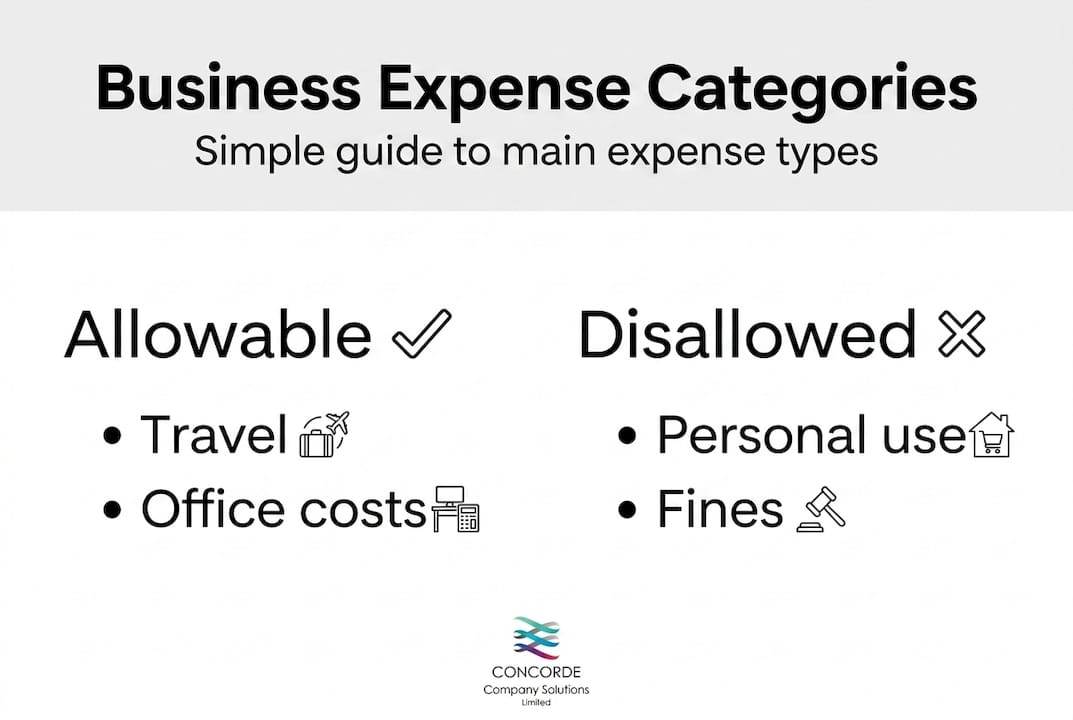
- What is disallowed: common mistakes and expenses to avoid
- Best practices for categorising business expenses and boosting compliance
- Why most businesses underestimate expense categorisation’s true value
- How Concorde can help you with expense management and payroll
- Frequently asked questions
Key Takeaways
| Point | Details |
|---|---|
| Define and separate expenses | Knowing what qualifies as an allowable business expense is essential for UK tax compliance and better financial clarity. |
| Avoid common disallowed costs | Understanding which expenses HMRC excludes helps you steer clear of costly errors and penalties. |
| Implement robust categorisation | Using precise categories, supported by real examples and digital tools, makes expense management simpler and more accurate. |
| Monitor and adjust systems | Regular reviews improve your expense processes, support VAT reclaim, and strengthen audit preparedness. |
Understanding allowable business expenses in the UK
Before you can claim anything against your tax bill, you need to understand the rules that govern which expenditure qualifies in the first place. HMRC does not operate on a loose interpretation. There is one central test that virtually every allowable expense must pass.
The “wholly and exclusively” rule: Under UK tax law, a business expense is only deductible if it is incurred wholly and exclusively for the purposes of the trade. If an expense has any personal element, it may be disallowed entirely or require careful apportionment.
This single principle causes more confusion than almost anything else in business finance. It does not mean that every mixed-use cost is automatically rejected. It means that you must be able to clearly demonstrate that the business portion is separable and genuinely business-motivated.
Revenue versus capital: knowing the difference
UK tax law draws a sharp distinction between two types of expenditure:
- Revenue expenses cover the day-to-day running of your business. Stationery, software subscriptions, staff wages, accountancy fees, and utility bills are all revenue expenses. These are generally deductible against your profits in the period they are incurred.
- Capital expenses relate to longer-term assets, such as machinery, vehicles, or commercial property improvements. These are not immediately deductible in the same way. Instead, you may be able to claim capital allowances, such as the Annual Investment Allowance, to reduce your Corporation Tax bill over time.
Mixing these two categories up is a common and costly error. Buying a new laptop outright is a capital purchase. Paying a monthly subscription for cloud-based design software is a revenue expense. The treatment differs significantly.
Apportionment for mixed-use costs
Many business owners use a vehicle for both work and personal journeys, or work from home part of the week. HMRC accepts apportioned claims in these situations, provided you can demonstrate a fair and consistent method of calculation. For home working, this might mean calculating the proportion of rooms used for business or tracking the hours worked at home. For vehicles, a mileage log is essential.
Common allowable business expenses include:
- Office rent, rates, and utilities
- Employees’ salaries and employer’s National Insurance contributions
- Professional subscriptions and accountancy fees
- Business insurance premiums
- Advertising and marketing costs
- Cost of goods sold and raw materials
Proper record-keeping underpins everything. Without receipts, invoices, and clear categorisation, even legitimate expenses become difficult to defend under HMRC enquiry. If you are still unsure how different costs feed into your overall liability, our guide on calculating business taxes offers useful context.

Key categories of business expenses and practical examples
Now that we understand what counts, let us explore the main types of expenses with real examples to guide your own categorisation. Organising your expenditure by category is not just an administrative exercise; it makes your profit and loss accounts far more meaningful and your VAT returns far more accurate.
Main expense categories with examples
| Category | Example expenses | VAT notes |
|---|---|---|
| Travel and transport | Business mileage, rail fares, overnight accommodation | VAT reclaimable on most travel costs |
| Office costs | Stationery, postage, printing, office software | Standard-rated VAT usually reclaimable |
| Staff and payroll | Salaries, employer’s NI, pension contributions | Generally outside scope of VAT |
| Professional fees | Accountancy, legal advice, consultancy | Standard-rated, VAT reclaimable |
| Utilities and premises | Electricity, gas, business rates, rent | Mixed VAT treatment depending on supplier |
| Insurance | Public liability, professional indemnity, employer’s liability | Exempt from VAT |
| Marketing and advertising | Website costs, social media ads, print materials | Standard-rated, VAT usually reclaimable |
According to HMRC guidance, revenue expenses are deductible provided they are not capital in nature and are not specifically disallowed. Mixed-use costs must be apportioned by actual business proportion and documented carefully.
Step-by-step guide to classifying expenditure
- Identify the nature of the cost. Ask whether it is a one-off asset purchase or a recurring running cost. This determines revenue versus capital treatment.
- Apply the wholly and exclusively test. Is there a personal element? If so, calculate the business proportion and be prepared to evidence it.
- Assign a category. Match the expense to one of your chart of accounts categories, such as travel, professional fees, or marketing.
- Check the VAT position. Is there input VAT you can reclaim? Not all expenses carry reclaimable VAT, so do not assume.
- File the documentation. Store the receipt, invoice, or bank statement entry against the transaction in your accounting software before you forget.
Pro Tip: Set up a consistent naming convention in your accounting software from the start. When every transaction is labelled the same way, your profit and loss accounts become a genuinely useful management tool rather than a confusing list of transactions.
Reviewing your company tax deduction examples can help you spot categories you may currently be under-claiming, which is more common than most business owners realise.
What is disallowed: common mistakes and expenses to avoid
Equally important is understanding what you cannot claim. Many SMB owners make the mistake of assuming that anything spent in the course of running a business is automatically deductible. This is simply not true, and HMRC is clear about the categories that are off limits.
Expenses that are specifically disallowed under UK law
According to parliamentary research on permitted expenses, the following are firmly disallowed for tax purposes:
- Client entertainment and hospitality (such as taking a client to dinner or a sporting event)
- Normal everyday clothing, even if you only wear it for work
- Commuting costs from home to your regular workplace
- Fines and penalties imposed by regulatory bodies or courts
- Personal grooming, including haircuts and gym memberships
- Capital loan repayments (the principal element, as opposed to interest)
- Drawings and dividends paid to directors or shareholders
Allowed vs. disallowed: a quick comparison
| Expense | Allowed? | Notes |
|---|---|---|
| Business travel to a client site | Yes | Keep mileage log or receipts |
| Commuting from home to office | No | Personal travel, not allowable |
| Branded workwear with company logo | Often yes | Must be functional, not ordinary clothing |
| Taking a client to a restaurant | No | Entertainment is specifically excluded |
| Staff training and development | Yes | Must be work-related |
| Personal mobile phone (business calls) | Partly | Only business proportion claimable |
| Interest on a business loan | Yes | Interest only, not capital repayments |
| HMRC fines | No | Penalties are never deductible |
Pro Tip: Keep your business and personal bank accounts completely separate from day one. Mixing transactions makes it far harder to evidence your business expenses and significantly increases the risk of disallowed claims or an HMRC enquiry.
Common errors made by UK SMBs
The most frequent mistake is claiming expenses that are ordinary, private expenditure simply because they happened near a business event. Buying lunch on the way to a meeting does not make the meal a business expense. Another common error is failing to apportion dual-use costs, such as a mobile phone bill, and instead claiming the full amount when only part of it relates to business use.
Director-shareholders sometimes also try to claim personal expenses through the company, treating them as salary or expenses when they are actually drawings. This can trigger additional tax charges and interest. Our article on reducing tax liability covers how to structure your finances to maximise legitimate savings without crossing into disallowed territory.
Best practices for categorising business expenses and boosting compliance
With clear boundaries in place, the focus now shifts to what you can actively do to make your expense categorisation system watertight. Good habits here pay dividends well beyond tax season.
Industry benchmark: Businesses with well-controlled operational expenditure typically keep their expense ratio (total operating expenses divided by revenue) below 60%. Precise categorisation is essential for tracking this figure and identifying where costs are creeping upwards.
How to build an effective expense categorisation system
- Set up a chart of accounts that reflects your business. Most accounting software provides a default chart of accounts, but tailoring it to your industry makes categorisation faster and your reports far more meaningful. A consultancy firm and a retail business have very different expense profiles.
- Categorise in real time, not at year end. The further you get from the original transaction, the harder it becomes to remember exactly what it was for. Make categorisation a weekly routine rather than an annual panic.
- Use digital receipt capture tools. Apps that photograph and code receipts on the spot eliminate the shoebox problem entirely. Many integrate directly with cloud accounting platforms like Xero or QuickBooks, saving significant time.
- Monitor your expense ratios monthly. Compare your actual spending in each category against budget. If professional fees suddenly spike or travel costs creep up, you want to know before it becomes a problem.
- Conduct a quarterly review of disallowed items. Run a check on your entertainment, clothing, and personal cost categories to ensure nothing has been miscoded. A brief internal review is far preferable to a surprise HMRC query.
- Document the business purpose of every significant expense. For larger or less routine costs, add a brief note explaining the business reason. This is invaluable if HMRC ever asks.
Accurate categorisation also directly supports your VAT reclaim process. Only expenses coded as standard-rated and used exclusively for business purposes can generate reclaimable input VAT. If your categories are muddled, your VAT return will be too, and HMRC enquiries can follow.
Software-generated reports, when built on clean categorised data, also allow you to benchmark against previous periods and make informed decisions about where to invest or cut back. This is where expense categorisation moves from being a compliance task to a genuine management tool. If you are looking to go further, exploring optimising tax efficiency can show you how well-organised financial data feeds directly into better planning decisions.
Why most businesses underestimate expense categorisation’s true value
Here is a perspective that most accounting guides skip over: expense categorisation is not primarily a tax exercise. It is a financial intelligence exercise, and the businesses that treat it as such have a genuine competitive advantage.
Most owners categorise expenses grudgingly, viewing it as paperwork imposed from outside. But when your categories are clean and consistently applied, you gain something far more valuable than a tidy set of accounts. You gain a real-time window into how your business actually operates. You can see whether your marketing spend is growing faster than your revenue. You can spot whether staff costs are consuming an increasing share of your income. These insights shape strategic decisions long before your accountant produces year-end figures.
Tax efficiency for Leeds businesses and businesses across the UK more broadly is closely tied to how well owners understand their own numbers. The firms that treat categorisation as a living management process rather than a year-end compliance checkbox are the same firms that tend to make better use of every legitimate deduction, reclaim VAT accurately, and respond quickly when costs drift out of control.
The administrative burden is real, but it is far smaller than the cost of getting it wrong. An extra hour per month spent reviewing your expense categories is an investment with measurable returns.
How Concorde can help you with expense management and payroll
Getting expense categorisation right is straightforward in principle but genuinely time-consuming in practice, especially when you are focused on running your business day to day.

At Concorde Company Solutions, we work with small and medium-sized businesses across Leeds and the wider UK to take the complexity out of financial management. From bookkeeping and VAT returns to full payroll management solutions, our team ensures that every transaction is coded correctly, every allowable deduction is captured, and your records are always audit-ready. We use cloud-based tools that give you real-time visibility into your finances without the administrative overhead. If you would like to talk through how we can support your business, get in touch with our team in Garforth, Leeds today.
Frequently asked questions
What is the difference between capital and revenue expenses?
Capital expenses are for long-term assets like equipment or property improvements, while revenue expenses cover day-to-day business running costs such as wages, rent, and subscriptions.
Can I claim lunch costs as a business expense?
Only if the meal is wholly and exclusively for business, such as when travelling to an external meeting; everyday meals are generally not allowable because they serve a personal purpose as well.
How should I apportion expenses used for both business and personal purposes?
You must reasonably split the cost based on actual business use and keep clear supporting records, such as mileage logs or time-use calculations, for HMRC purposes.
Why has HMRC disallowed my expense claim?
Common reasons include the expense not being wholly and exclusively for business or falling into specifically excluded categories such as personal items, client entertainment, or commuting costs.
How does proper expense categorisation improve VAT reclaim?
Accurate expense categories ensure you only reclaim VAT on eligible purchases, reducing the risk of HMRC compliance challenges and ensuring your VAT return reflects your actual business activity.
No responses yet