
TL;DR:
- UK SMEs face £25bn annual compliance costs but can manage obligations with proper systems.
- Key HMRC requirements include VAT registration, corporation tax, PAYE, and digital record keeping.
- Regular reviews and expert support help prevent common mistakes and ensure ongoing compliance.
Tax compliance costs UK SMEs £25bn annually, yet many business owners still approach HMRC obligations with a mixture of dread and guesswork. A missed deadline or an incorrectly filed return can trigger penalties that compound quickly, turning a small admin slip into a serious financial headache. The good news is that HMRC compliance is not the impenetrable maze it can feel like. With the right framework, every small or medium-sized business owner can understand their obligations, meet their deadlines, and avoid costly mistakes. This guide walks you through each requirement clearly and practically, so you can manage compliance with confidence rather than anxiety.
Table of Contents
- Understanding the core HMRC requirements
- Step-by-step: How to comply with HMRC for your business structure
- Common compliance pitfalls and how to avoid them
- Maintaining compliance: Records, software, and ongoing obligations
- What most guides miss about HMRC compliance
- Get expert support to guarantee compliance
- Frequently asked questions
Key Takeaways
| Point | Details |
|---|---|
| Know your obligations | Identify which HMRC taxes, registrations, and deadlines apply to your business structure. |
| Go digital early | Using MTD-approved software makes compliance easier, reduces errors, and helps meet deadlines. |
| Keep records accurately | Maintain all HMRC-required digital records for 5–6 years to avoid fines. |
| Avoid common slip-ups | Watch for missed deadlines, poor records, and MTD misunderstandings to sidestep big penalties. |
| Review annually | Update your compliance processes each year to adapt to changing HMRC rules and tech. |
Understanding the core HMRC requirements
Before you can comply, you need to know exactly what you are complying with. HMRC imposes a range of obligations on UK businesses depending on their structure, turnover, and the number of people they employ. Getting a clear picture of these requirements is the essential first step.
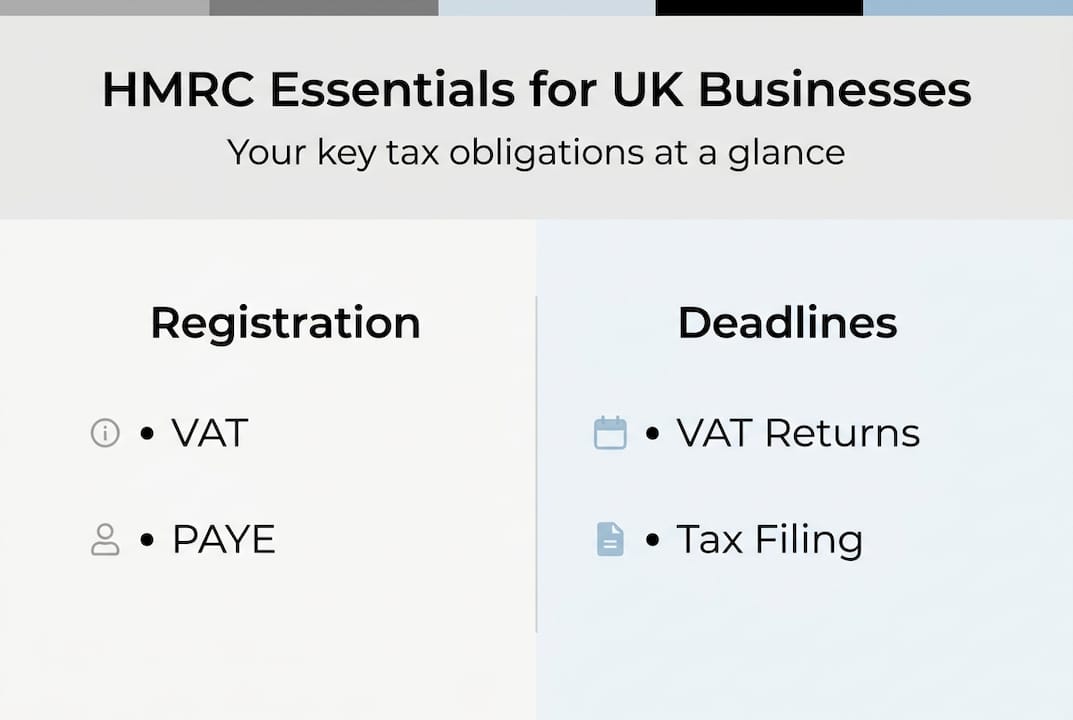
VAT is one of the most significant obligations. Businesses must register for VAT if turnover exceeds £90,000 in any rolling 12-month period, file quarterly returns through Making Tax Digital (MTD) compatible software, and retain digital records for six years. Miss the registration threshold and HMRC can backdate the liability, creating an unexpected bill.
Corporation Tax applies to all limited companies. CT rates sit at 19% up to £50,000 profit and 25% above £250,000, with marginal relief between those figures. Understanding what HMRC compliance means for your specific structure makes it far easier to plan your tax position in advance.
PAYE becomes mandatory the moment you take on an employee or pay yourself a salary through your company. You must register as an employer, run payroll in real time, and submit Full Payment Submissions to HMRC on or before each payday.
Self Assessment applies to sole traders, partners, and company directors. Self Assessment explained clearly: you report income and expenses annually, with the return and payment due by 31 January following the tax year end.
Here is a quick overview of the key obligations every owner must keep front of mind:
- Register for VAT once taxable turnover exceeds £90,000
- File Corporation Tax returns and pay on time if you run a limited company
- Submit Self Assessment returns annually by 31 January
- Register as an employer and run real-time PAYE if you have staff
- Keep digital records under MTD rules for the required retention period
- File quarterly VAT returns using MTD-compatible software
| Obligation | Threshold or trigger | Deadline | Record retention |
|---|---|---|---|
| VAT registration | Turnover over £90,000 | 30 days from threshold | 6 years |
| Corporation Tax | All limited companies | 12 months after year end | 6 years |
| Self Assessment | Sole traders, directors | 31 January | 5 years |
| PAYE | First employee or salary | On or before payday | 3 years |
| MTD digital records | VAT and income tax | Ongoing | 5 to 6 years |
Reviewing HMRC compliance essentials regularly ensures you are not caught out by threshold changes or new digital requirements.
Step-by-step: How to comply with HMRC for your business structure
Knowing the obligations is one thing. Acting on them in the right order is another. The steps you need to take depend heavily on how your business is set up.
Sole traders should follow this path:
- Register for Self Assessment with HMRC by 5 October in your second year of trading.
- Keep digital records of all income and allowable expenses throughout the year.
- From April 2026, MTD-compatible digital records for income over £50,000 are mandatory, with quarterly submissions and an annual return due by 31 January.
- Register for VAT if your turnover crosses £90,000.
- Submit your Self Assessment return and pay any tax owed by 31 January.
Partnerships follow a similar route but also require a nominated partner to file a partnership return in addition to individual Self Assessment returns.
Limited companies have a more structured process:
- Register for Corporation Tax within three months of starting to trade.
- Prepare annual statutory accounts and file them with Companies House.
- File the CT600 within 12 months of your year end and pay within 9 months and 1 day.
- Register for PAYE before your first payroll run.
- Register for VAT if turnover exceeds the threshold.
For a detailed walkthrough of Corporation Tax steps specific to limited companies, it is worth reviewing the process before your first year end arrives.
| Business structure | Key returns | Main deadlines | Key forms |
|---|---|---|---|
| Sole trader | Self Assessment, VAT | 31 Jan, quarterly | SA100, VAT return |
| Partnership | Partnership return, SA | 31 Jan | SA800, SA100 |
| Limited company | CT600, accounts, VAT | 12 mths, 9 mths+1 day | CT600, VAT return |
Pro Tip: Use Making Tax Digital requirements compatible software from day one. Tools like Xero or QuickBooks automate reminders, reduce manual errors, and produce the digital records HMRC now expects as standard.
Common compliance pitfalls and how to avoid them
Even well-intentioned business owners make mistakes. The most damaging ones are rarely about complex tax law. They are usually the result of poor habits, missed reminders, or misunderstanding new rules.
Here are the most frequent mistakes to watch for:
- Filing returns late because diary reminders were not set
- Keeping paper records when HMRC now requires digital ones under MTD
- Failing to register for VAT promptly when the threshold is crossed
- Misunderstanding the cash basis versus accruals basis for accounting
- Mixing personal and business finances, making records unreliable
- Forgetting to include all income sources in a Self Assessment return
Penalty warning: Inadequate business records can cost up to £3,000 per tax year in HMRC penalties. And late payments cost UK SMEs £11bn per year, triggering penalty points that accumulate toward automatic surcharges.
The essential HMRC deadlines for small businesses are worth bookmarking and reviewing at the start of every financial year. Many owners only check them when something goes wrong, which is too late.
Poor record keeping is the single biggest trigger for HMRC enquiries. If your records cannot explain every figure on your return, you are exposed. HMRC’s record requirements are clear: every invoice, receipt, and bank statement needs to be stored and retrievable.

Pro Tip: Build a compliance checklist and review it quarterly rather than annually. Catching a missed VAT registration or a late payroll submission in March is far cheaper than discovering it in January when everything is due at once. The digital tax submission impact on penalty reduction is significant for businesses that adopt it early.
Maintaining compliance: Records, software, and ongoing obligations
Avoiding common pitfalls is the first step. Consistently staying compliant is the real advantage. Here is how to maintain it year after year.
HMRC is explicit about what you must keep and for how long. Sole traders must retain Self Assessment records for 5 years, while companies and VAT-registered businesses must keep records for 6 years. These are not suggestions. Failing an HMRC enquiry because you cannot produce records from three years ago is an avoidable and expensive outcome.
Digital record keeping is now the standard, not an optional extra. MTD applies to VAT for all registered businesses and is expanding to income tax from April 2026. Your software must be HMRC-recognised and capable of submitting returns directly.
Here are the essential tools and routines for ongoing compliance:
- Use HMRC-recognised software such as Xero, Sage, or QuickBooks for all bookkeeping
- Reconcile your bank accounts monthly, not just at year end
- Store digital copies of all invoices and receipts as they arrive
- Set calendar reminders for every HMRC deadline at least 30 days in advance
- Review your VAT turnover monthly to catch threshold crossings early
- Conduct an annual review of your accounting basis and expense categories
The growing role of technology in compliance cannot be overstated. HMRC’s own systems are becoming increasingly automated, which means discrepancies between your records and third-party data (banks, payment processors) are more likely to be flagged. Keeping your digital tax submission processes tight protects you from automated enquiries before they start.
A business record keeping guide is a practical resource for understanding exactly what HMRC expects in terms of format and content. Reviewing it once a year alongside your own processes is a straightforward habit that pays dividends. The goal is to prevent tax losses before they occur rather than correct them after an enquiry.
What most guides miss about HMRC compliance
Most compliance guides focus on rates, thresholds, and deadlines. Those things matter, but they are not where most businesses actually come unstuck. In our experience working with SMEs across West Yorkshire, the bigger risk is human error rooted in outdated processes.
A business can know every deadline and still miss them because the person responsible for filing has no system, no reminders, and no backup. That is an admin failure, not a knowledge failure. The distinction matters because the fix is different. You do not need more information. You need better processes.
The upcoming MTD expansion and the gradual introduction of AI-assisted compliance tools will make routine submissions easier. But automation is only as reliable as the data fed into it. If your bookkeeping is inconsistent, automated submissions will reflect that inconsistency directly to HMRC.
The businesses that handle compliance well are not necessarily the ones with the most sophisticated software. They are the ones that review their processes regularly and fix small problems before they become large ones. Checking your digital tax impact processes after your first full year under MTD is a practical starting point.
Pro Tip: Schedule a 30-minute compliance review every six months. Check your software is still HMRC-recognised, confirm your deadlines are in the diary, and verify your record retention is on track. It takes less time than dealing with a penalty notice.
Get expert support to guarantee compliance
If you’d rather be certain nothing falls through the cracks, professional support might be your smartest move. Navigating HMRC requirements alongside running a business is genuinely demanding, and the cost of getting it wrong far outweighs the cost of getting expert help.

At Concorde Company Solutions, we work with small and medium-sized businesses across Leeds and beyond to keep their compliance straightforward and stress-free. Whether you need help setting up MTD-compatible software, managing your payroll, filing your Corporation Tax return, or simply understanding what applies to your business, we offer clear, jargon-free support at transparent prices. Visit Concorde Company Solutions to find out how we can take the compliance burden off your plate and let you focus on running your business.
Frequently asked questions
What is Making Tax Digital and does it apply to my business?
Making Tax Digital is HMRC’s requirement to keep and submit tax records digitally. It applies to VAT-registered businesses now and expands to self-employed people with income over £50,000 from April 2026, with those earning over £30,000 following in April 2027.
How long do I need to keep HMRC records?
Sole traders keep records for 5 years after the 31 January filing deadline, while limited companies and VAT-registered businesses must retain records for 6 years from the end of the relevant accounting period.
What are the main penalties for non-compliance?
Penalties range from a fixed £100 fine for a late Self Assessment return to up to £3,000 per tax year for inadequate records, and they can escalate significantly for repeated or deliberate offences.
Is VAT registration compulsory for all SMEs?
VAT registration is only compulsory once your taxable turnover exceeds £90,000 in any 12-month period, though voluntary registration is available and can be beneficial if your customers are VAT-registered businesses themselves.
No responses yet