Nearly half of UK small business owners admit to mixing personal and business finances, yet this common practice creates serious tax compliance risks and legal complications. Separating your finances is not just good housekeeping, it is essential for HMRC compliance, protecting your limited liability status, and avoiding costly penalties. Whether you operate as a limited company or sole trader, understanding when and how to separate your finances can save you thousands in tax charges and prevent director disqualification. This guide explains the legal requirements, practical benefits, and actionable steps to establish clear financial boundaries for your business.
Table of Contents
- Why Separating Finances Matters For Tax Compliance
- Legal Requirements Differ: Limited Companies Versus Sole Traders
- The Financial And Practical Benefits Of Separating Business Finances
- Common Misconceptions And Challenges Around Finance Separation
- Professional Services To Help You Separate And Manage Business Finances
Key takeaways
| Point | Details |
|---|---|
| Tax compliance | Separating finances is essential for HMRC compliance and prevents missed deductions or incorrect claims that trigger penalties. |
| Legal obligation | Limited companies must legally separate finances to avoid Section 455 tax charges of 35.75% on unpaid director’s loans from April 2026. |
| Sole trader clarity | Whilst sole traders face no legal requirement to separate accounts, doing so greatly improves record keeping and reduces audit risk. |
| Insolvency protection | Mixed finances complicate insolvency proceedings and increase the risk of director disqualification for mismanagement. |
| Digital tools | Dedicated business accounts linked to Making Tax Digital compatible software automate reconciliations and simplify reporting. |
Why separating finances matters for tax compliance
HMRC expects clear, accurate business records for all tax obligations, including VAT registration at the £90,000 threshold and annual Self Assessment returns. When personal and business transactions share the same accounts, identifying legitimate business expenses becomes nearly impossible. You risk missing valuable tax deductions on allowable costs like office supplies, travel, and professional fees. Every missed deduction means you overpay tax unnecessarily.
Poor record keeping is one of the main causes of tax penalties among UK small businesses. HMRC can impose fines for inaccurate returns, late submissions, or failure to maintain proper documentation. Mixed finances create a paper trail nightmare during investigations. Auditors struggle to distinguish business expenditure from personal spending, raising red flags that trigger deeper scrutiny.
Essential for HMRC tax compliance, mixing risks missing deductions and incorrect claims that lead to penalties. Clear separation reduces the chance of errors appearing on your tax return. When business transactions flow through dedicated accounts, your accountant can quickly identify deductible expenses and prepare accurate submissions.
Dedicated business bank accounts transform your record keeping accuracy. Every transaction has a clear business purpose. You eliminate the time consuming task of sorting through personal purchases to find business expenses. Integration with cloud accounting software means transactions automatically categorise and reconcile, reducing manual data entry errors.
Implementing proper separation protects you during HMRC investigations. Clean records demonstrate professional financial management and reduce audit duration. Consider these compliance benefits:
- Accurate expense tracking ensures you claim all allowable deductions
- Clear audit trails speed up HMRC enquiries and reduce professional fees
- Automated reporting through digital tools minimises human error
- Transparent records reduce suspicion of tax evasion
Pro Tip: Review your business bank statements monthly to catch any personal transactions that slip through, ensuring your records remain pristine for year end accounts and tax filing.
For additional guidance on maximising your tax position whilst maintaining compliance, explore our small business tax tips tailored for UK owners.
Legal requirements differ: limited companies versus sole traders
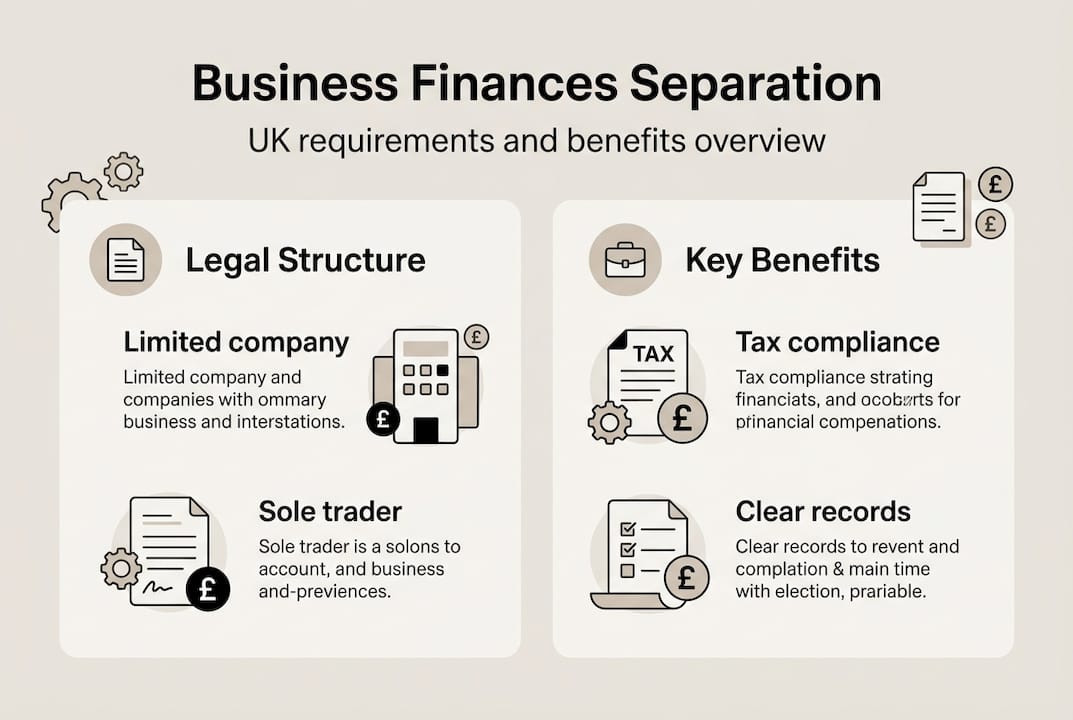
Your business structure determines whether separating finances is a legal obligation or simply best practice. Limited companies operate as distinct legal entities, completely separate from their directors and shareholders. This separation creates a legal barrier protecting your personal assets from business debts. However, it also imposes strict requirements on how you manage company funds.
For limited companies, separating finances is a legal requirement to avoid Section 455 tax charges on director’s loans. When you use company money for personal expenses without proper documentation, HMRC treats this as a director’s loan. If you fail to repay the loan within nine months of your company’s year end, a punitive tax charge applies. This rate currently stands at 33.75% but rises to 35.75% from April 2026.
Sole traders face a different landscape. You and your business are legally the same entity, meaning you have unlimited liability for business debts. Personal assets like your home can be seized to settle business obligations. Despite this legal unity, HMRC still expects clear business records. Whilst you are not legally obliged to maintain separate bank accounts, doing so dramatically improves clarity and reduces the risk of appearing to evade tax.
The table below compares key obligations and risks:
| Aspect | Limited company | Sole trader |
|---|---|---|
| Legal separation | Required by law | Not legally required |
| Personal liability | Limited to share capital | Unlimited personal liability |
| Director’s loan tax | 35.75% from April 2026 | Not applicable |
| Record keeping | Must separate all finances | Must distinguish business expenses |
| Insolvency risk | Company assets only | Personal assets at risk |
Pro Tip: Limited company directors should monitor their director’s loan accounts monthly to ensure any personal drawings are repaid or properly documented as salary or dividends before the nine month deadline.
The consequences of mixing finances extend beyond tax charges. Directors who fail to maintain proper separation risk disqualification from holding future directorships if their company enters insolvency. Personal use of company funds without clear documentation suggests financial mismanagement, a serious matter in the eyes of the Insolvency Service.
For sole traders, separation provides protection during HMRC enquiries. When your business and personal spending flow through the same account, proving the business purpose of each transaction becomes time consuming and stressful. Dedicated business accounts create instant clarity. Your sole trader tax return becomes straightforward when every transaction in your business account has a clear commercial purpose.
The financial and practical benefits of separating business finances
Dedicated business bank accounts simplify tracking and prevent the accidental mixing that creates tax headaches. When all business income and expenses flow through one account, reconciling your books becomes a straightforward monthly task rather than a year end nightmare. You gain instant visibility of your cash flow, profit margins, and spending patterns.
Follow these practical steps to establish proper separation:
- Open a dedicated business bank account with a provider offering features suited to your industry
- Transfer all business income directly into this account, never your personal account
- Pay yourself via formal salary payments or dividend distributions, not casual withdrawals
- Use a business credit card exclusively for company purchases to build a clear expense trail
- Link your business accounts to Making Tax Digital compatible accounting software
Integration with Making Tax Digital compatible software automates reconciliations and reporting, saving hours each month. Bank feeds import transactions directly into your accounting system. The software categorises common expenses automatically. You review and approve rather than manually entering hundreds of transactions.
Financial clarity aids budgeting and tax planning in ways mixed finances never can. When you see exactly how much your business generates and spends, you make informed decisions about investments, hiring, and growth strategies. Separation also reduces the risk of insolvency or director disqualification due to financial mismanagement. Courts and insolvency practitioners view mixed finances as evidence of poor governance.
Consider these practical advantages:
- Instant cash flow visibility helps you avoid overdrafts and manage working capital
- Clear profit tracking enables accurate quarterly tax estimates and prevents year end surprises
- Professional financial records increase your chances of securing business loans or investment
- Simplified year end accounts reduce accountancy fees and stress
Pro Tip: Track any overdrafts or company loans carefully to avoid beneficial interest in kind tax on overdrawn director’s loan accounts, which HMRC treats as a taxable benefit.
The time investment in establishing separation pays dividends immediately. Monthly reconciliations take minutes instead of hours. Tax return preparation becomes straightforward. Your accountant spends less time untangling mixed transactions and more time providing strategic tax planning advice. You gain peace of mind knowing your financial records can withstand HMRC scrutiny.
For detailed guidance on maintaining accurate records throughout the year, review our bookkeeping best practices tailored for UK small businesses.
Common misconceptions and challenges around finance separation
Many small sole traders believe mixing finances simplifies their financial management, especially in the early stages when transaction volumes are low. The logic seems sound: why maintain two accounts when you are the business? This misconception ignores the reality that HMRC requires clear business records even if no legal requirement exists to separate accounts for sole traders.
The perceived time saving evaporates at tax return time. Sorting through twelve months of mixed transactions to identify business expenses consumes far more time than maintaining separation from day one. You waste hours reviewing bank statements, trying to remember whether that payment was for business supplies or personal shopping. Missing receipts compound the problem, forcing you to forfeit legitimate tax deductions.
Blurring lines between personal and business finances increases your risk of tax evasion suspicion during HMRC investigations. Investigators see mixed accounts as a red flag suggesting deliberate concealment of income or fraudulent expense claims. Even innocent mixing triggers deeper scrutiny. You face extended enquiries, higher professional fees defending your position, and potential penalties if errors emerge.
Using personal funds for business expenses is common among new business owners but complicates your tax returns significantly. Every personal payment for business purposes requires documentation and manual entry into your accounts. You must prove the business purpose of each transaction. The administrative burden grows with your business, creating a record keeping crisis just when you can least afford the distraction.
Consider these realities that contradict common misconceptions:
- Separation takes minimal time to establish but saves dozens of hours annually in record keeping
- Modern banking apps make managing multiple accounts as simple as managing one
- Clear separation actually simplifies financial management by creating automatic categorisation
- Professional appearance matters when seeking finance, and mixed accounts suggest amateurism
The challenge of changing established habits prevents many business owners from implementing separation even after recognising its benefits. You have operated with mixed finances for months or years. The thought of untangling existing records and establishing new systems feels overwhelming. Start fresh from your next accounting period rather than attempting to retroactively separate historical transactions.
Transparency and long term sustainability require clear financial boundaries. As your business grows, mixed finances become increasingly unmanageable. The sole trader who muddles through with one account in year one faces a record keeping catastrophe by year three. Implementing separation early establishes professional habits that scale with your success.
For specialist support in establishing proper financial systems as a sole trader, explore our accountants for sole traders guide covering setup and ongoing compliance.
Professional services to help you separate and manage business finances
Separating and managing your business finances properly requires expertise and ongoing attention that many business owners struggle to maintain alongside running their operations. Professional accounting services reduce this burden whilst ensuring full HMRC compliance. Concorde Company Solutions specialises in helping UK small and medium businesses establish clear financial boundaries and maintain accurate records.

Our payroll services help you manage salaries and dividend payments correctly, ensuring you pay yourself through proper channels rather than informal drawings that trigger tax complications. We handle all HMRC submissions, calculate optimal salary and dividend splits for tax efficiency, and maintain the documentation that protects you during investigations.
Expert bookkeeping speeds up your record keeping and tax preparation significantly. Our team reconciles your business accounts monthly, categorises transactions accurately, and identifies potential issues before they become problems. You gain real time visibility of your financial position through cloud accounting platforms. Learn more about maintaining accurate records in our bookkeeping best practices for small business guide.
As your trusted partner, Concorde Company Solutions keeps your business finances organised and HMRC compliant, allowing you to focus on growth rather than administration.
FAQ
What are the risks of mixing personal and business finances?
Mixing finances creates tax errors through missed deductions and incorrect expense claims, triggering HMRC penalties that can reach thousands of pounds. Limited companies face additional legal complications including Section 455 tax charges of 35.75% on unpaid director’s loans from April 2026. Mixed accounts also increase audit risk and create confusion during insolvency proceedings, potentially leading to director disqualification.
Is it legally required for sole traders to separate their finances?
Sole traders face no legal requirement to maintain separate business bank accounts, unlike limited companies. However, HMRC still expects clear, distinguishable financial records that identify all business income and expenses. Separation is highly recommended to avoid complications during tax investigations and reduce the suspicion of tax evasion that mixed accounts can trigger.
What is a director’s loan and why does mixing finances cause tax issues?
Director’s loans occur when limited company funds are used for personal expenses without formal repayment arrangements or proper documentation as salary or dividends. If these loans remain unpaid nine months after your company’s year end, HMRC imposes a Section 455 tax charge currently at 33.75%, rising to 35.75% from April 2026. Mixed finances make tracking these loans nearly impossible, creating accidental tax liabilities.
How can I practically separate personal and business finances?
Open dedicated business bank accounts and credit cards exclusively for company transactions, never mixing personal purchases. Pay yourself through formal salary payments or dividend distributions rather than casual withdrawals that create director’s loan complications. Use Making Tax Digital compatible accounting software linked to your business accounts to automate transaction imports, categorisation, and reconciliation, eliminating manual data entry errors.
No responses yet