
Many UK small business owners view record keeping as tedious paperwork that only matters when tax returns loom. This misconception can prove costly, as maintaining accurate company records is a legal requirement for every limited company in England and Wales under the Companies Act 2006 and reinforced by HMRC. Beyond compliance, proper records form the backbone of sound financial management, enabling informed decisions and protecting your business from avoidable penalties. This guide explains why maintaining business records matters legally and practically, what you must keep, and how modern tools can simplify the entire process for 2026.
Table of Contents
- Legal Requirements For Maintaining Business Records In The UK
- How Accurate Records Improve Business Management And Financial Control
- Retention Periods And Types Of Records Small Businesses Must Keep
- Practical Tips And Tools For Effective Business Record Keeping In 2026
- How Concorde Company Solutions Can Support Your Record Keeping Needs
Key takeaways
| Point | Details |
|---|---|
| Legal compliance | UK law mandates specific business records under the Companies Act 2006, with stricter identity verification requirements from the Economic Crime and Corporate Transparency Act 2023. |
| Financial control | Accurate records enable you to monitor cash flow, profitability, and costs whilst supporting tax submissions and investor reports. |
| Retention periods | Limited companies must retain records for at least six years, whilst sole traders need five years after tax deadlines. |
| Penalties for failure | Poor record keeping can trigger fines up to £3,000 per tax year, legal disputes, and operational disruptions. |
| Digital solutions | Adopting compliant accounting software and clear retention schedules simplifies compliance and reduces administrative burden. |
Legal requirements for maintaining business records in the UK
UK legislation imposes clear obligations on businesses to maintain specific records. The Companies Act 2006 establishes the baseline framework, requiring every limited company to keep statutory registers, accounting records, and minutes of board meetings. These aren’t optional administrative tasks but legal duties that underpin corporate transparency and accountability.
Recent regulatory changes have tightened these requirements further. The Economic Crime and Corporate Transparency Act 2023 strengthens company records requirements in the UK, including stricter identity verification for directors and members. This legislation aims to combat fraud and money laundering by ensuring Companies House holds accurate, verified information about who controls UK businesses. For SMEs, this means additional diligence when appointing directors or updating company details.
Different business structures face varying obligations. Limited companies must maintain comprehensive statutory registers covering directors, shareholders, people with significant control, and company secretaries. Sole traders and partnerships have simpler requirements but still need detailed records of income, expenses, and VAT transactions. Understanding your specific obligations prevents costly oversights.
HMRC enforces these requirements rigorously. Businesses failing to keep adequate records face fines up to £3,000 per tax year. Late filing penalties escalate based on delay length, ranging from £150 for returns filed within three months of the deadline to £1,500 for delays exceeding twelve months. These financial consequences add up quickly for businesses with persistent record keeping failures.
Beyond monetary penalties, inadequate records can trigger HMRC enquiries, director disqualification proceedings, and legal claims from stakeholders. Investors and lenders scrutinise record quality when assessing funding applications. Poor documentation signals operational weakness and increases perceived risk. Our UK company compliance guide explores these obligations in greater depth, whilst the company compliance checklist helps ensure you meet every requirement.
Pro Tip: Review UK company annual requirements each January to stay current with regulatory changes that might affect your record keeping duties for the new financial year.
How accurate records improve business management and financial control
Whilst legal compliance drives many businesses to maintain records, the management benefits often prove more valuable. Well organised records transform raw transaction data into actionable intelligence about your business performance. They reveal profitability patterns, highlight cost control opportunities, and expose cash flow trends before they become critical problems.
Financial statements built on accurate records enable confident decision making. You can assess whether launching a new product line makes sense, evaluate supplier pricing against actual costs, or determine if hiring additional staff fits your budget. Without reliable data, these decisions become guesswork. Accurate records facilitate effective financial management, enabling businesses to monitor performance, make informed decisions, and secure funding.

Investors and lenders demand transparent financial reporting backed by verifiable records. When seeking growth capital or negotiating credit terms, your ability to produce detailed financial histories directly impacts the terms you receive. Banks assess loan applications partly on record quality because it demonstrates operational competence and reduces their risk exposure.
Proper records also protect against costly errors in tax submissions. Underreporting income or VAT due to incomplete records triggers penalties and interest charges. Conversely, missing legitimate expense deductions means overpaying tax unnecessarily. Both scenarios hurt your bottom line and stem from inadequate record keeping systems.
Effective records simplify tax return preparation and ease HMRC enquiries. When inspectors request supporting documentation, organised businesses provide it promptly whilst disorganised ones scramble to reconstruct transactions from memory and incomplete files. This distinction affects how quickly enquiries resolve and whether HMRC applies penalties. Our annual accounts filing guide demonstrates how proper records streamline compliance processes.
Beyond external reporting, internal management benefits compound over time. Comparing current performance against historical data reveals seasonal patterns, identifies growth opportunities, and validates strategic initiatives. This longitudinal perspective only exists when you maintain consistent, accurate records year after year. Understanding tax compliance importance UK helps contextualise why these practices matter for long term business health.
Pro Tip: Schedule monthly reviews of your key financial records rather than waiting until year end. This habit catches errors early, improves forecasting accuracy, and reduces the stress of annual compliance deadlines.
Retention periods and types of records small businesses must keep
Understanding what records to keep and for how long prevents both premature disposal and unnecessary hoarding. UK regulations specify minimum retention periods that vary by business type and record category, creating a framework that balances legal requirements with practical storage considerations.
Limited companies should keep records for at least six years from the end of the financial year they relate to. This period covers accounting books, invoices, bank statements, payroll records, VAT documentation, and contractual agreements. The six year timeframe aligns with HMRC’s ability to investigate historical tax returns and Companies House requirements for maintaining accessible company records.
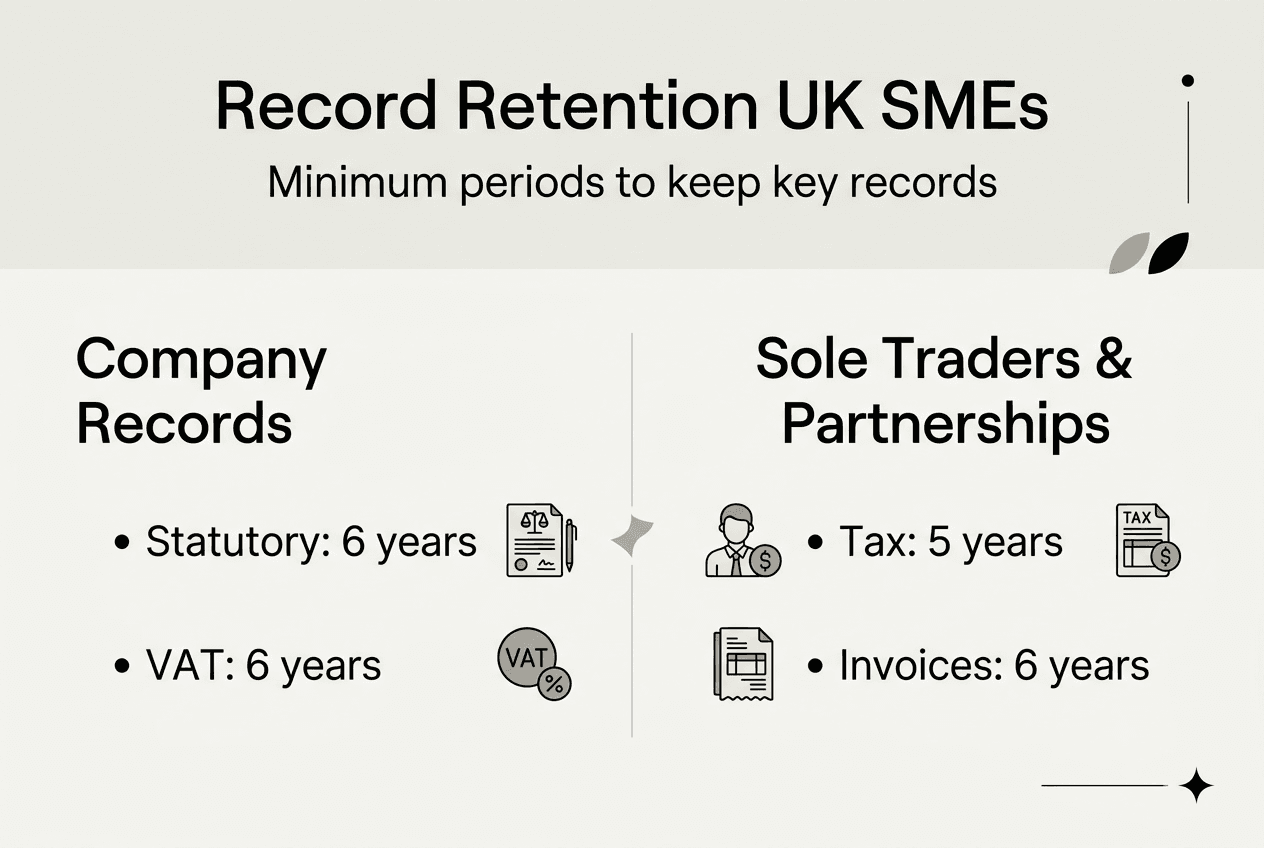
Sole traders and partnerships should keep records for at least five years after the 31 January submission deadline for the relevant tax year. This shorter period reflects simpler business structures but still encompasses all transaction records, expense receipts, and income documentation needed to support tax returns.
VAT registered businesses face specific requirements. HMRC mandates retaining VAT records for six years regardless of business structure. These include VAT invoices, purchase receipts, credit notes, and VAT account calculations. Digital records must remain accessible and readable throughout the retention period, requiring periodic format updates as technology evolves.
Certain documents warrant longer retention based on potential legal claims. The Limitation Act 1980 allows claims up to six years after an event, meaning contracts, property deeds, and dispute related correspondence should remain accessible for this duration. Employment records often require longer retention when they relate to pensions, workplace injuries, or discrimination claims.
| Record type | Retention period | Key considerations |
|---|---|---|
| Statutory accounts | 6 years | Required for limited companies under Companies Act 2006 |
| VAT records | 6 years | Applies to all VAT registered businesses regardless of structure |
| Payroll records | 6 years | Includes PAYE, National Insurance, and employee details |
| Sole trader tax records | 5 years after deadline | Count from 31 January following the tax year |
| Contracts and legal documents | 6 years minimum | Longer if ongoing obligations or potential claims exist |
Digital storage has transformed record keeping practicality. Cloud based systems provide secure, searchable archives that eliminate physical storage costs whilst ensuring records remain accessible throughout retention periods. However, digital preservation requires regular backups, format migration as software evolves, and GDPR compliance when records contain personal data.
Losing required records creates serious problems. HMRC may estimate your tax liability based on industry averages rather than actual performance, typically resulting in higher assessments. You lose the ability to defend against customer disputes, supplier claims, or regulatory challenges. Recovery efforts consume time and money whilst rarely achieving complete reconstruction. Meeting small business tax deadlines 2025 becomes significantly harder without proper historical records.
Pro Tip: Create a retention schedule spreadsheet listing each record type, its creation date, and disposal date. Review this quarterly to dispose of expired records systematically whilst ensuring current documents remain protected.
Practical tips and tools for effective business record keeping in 2026
Modern technology has revolutionised record keeping, making compliance easier and more efficient than ever. However, technology alone doesn’t guarantee success. Effective systems combine appropriate tools with clear processes and regular oversight.
Adopting Making Tax Digital compliant accounting software addresses multiple needs simultaneously. These platforms automatically categorise transactions, generate required reports, and maintain audit trails that satisfy HMRC requirements. The shift towards digital filing and the closure of the online accounts and Company Tax Return service on 31 March 2026 highlights the importance of adopting compliant software and processes. Businesses still using outdated methods must transition to approved platforms before this deadline.
Implementing these tools requires planning:
- Assess your specific record keeping needs based on business structure, industry, and transaction volume.
- Research software options that offer features matching your requirements whilst maintaining MTD compliance.
- Migrate historical data carefully, verifying accuracy before decommissioning old systems.
- Train all relevant staff on proper usage, emphasising data entry standards and backup procedures.
- Establish regular review cycles to ensure the system continues meeting your evolving needs.
Beyond software selection, organisational practices determine record keeping effectiveness. Establish clear retention schedules that specify what to keep, where to store it, and when disposal becomes appropriate. Document these policies formally so staff understand their responsibilities and new employees can quickly learn procedures.
Segregating duties reduces error rates and fraud risks. Different individuals should handle transaction recording, bank reconciliations, and financial reporting. This separation creates natural checkpoints where discrepancies surface quickly rather than compounding over time. Even small businesses benefit from this principle by rotating responsibilities or involving external accountants in oversight roles.
Regular staff training maintains record keeping quality as regulations evolve and personnel change. Annual refresher sessions covering software updates, regulatory changes, and common errors prevent knowledge gaps that degrade record accuracy. These investments pay dividends through reduced compliance issues and improved financial visibility.
Data security deserves equal attention. Backup records to multiple locations, including off site or cloud storage, protecting against hardware failures, theft, or disasters. Implement access controls ensuring only authorised personnel view sensitive financial information. GDPR compliance becomes critical when records contain customer or employee personal data, requiring documented retention policies and secure disposal procedures.
Outsourcing complex tasks to specialists often proves cost effective for SMEs. Professional accountants bring expertise in regulatory compliance, tax optimisation, and financial reporting that internal staff may lack. They also provide continuity when key employees leave and objective oversight that catches problems early. Our HMRC compliance guide 2026 explores how professional support strengthens compliance whilst reducing administrative burden.
Pro Tip: Schedule quarterly record keeping audits where you randomly sample transactions and verify supporting documentation exists and meets retention standards. This proactive approach identifies gaps before they become compliance issues.
How Concorde Company Solutions can support your record keeping needs
Navigating the complexities of business record keeping whilst running your company demands significant time and expertise. Many SME owners find themselves overwhelmed by evolving regulations, software requirements, and the sheer volume of documentation modern compliance demands. Professional support transforms this burden into a manageable, systematic process.

Concorde Company Solutions specialises in payroll services designed specifically for UK small and medium businesses. Our team ensures your payroll records meet all statutory requirements whilst integrating seamlessly with your broader financial record keeping systems. We handle the technical compliance details, from RTI submissions to pension auto enrolment documentation, letting you focus on growing your business rather than wrestling with administrative complexities. Our expert support reduces compliance risks, prevents costly errors, and provides peace of mind that your records will withstand HMRC scrutiny whenever required.
FAQ
What records must my limited company legally keep?
Limited companies must keep statutory registers, financial records, minutes of meetings, and key resolutions according to the Companies Act 2006. These include registers of directors, shareholders, people with significant control, and company secretaries. Accounting records must detail all money received and spent, assets and liabilities, and stock records where applicable. Meeting minutes should capture decisions made at board and shareholder meetings, whilst resolutions document significant company actions like share allotments or director appointments.
How long must I keep business records for tax purposes?
HMRC requires VAT records to be kept for six years, limited companies at least six years from financial year end, and sole traders five years after tax deadline. These periods allow HMRC sufficient time to investigate historical returns and verify tax calculations. Disposing of records prematurely can result in penalties and estimated tax assessments. Digital records must remain accessible and readable throughout the retention period, requiring format updates as technology evolves to prevent obsolescence.
What are the risks of poor business record keeping?
Poor records can lead to fines up to £3,000 per tax year, legal disputes, director disqualification, and halted investments. HMRC may estimate your tax liability unfavourably when adequate records don’t exist to support actual figures. Investors and lenders view inadequate documentation as a red flag indicating operational weakness, often declining funding applications or demanding higher interest rates. Customer disputes become harder to resolve without transaction histories, potentially resulting in costly settlements or lost business relationships.
How can I simplify record keeping for my business?
Using compliant accounting software and establishing clear internal controls help ensure accuracy and ease compliance. Cloud based platforms automate transaction categorisation, generate required reports, and maintain searchable archives accessible from anywhere. Regular staff training on software usage and record keeping standards prevents errors whilst ensuring consistency. Professional accountants provide expert oversight, catching issues early and handling complex compliance requirements that exceed internal capabilities, ultimately saving time and reducing stress.
No responses yet