
TL;DR:
- HMRC compliance is an ongoing responsibility involving accurate filings, record-keeping, and prompt responses.
- Digital systems automate flagging inconsistencies, making proactive management essential to avoid penalties.
- Expert support helps SMEs navigate complex rules, meet deadlines, and reduce investigation risks.
HMRC compliance is not something you think about once a year and forget. For UK small and medium-sized businesses, it is a continuous, year-round responsibility that touches payroll, VAT, record keeping, and more. With HMRC’s digital systems now cross-referencing data in real time, even small inconsistencies can trigger a formal review. The importance of tax compliance has never been greater, and the cost of getting it wrong, whether through fines, interest charges, or time lost responding to investigations, is rising. This guide gives you a practical, plain-English roadmap so you know exactly what is expected and how to stay on the right side of HMRC.
Table of Contents
- Understanding HMRC compliance: The basics
- Key mechanics: Registration, Making Tax Digital, and digital records
- What happens in a compliance check?
- Penalties, points and the true cost of non-compliance
- Edge cases: Exemptions, appeals and ‘grey areas’ for SMEs
- Why proactive compliance saves SMEs more than penalties
- Staying compliant: Get expert support for your business
- Frequently asked questions
Key Takeaways
| Point | Details |
|---|---|
| HMRC compliance essentials | File all required taxes on time, keep accurate digital records, and respond to reviews for full compliance. |
| Digital rules matter | Embracing Making Tax Digital is now mandatory for VAT and soon for Income Tax, so get digital-ready early. |
| Penalties can add up | Late filings and payments trigger points-based fines and interest, which quickly become costly for SMEs. |
| Routine checks happen | HMRC compliance checks are normal, so clear records and prompt cooperation help avoid bigger issues. |
| Help is available | Professional support and approved software make compliance much easier and reduce risk. |
Understanding HMRC compliance: The basics
With the misconceptions set aside, it is crucial to grasp what HMRC compliance actually involves for your business. At its core, it is not a once-a-year event tied to a tax return deadline. It is an ongoing set of obligations that run alongside your day-to-day operations.
HMRC compliance refers to meeting all legal tax obligations set by HMRC, including accurate and timely filing of tax returns such as VAT, Income Tax Self Assessment, Corporation Tax, and PAYE, maintaining proper records, and responding to compliance checks.
In practical terms, this means your business must register for the correct taxes, submit returns on time, keep records that can withstand scrutiny, and respond promptly if HMRC asks questions. The role of accountants in managing these obligations is significant, particularly as rules become more complex.
Here is a summary of the most common obligations for a UK SME:
- VAT returns: Quarterly or monthly submissions if you are VAT-registered
- Corporation Tax: Annual return and payment, usually nine months after your financial year end
- PAYE: Real Time Information (RTI) submissions every time you pay employees
- Self Assessment: Annual Income Tax return for directors and sole traders
- Record keeping: Digital records required under Making Tax Digital rules
- Responding to compliance checks: Timely and accurate responses to any HMRC enquiry
Each of these areas carries its own deadlines, formats, and rules. Missing one does not just affect that single obligation. It can trigger a broader review of your entire tax position. HMRC’s systems are increasingly automated, meaning data mismatches between your submissions and third-party information, such as bank data or supplier records, are flagged quickly and without manual intervention.
Understanding this routine nature of compliance is the first step. It is not a burden reserved for businesses under investigation. It is simply how responsible business ownership works in the UK today.
Key mechanics: Registration, Making Tax Digital, and digital records
Now that you know the basics, let us break down how digital changes and registration processes directly affect your business.
Registration is where compliance begins. You must register for VAT if your turnover exceeds £90,000 in any rolling 12-month period. Corporation Tax registration is required as soon as your company begins trading, and PAYE registration is needed before you pay your first employee. Getting these registrations in place promptly avoids automatic penalties.
Making Tax Digital (MTD) is reshaping how businesses interact with HMRC. MTD for VAT is already mandatory for all VAT-registered businesses. The phased rollout for Income Tax is now underway, with MTD for Income Tax applying from April 2026 for those earning over £50,000, extending to £30,000 earners in 2027 and £20,000 earners in 2028. Under MTD, you must keep digital records and submit quarterly updates using HMRC-approved software.
| Feature | MTD for VAT | MTD for Income Tax |
|---|---|---|
| Who it applies to | All VAT-registered businesses | Self-employed and landlords above income thresholds |
| Start date | Already mandatory | Phased from April 2026 |
| Submission frequency | Quarterly or monthly | Quarterly plus end-of-year finalisation |
| Software required | HMRC-compatible VAT software | HMRC-compatible ITSA software |
| Record keeping | Digital | Digital |
For a new business setting up compliance from scratch, here is a practical sequence to follow:
- Register your company with Companies House and HMRC for Corporation Tax within three months of starting to trade
- Register for VAT once your turnover approaches or exceeds the £90,000 threshold
- Set up PAYE before making your first payroll payment
- Choose MTD-compatible accounting software and connect it to your HMRC account
- Establish a digital record-keeping system for all income and expenses
- Diarise all submission deadlines and set reminders at least two weeks in advance
For a broader look at digital tax submission requirements and a full Making Tax Digital overview, these resources cover the detail you need.
Pro Tip: Register for taxes earlier than the legal deadline and choose your MTD-compatible software before you are forced to. Rushing these decisions under pressure leads to errors that cost more to fix later.
What happens in a compliance check?
Understanding registration is just one step. You are also subject to compliance reviews, so here is what to expect and how to respond.
A compliance check is HMRC’s formal process for verifying that your tax affairs are correct. Compliance checks are triggered by discrepancies in your submissions, late filings, random selection, or patterns flagged by HMRC’s data systems. They are not necessarily a sign that HMRC suspects wrongdoing. Many are entirely routine.

The typical process follows these stages:
| Stage | What happens | Your action |
|---|---|---|
| Notification | You receive a letter or digital notice from HMRC | Read carefully, note the deadline for response |
| Information request | HMRC asks for specific records or explanations | Gather documents, respond within the stated timeframe |
| Review | HMRC examines the information provided | Cooperate fully; seek professional advice if needed |
| Decision | HMRC issues findings: no action, amendment, or penalty | Accept, pay, or appeal within 30 days |
Knowing how compliance checks work in advance means you are not caught off guard. HMRC holds significant compliance powers under Schedule 36, including the right to request documents and information from third parties.
If you receive a compliance check letter, prepare the following:
- All relevant invoices, receipts, and bank statements for the period in question
- Your VAT returns, payroll records, and Corporation Tax computations
- Any correspondence with HMRC relating to the period
- A clear explanation of any unusual transactions or one-off items
- Evidence of your record-keeping processes and software
Using a compliance checklist before a check arrives is far better than scrambling once you receive the letter. Professional advice for compliance is particularly valuable at this stage.
Pro Tip: Prompt, full cooperation and well-organised records are your strongest tools. HMRC can reduce penalties significantly where a business demonstrates transparency and good faith from the outset.
Penalties, points and the true cost of non-compliance
Knowing the steps is not enough. Here is what you risk financially if you fail to comply with HMRC requirements.
HMRC operates a points-based penalty system for late submissions. Each missed deadline earns a point. Reach four points on a quarterly filing schedule and you receive a £200 fine. Points accumulate separately for each tax obligation, so a business filing VAT and MTD Income Tax returns could be building points on two fronts simultaneously. Late payments carry additional charges: 3% interest if unpaid at 15 days, rising to 10% per annum for persistent non-payment. Inaccuracies in returns can attract penalties of up to 100% of the tax lost, depending on whether the error was careless, deliberate, or concealed.
HMRC’s compliance yield reached £48 billion in 2024 to 2025, with 41% generated through upstream prevention worth £19 billion. The UK tax gap stands at 5.3%, equivalent to £46.8 billion for 2023 to 2024, and Q3 2025 to 2026 alone yielded £8.6 billion from compliance activity.
These figures show that HMRC is not simply waiting for errors to surface. It is actively investing in finding them. The tax gap figure means billions in unpaid tax are being actively pursued, and SMEs represent a significant portion of that target.
To avoid accumulating points and penalties, follow these steps:
- Set calendar reminders for every filing deadline across VAT, PAYE, Corporation Tax, and Self Assessment
- Reconcile your accounts monthly rather than leaving it to the last minute before each deadline
- Use MTD-compatible software that flags upcoming deadlines automatically
- Review SME tax deadlines regularly and update your schedule when rules change
- Apply tax return tips to reduce the risk of errors before you submit
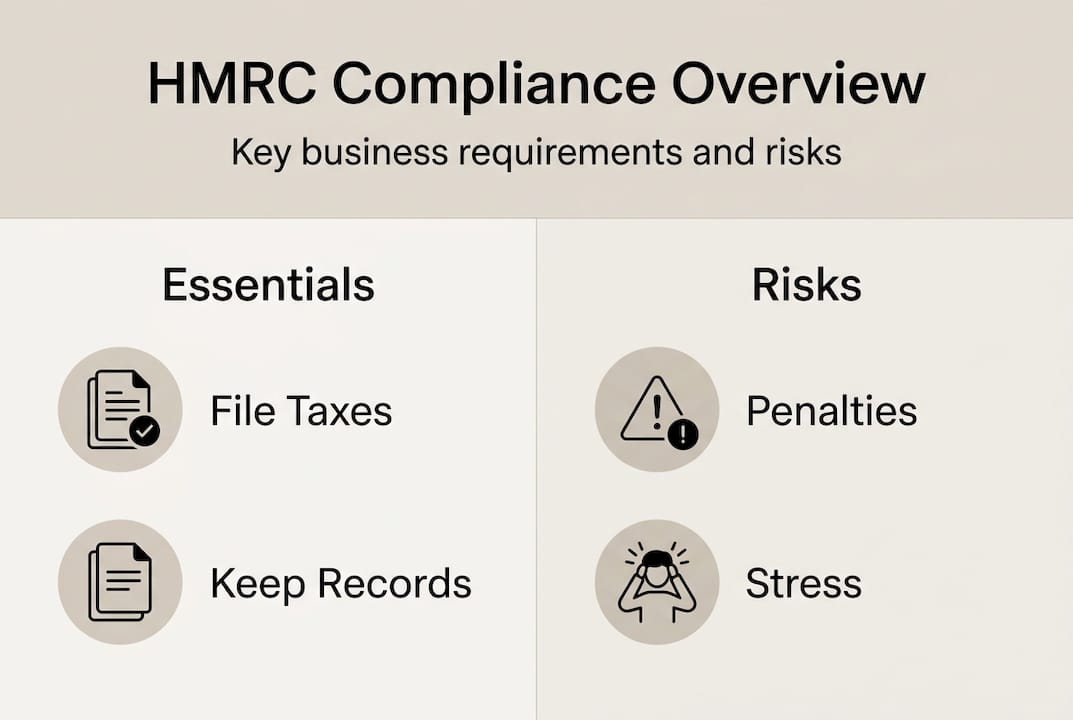
The financial cost of non-compliance is real and measurable. But the hidden costs, including management time, stress, and reputational damage with lenders or investors, are often far greater.
Edge cases: Exemptions, appeals and ‘grey areas’ for SMEs
Beyond straightforward rules, there are special cases and appeal processes that every owner should understand.
Not every business fits neatly into the standard compliance framework. There are legitimate situations where the rules flex, and knowing when to use them is a genuine advantage.
Voluntary VAT registration is one of the most overlooked tools available to smaller businesses. If your turnover is below the £90,000 threshold but you buy goods or services from VAT-registered suppliers, registering voluntarily lets you reclaim that input VAT. For businesses with significant supplier costs, this can produce a meaningful cash benefit each quarter.
MTD exemptions exist for specific groups. Businesses or individuals who cannot use digital tools due to age, disability, or remoteness may apply to HMRC for an exemption. These are granted for limited periods and require documented justification. They are not a permanent escape from digital obligations.
Schedule 36 notices are formal information requests that HMRC can issue during a compliance check. You have the right to appeal a Schedule 36 notice if you believe it is disproportionate or unlawful. Acting on compliance prevention before a notice arrives is always the better strategy.
Common grey areas that SMEs encounter include:
- Subcontractor versus employee classification: Misclassifying workers under IR35 or CIS rules is a frequent trigger for compliance checks
- Mixed-use expenses: Claiming personal expenses through the business, even accidentally, can lead to penalties
- VAT on exempt versus standard-rated supplies: Businesses offering a mix of services often miscalculate VAT liability
- Late registration: Businesses that exceed the VAT threshold but delay registration face backdated VAT liability plus penalties
- Reasonable excuse claims: If you missed a deadline due to illness, bereavement, or a genuine system failure, you may appeal the penalty
Pro Tip: Document everything if you intend to claim a reasonable excuse. HMRC requires evidence, not just an explanation. A contemporaneous note, a medical certificate, or a software error log carries far more weight than a retrospective account. Check the MTD exemptions guide for the specific criteria that apply to your situation.
Why proactive compliance saves SMEs more than penalties
All rules considered, it is worth reflecting on why proactive compliance can do far more for a business than simply prevent fines.
The conventional view is that compliance is a cost. You spend time and money staying compliant so that HMRC does not penalise you. That framing is too narrow. Businesses with clean, accurate, up-to-date financial records are better placed to access finance, win contracts that require audited accounts, and make faster decisions based on reliable data. Compliance is infrastructure, not just insurance.
There is also a risk perception problem. Many SME owners assume that minor errors are quietly tolerated by HMRC. In reality, increased digital scrutiny means smaller inconsistencies are now surfaced automatically. The system does not distinguish between accidental and deliberate. It flags anomalies and investigates.
Proactive steps, including monthly reconciliations, timely registrations, and working with professional advisers, reduce investigation risk and free up the mental bandwidth that reactive compliance consumes. The businesses that treat compliance as a management discipline rather than an annual chore are the ones that grow with fewer interruptions and greater financial clarity.
Staying compliant: Get expert support for your business
If you want to make compliance straightforward and lower your risk, getting expert support is the smart next step.
Staying on top of HMRC obligations does not mean you have to manage every detail yourself. The rules are changing, the digital requirements are expanding, and the penalty stakes are rising. That is exactly the environment where professional support pays for itself.

At Concorde Company Solutions, we work with small and medium-sized businesses across the UK to handle everything from VAT returns and Corporation Tax to full payroll compliance support and MTD software setup. We take the pressure off your plate so you can focus on running your business, confident that your obligations are being met accurately and on time. Get in touch today to find out how we can help you stay compliant without the stress.
Frequently asked questions
What are the main HMRC compliance requirements for UK SMEs?
You need to file accurate and timely VAT, Income Tax, Corporation Tax, and PAYE returns, keep digital records under Making Tax Digital, and respond promptly to any compliance checks issued by HMRC.
When do I need to register for VAT under HMRC rules?
You must register for VAT once your turnover exceeds £90,000 in any rolling 12-month period, though voluntary registration below that threshold is also available and can be financially beneficial.
What triggers an HMRC compliance check?
Triggers include data discrepancies, late filings, and random selection by HMRC’s automated systems, which cross-reference your submissions against third-party financial data.
What are the penalties for late HMRC submissions under MTD?
Each missed deadline earns a penalty point, and four points triggers a £200 fine for quarterly filers, with late payments attracting additional interest charges starting at 3% after 15 days.
Can I appeal HMRC penalties or claim exemption?
Yes, you can appeal penalties by demonstrating a reasonable excuse with supporting evidence, and limited exemptions from Making Tax Digital are available for those who genuinely cannot use digital tools.
No responses yet