
Many UK business owners believe accrual accounting simply delays recognising income until payment arrives. This misunderstanding obscures a powerful financial management tool that reveals true profitability regardless of cash timing. Accrual accounting transforms how you view business performance by matching income with related expenses in the same period, providing accurate insights essential for growth and compliance. Understanding these principles in 2026 helps you navigate updated FRS 102 standards whilst building stronger financial foundations for your enterprise.
Table of Contents
- What Is Accrual Accounting? Understanding The Basics
- Key Principles And UK Standards: FRS 102 And Post-Balance-Sheet Events
- Benefits Of Accurate Accrual Accounting For UK SMEs
- Common Challenges And Best Practices In Accrual Accounting
- Discover Expert Support For Your Accrual Accounting Needs
- Frequently Asked Questions
Key takeaways
| Point | Details |
|---|---|
| Recognition timing | Accrual accounting records income and expenses when they occur, not when cash moves, ensuring accurate period matching. |
| Regulatory alignment | UK GAAP and FRS 102 standards require accrual methods for most businesses, with new revenue recognition rules effective in 2026. |
| Financial accuracy | Proper accrual implementation improves market valuation, supports funding opportunities, and enhances operational decision making. |
| Event classification | Understanding adjusting versus non-adjusting post-balance-sheet events ensures compliant and reliable financial reporting. |
| Growth enablement | Accurate accrual records provide the financial clarity needed for sustainable SME expansion and strategic planning. |
What is accrual accounting? Understanding the basics
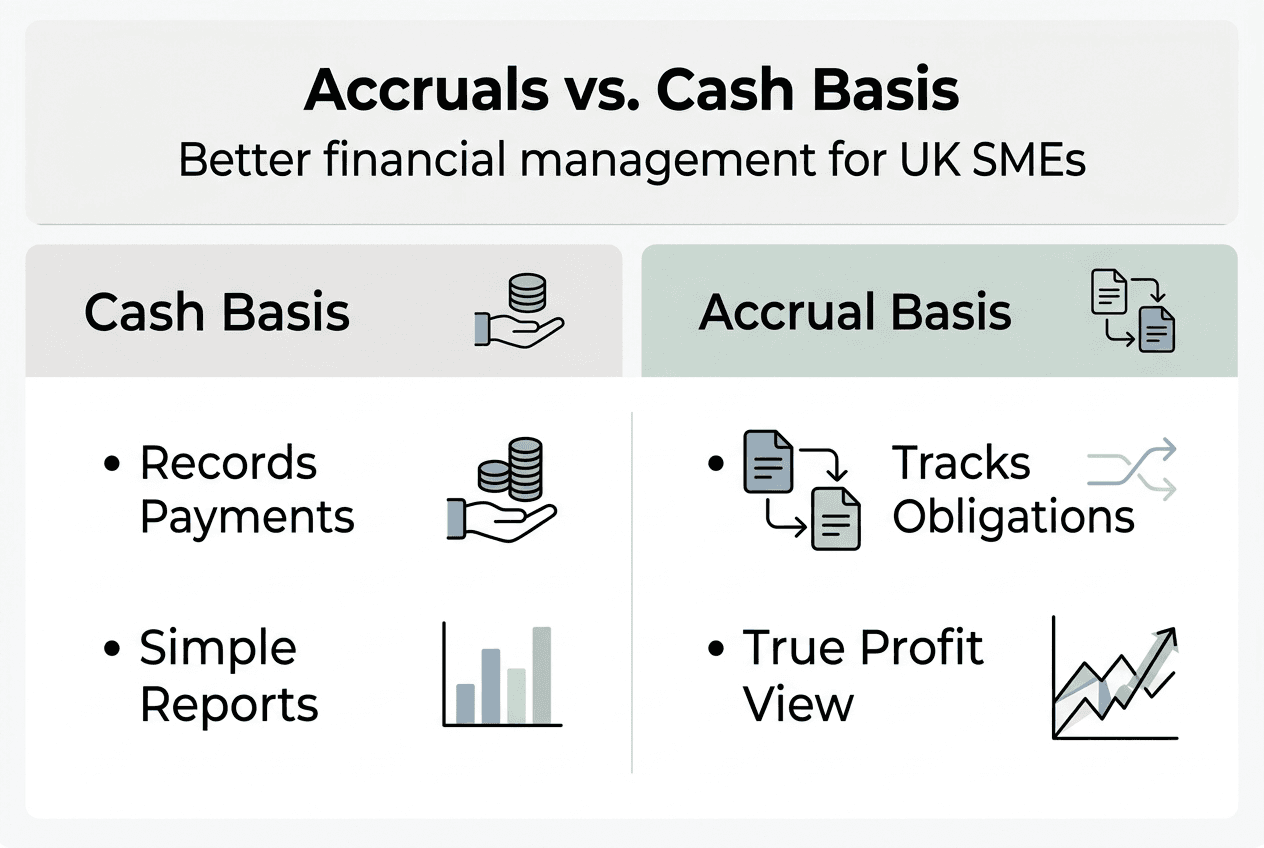
Accrual accounting recognises income when you earn it and expenses when you incur them, regardless of when money changes hands. This contrasts sharply with cash basis accounting, where transactions only appear when payments occur. The distinction matters because accrual methods reveal your actual financial position rather than just your bank balance.
Consider a Leeds consultancy that completes a project in March but receives payment in May. Under cash basis, the income appears in May, potentially misrepresenting March profitability. Accrual accounting correctly shows the revenue in March when earned, matching it with associated expenses from that period. This timing accuracy transforms financial understanding.
The benefits extend beyond simple record keeping. Accrual accounting enhances financial management by providing a true profitability view vital for growth and funding decisions. Banks and investors scrutinise accrual-based statements because they reflect economic reality more reliably than cash records. You gain better control over financial planning when you understand obligations and receivables regardless of payment timing.
Most UK businesses must follow accrual principles under FRS 102 standards. Small companies may opt for cash basis if they meet specific criteria, typically involving turnover thresholds below £150,000 for VAT purposes. However, even eligible businesses often choose accrual methods because they support better business cash flow management and strategic decision making.
Pro Tip: Review your accounting method annually. As your business grows beyond small company thresholds, transitioning to accrual accounting becomes mandatory, and early adoption smooths the adjustment process whilst improving financial insights immediately.
Practical implementation involves tracking invoices issued and received, recording depreciation on assets, and recognising prepayments or accrued expenses at period ends. A Manchester retailer might prepay six months of insurance in January. Accrual accounting spreads this cost across the coverage period rather than hitting January’s profit entirely. Similarly, utility bills received after month end get accrued back to reflect actual consumption timing.
The methodology requires more sophisticated record keeping than cash basis but delivers substantially greater value. You see which periods generate profit, identify seasonal patterns accurately, and make informed decisions about pricing, investment, and resource allocation. Financial managers rely on these insights to steer businesses toward sustainable growth whilst maintaining regulatory compliance.
Key principles and UK standards: FRS 102 and post-balance-sheet events
FRS 102 provides the regulatory framework governing accrual accounting for most UK entities. This standard ensures consistency and comparability across financial statements whilst establishing principles for recognising, measuring, and presenting transactions. Understanding these requirements protects you from compliance issues and strengthens financial reporting quality.
The 2026 updates introduce a five-step model for revenue recognition that brings UK GAAP closer to international standards. This framework requires careful analysis of each customer contract:
- Identify the contract with a customer, ensuring enforceable rights and obligations exist between parties.
- Identify separate performance obligations within the contract, distinguishing distinct goods or services promised.
- Determine the transaction price, considering variable consideration, financing components, and non-cash elements.
- Allocate the transaction price to performance obligations based on standalone selling prices or appropriate estimates.
- Recognise revenue when you satisfy each performance obligation by transferring control of goods or services.
This structured approach eliminates ambiguity in complex arrangements. A Birmingham software company selling licenses with ongoing support must now separate these obligations, recognising license revenue upfront whilst deferring support income over the service period. The precision improves financial statement reliability and investor confidence.

Post-balance-sheet events present another critical consideration. UK GAAP distinguishes between adjusting and non-adjusting events based on whether they provide evidence of conditions existing at the balance sheet date. Adjusting events require financial statement amendments because they clarify the position at year end. A customer bankruptcy confirmed in January but relating to December sales demands adjustment to receivables and profit figures.
Non-adjusting events occur after the balance sheet date and reflect new conditions. A fire destroying inventory in January does not adjust December statements because the inventory existed intact at year end. However, disclosure in the notes informs users about significant subsequent developments affecting the business.
“The distinction between adjusting and non-adjusting events requires professional judgement. Consider whether information received after year end provides evidence about conditions at the balance sheet date or represents entirely new circumstances.”
This judgement extends to estimates throughout accrual accounting. Depreciation rates, bad debt provisions, and warranty obligations all involve estimation. FRS 102 requires reasonable estimates based on available evidence, with changes recognised prospectively as better information emerges. The quality of these judgements directly impacts financial statement reliability and user trust.
Financial managers must stay current with standard updates. The 2026 revenue recognition changes affect contract review processes, system configurations, and staff training requirements. Early preparation prevents compliance gaps and positions your business to implement new requirements smoothly whilst maintaining operational continuity.
Benefits of accurate accrual accounting for UK SMEs
Empirical research demonstrates tangible advantages from maintaining precise accrual records. Studies show accrual accuracy positively impacts business market value and operational decision quality among UK SMEs. This evidence-based validation confirms what financial professionals observe: better accounting drives better outcomes.
Accurate accruals improve cash conversion management, a critical concern for smaller enterprises. When you recognise revenue upon earning it, you simultaneously track outstanding receivables requiring collection. This visibility enables proactive credit control and reduces the cash gap between sales and receipts. A Nottingham manufacturer using accrual methods identified slow-paying customers earlier, tightening credit terms and improving cash flow by 18% within six months.
The relationship between accrual quality and sustainable growth appears consistently across markets. Research in emerging economies shows reduced discretionary accruals correlate with stronger long-term performance. This pattern reflects how reliable financial information supports sound strategic decisions. You avoid overextending based on inflated profits or missing opportunities due to understated performance.
Funding opportunities expand when you present accrual-based financials. Banks assess lending applications using profit trends, working capital positions, and debt servicing capacity, all clearer under accrual accounting. Investors similarly prefer accrual statements because they reveal economic substance beyond cash movements. A Bristol tech startup secured venture funding partly because accrual accounts demonstrated recurring revenue patterns obscured in cash records.
Pro Tip: Use accrual data to build rolling forecasts. Project future cash positions by analysing receivables aging, payables timing, and seasonal patterns visible in accrual records but hidden in cash statements.
The following table illustrates how accrual accounting impacts key SME performance indicators:
| Performance Indicator | Cash Basis View | Accrual Basis View | Management Advantage |
| — | — | — |
| Profitability | Distorted by payment timing | Matched to earning period | Accurate pricing decisions |
| Working capital | Bank balance only | Receivables plus inventory less payables | Better liquidity planning |
| Seasonal patterns | Obscured by cash delays | Clear period-to-period trends | Informed resource allocation |
| Creditworthiness | Incomplete picture | Full obligation visibility | Improved lending terms |
Financial managers leveraging these advantages gain competitive edge. You identify profitable products accurately, time investments strategically, and demonstrate financial health convincingly to stakeholders. The role of accountants for SMEs includes translating accrual data into actionable insights that drive growth whilst maintaining compliance.
The market valuation impact deserves emphasis. Acquirers and investors apply multiples to sustainable earnings, not erratic cash flows. Accrual accounting smooths artificial volatility caused by payment timing, revealing underlying business quality. This clarity can increase enterprise value significantly when you seek investment or plan succession.
Maintaining accurate bookkeeping for UK SMEs forms the foundation for these benefits. Regular reconciliation, proper cut-off procedures, and timely accruals ensure your financial statements reflect reality. The discipline required pays dividends through better decisions, stronger stakeholder relationships, and sustainable growth trajectories.
Common challenges and best practices in accrual accounting
Implementing accrual accounting presents several recurring challenges for UK businesses. Cut-off timing errors occur when transactions near period ends land in wrong accounting periods. A Sheffield distributor might receive December goods but record them in January, understating year-end inventory and cost of sales. This misstatement distorts profitability comparisons and potentially breaches reporting standards.
Estimate errors pose another frequent problem. Calculating depreciation, provisions, and accruals requires judgement that improves with experience. New financial managers sometimes underestimate bad debts or overstate warranty obligations, creating artificial profit volatility. Financial managers should prioritise accrual quality through regular review and adjustment as better information emerges.
Distinguishing event types causes confusion, particularly around post-balance-sheet occurrences. Determining whether February information adjusts December statements or simply warrants disclosure requires understanding the underlying conditions. Professional guidance helps navigate these grey areas whilst building internal expertise over time.
The following comparison highlights common pitfalls and prevention strategies:
| Aspect | Cash Basis Pitfall | Accrual Basis Pitfall | Prevention Strategy |
| — | — | — |
| Period matching | Income/expenses misaligned | Cut-off errors at period end | Implement strict cut-off procedures with documentation |
| Estimates | Not applicable | Inaccurate provisions or accruals | Regular review against actual outcomes, adjust methodically |
| Revenue timing | Premature recognition on receipt | Complex contract allocation errors | Apply FRS 102 five-step model consistently |
| Compliance | Limited regulatory requirements | Must meet FRS 102 standards | Engage professional support and maintain current knowledge |
Best practices start with regular reconciliation. Monthly bank reconciliations catch errors early whilst reviewing aged receivables and payables ensures accurate accruals. A Cambridge consultancy reconciling weekly identified invoice duplication that would have overstated revenue significantly.
Professional bookkeeping services provide expertise and consistency. External specialists stay current with regulatory changes, implement proper procedures, and offer objective review of management estimates. This support proves particularly valuable during the 2026 FRS 102 revenue recognition transition when contract review requirements intensify.
Contract review becomes essential under updated standards. Examine customer agreements to identify separate performance obligations, variable consideration, and financing components. A Liverpool construction firm discovered their contracts contained multiple obligations requiring separate revenue recognition, fundamentally changing their financial reporting approach.
Adapting to regulatory evolution requires proactive planning. The 2026 changes affect revenue timing, potentially impacting reported profits, banking covenants, and tax positions. Early assessment identifies necessary system updates, process changes, and staff training whilst allowing time to communicate impacts to stakeholders.
Key implementation steps include:
- Establish clear cut-off procedures documented in accounting manuals with specific responsibilities assigned
- Review estimates quarterly against actual outcomes, investigating variances and refining methodologies
- Maintain detailed contract registers identifying performance obligations and recognition criteria
- Schedule regular training on FRS 102 updates and emerging best practices
- Engage qualified accountants for complex transactions and annual financial statement preparation
Forward-looking financial planning integrates naturally with accrual accuracy. When you recognise obligations as incurred, you see future cash requirements clearly. A Newcastle retailer used accrual data to model seasonal working capital needs, arranging facilities proactively rather than scrambling during peak periods. This foresight reduced borrowing costs and strengthened supplier relationships through consistent payment performance.
The discipline of financial planning for Leeds businesses relies fundamentally on accurate accrual information. Strategic decisions about expansion, investment, and resource allocation require reliable financial data. Accrual accounting provides this foundation, enabling confident planning backed by economic reality rather than cash timing accidents.
Technology supports accrual implementation through automated accrual calculations, depreciation tracking, and period-end processing. Modern accounting software flags unusual transactions, maintains audit trails, and generates reports facilitating review. However, technology cannot replace professional judgement in estimates and event classification. The combination of robust systems and qualified expertise delivers optimal results.
Discover expert support for your accrual accounting needs
Navigating accrual accounting complexities whilst running your business demands expertise and time. Concorde Company Solutions specialises in supporting UK SMEs with comprehensive accounting services tailored to your specific circumstances. Our Garforth-based team understands the challenges facing growing businesses and provides personalised guidance ensuring compliance whilst enhancing financial clarity.

We help you implement robust accrual systems aligned with current FRS 102 standards, including the 2026 revenue recognition updates. Our services span statutory accounts preparation, bookkeeping, and ongoing financial management support that frees you to focus on business growth. Whether you need assistance transitioning from cash basis or want to strengthen existing accrual processes, we deliver practical solutions building long-term financial health.
Explore our accounting compliance checklist for SMEs to assess your current position and identify improvement opportunities. Understanding the role of accountants for SMEs clarifies how professional support accelerates your success whilst ensuring regulatory adherence. Contact us today to discuss how we can support your financial management journey.
Frequently asked questions
What is the difference between accrual and cash basis accounting?
Accrual accounting records income when earned and expenses when incurred, regardless of payment timing. Cash basis only recognises transactions when money moves. Accrual provides fuller financial pictures essential for compliance and management decisions, whilst cash basis offers simplicity suitable only for very small enterprises.
When must UK businesses use accrual accounting under FRS 102?
Businesses exceeding small company thresholds typically must follow FRS 102 accrual requirements. These thresholds relate to turnover, balance sheet totals, and employee numbers. Smaller entities may choose cash basis for tax purposes but often adopt accrual methods voluntarily for better financial management and stakeholder reporting.
How do post-balance-sheet events affect accrual accounting?
Adjusting events provide evidence about conditions existing at the balance sheet date and require financial statement amendments. Non-adjusting events reflect new conditions arising after year end and warrant disclosure without changing reported figures. Proper classification ensures financial statements accurately represent the position at reporting dates whilst informing users of significant subsequent developments.
What are best practices for maintaining accurate accrual records?
Regular reconciliations catch errors early whilst contract reviews under updated standards ensure proper revenue recognition. Professional bookkeeping and modern accounting software enhance accuracy and efficiency. Timely addressing of estimates through quarterly reviews and clear cut-off procedures at period ends maintain reliability and support confident decision making throughout the year.
No responses yet