
Setting up your own company in the UK feels overwhelming when you’re juggling name checks, legal documents, and compliance deadlines all at once. You want to get it right the first time without expensive mistakes or regulatory penalties. This guide walks you through every critical step of company formation, from choosing your business structure to maintaining ongoing compliance, with practical insights and expert tips to help you launch confidently and build a solid foundation for growth.
Table of Contents
- Key takeaways
- Choosing your company structure and name
- Preparing incorporation documents and registering your company
- Post-incorporation steps and ongoing compliance
- Common mistakes and expert tips for smooth company formation
- How Concorde Company Solutions can help your business formation
- Frequently asked questions
Key Takeaways
| Point | Details |
|---|---|
| Ltd is dominant | The Private Limited by Shares structure is the prevailing choice among UK startups, balancing liability protection with tax efficiency. |
| Name uniqueness checks | Your company name must be unique and pass Companies House checks before you proceed with branding or domain purchases. |
| Formation agents help | Using formation agents can reduce errors and speed up the registration process. |
| Post formation compliance | Ongoing compliance obligations such as annual filings and reporting help prevent penalties and maintain good standing. |
| Accounting from day one | Maintaining clear accounting from day one supports accurate reporting and scalable growth. |
Choosing your company structure and name
Your company structure determines everything from tax liability to personal asset protection. The Private Limited by Shares (Ltd) structure dominates UK entrepreneurship because 95% of new UK businesses register as Private Ltd companies. This structure separates your personal assets from business debts, meaning creditors cannot pursue your home or savings if the company faces financial difficulty. Limited companies also offer tax efficiency through lower Corporation Tax rates compared to Income Tax on sole trader profits.
Other structures exist, including sole trader status and partnerships, but they expose you to unlimited personal liability. Public limited companies (PLCs) suit larger enterprises planning to raise capital through public share offerings, not typical startups. Understanding what is company formation uk helps clarify why the Ltd structure works for most entrepreneurs building scalable businesses.
Your company name must be unique and compliant with Companies House regulations. Use the official Companies House name search tool to verify availability before committing to branding or domain purchases. Avoid names too similar to existing registered companies, as this triggers automatic rejection. Sensitive words like “Royal,” “Government,” or “Chartered” require special permission, and you cannot use offensive language or suggest connections to regulated activities without proper authorisation.
Pro Tip: Check domain availability simultaneously with your Companies House name search to secure matching web presence before registration.
Your chosen name appears on every official document, invoice, and public record. Consider future expansion when selecting it, avoiding overly narrow descriptors that limit growth into new markets or services. The name also affects customer perception and brand recognition, so balance uniqueness with clarity about what your business actually does. Many entrepreneurs choose descriptive names initially, then rebrand later as their vision evolves, but this creates administrative burden and potential customer confusion. Resources on setting up a limited company provide additional naming guidance and structure comparisons.
Key considerations for structure selection:
- Limited liability protection shields personal assets from business debts
- Corporation Tax rates typically lower than higher Income Tax bands
- Professional image attracts investors and larger clients
- Easier to transfer ownership through share sales
- Annual filing requirements add administrative responsibility
Preparing incorporation documents and registering your company
Successful registration requires precise documentation before you submit anything to Companies House. You need a registered UK office address where official correspondence arrives, which can be your home, a commercial property, or a registered office service provider. This address appears on public records, so many entrepreneurs use formation agents’ addresses to maintain privacy. Select appropriate Standard Industrial Classification (SIC) codes describing your business activities, as these determine regulatory oversight and statistical reporting requirements.

Your share structure defines ownership percentages and investment framework. Most startups issue 100 ordinary shares at £1 each, totalling £100 share capital, though you can choose any number and value. Decide who receives shares and in what proportion, documenting this clearly to avoid disputes later. Shareholders own the company and appoint directors to manage operations, so distinguish between ownership and management roles from the start.
Prepare documents including registered office, SIC codes, share structure, Articles of Association before beginning your application. The Articles of Association outline company rules governing director powers, shareholder rights, and decision-making processes. Companies House provides model articles suitable for most standard companies, or you can draft custom articles addressing specific governance needs. Custom articles cost more but offer flexibility for complex ownership structures or unusual voting arrangements.
Register online via Companies House WebFiling or formation agent; ID verification required since Nov 2025 under new ECCTA legislation. Formation agents charge from £12 compared to £50 for direct Companies House applications, offering faster processing and error checking. Since late 2025, all directors and persons with significant control (PSCs) must verify their identity using a personal code obtained through GOV.UK One Login or approved verification schemes. This mandatory step prevents fraudulent registrations and increases transparency.
Step-by-step registration process:
- Obtain director and PSC identity verification codes through GOV.UK One Login
- Gather registered office address and select appropriate SIC codes
- Define share structure and prepare shareholder details
- Choose between model articles or draft custom Articles of Association
- Complete online application via formation agent or Companies House WebFiling
- Pay registration fee (£12-£50 depending on method)
- Receive incorporation certificate and company number within 2-6 hours
Formation agents typically process applications within 2 to 6 hours, significantly faster than DIY submissions that may take several days. They pre-check documents for common errors, reducing rejection risk and registration delays. The company formation checklist 2026 uk guide provides a comprehensive overview of required documents and registration steps.
Essential incorporation documents:
- Registered office address confirmation
- Director and PSC personal details with verified identity codes
- Memorandum of Association stating intention to form the company
- Articles of Association defining governance rules
- Share structure detailing number, value, and allocation
- SIC codes identifying business activities
Post-incorporation steps and ongoing compliance
Your company legally exists once you receive the incorporation certificate, but critical registrations and compliance duties begin immediately. Register for Corporation Tax within 3 months, penalties apply for late registration; opens VAT registration consideration at £90,000 threshold of taxable turnover. HMRC imposes automatic penalties for late Corporation Tax registration, even if you owe no tax, so complete this within three months of starting any business activity, including receiving income or incurring expenses.
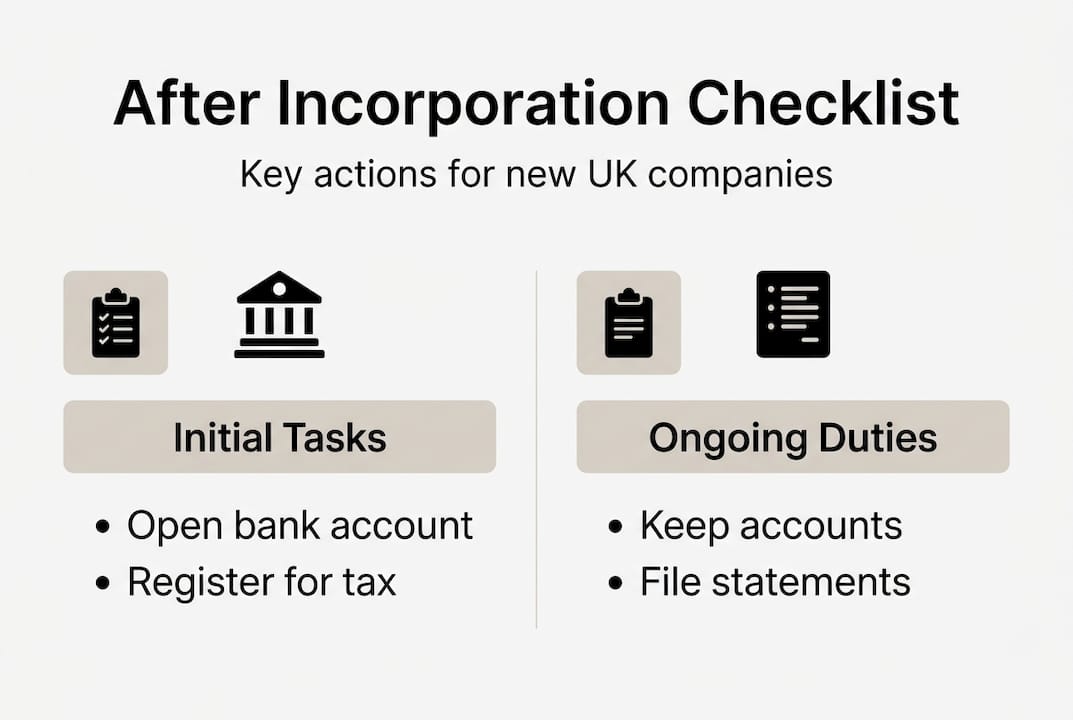
Open a dedicated business bank account to separate company finances from personal money. Limited companies legally require this separation to maintain limited liability protection. Mixing personal and business transactions pierces the corporate veil, potentially exposing personal assets to business creditors. Most banks require your incorporation certificate, Articles of Association, and director identification before opening accounts. Compare business banking packages, as fees and features vary significantly between providers.
Start bookkeeping from day one to avoid £34m+ penalties; use software like Xero or QuickBooks with quarterly reviews to maintain accurate financial records. HMRC collected over £34m in accounting-related penalties during recent years, demonstrating the cost of poor record-keeping. Digital accounting software automatically categorises transactions, generates reports, and prepares tax calculations, reducing manual errors and saving time. Quarterly financial reviews help identify cash flow issues early and support informed business decisions.
VAT registration becomes mandatory when your taxable turnover exceeds £90,000 within any rolling 12-month period. You can voluntarily register below this threshold to reclaim VAT on business purchases, beneficial if you buy expensive equipment or supplies. Weigh the administrative burden of quarterly VAT returns against potential savings before voluntary registration.
Pro Tip: Engage an accountant during your first month of trading to establish proper bookkeeping systems and compliance calendars, preventing costly mistakes and penalties later.
First Confirmation Statement due within 12 months; accounts within 21 months of incorporation mark critical compliance deadlines. The Confirmation Statement verifies company details with Companies House, including registered office, directors, shareholders, and SIC codes. File statutory accounts showing your financial position within 21 months of incorporation for the first year, then annually within nine months of each accounting period end. Companies House imposes automatic fines for late filings, starting at £150 and escalating to £1,500 for prolonged delays.
| Compliance task | Deadline | Penalty for non-compliance |
|---|---|---|
| Corporation Tax registration | 3 months from starting business | Automatic HMRC penalties |
| First Confirmation Statement | 12 months from incorporation | £150-£1,500 Companies House fine |
| First statutory accounts | 21 months from incorporation | £150-£1,500 Companies House fine |
| VAT registration | When turnover exceeds £90,000 | HMRC penalties and interest |
| Annual accounts filing | 9 months after year end | £150-£1,500 escalating fines |
The limited company compliance guide and accounting compliance checklist uk smes 2026 guide detail ongoing obligations and filing schedules. Setting up how to set up business finances uk properly from the start prevents compliance failures and financial confusion.
Immediate post-formation responsibilities:
- Register for Corporation Tax with HMRC within three months
- Open dedicated business bank account separating company and personal funds
- Implement accounting software and establish bookkeeping routines
- Register for VAT if turnover exceeds or will exceed £90,000 annually
- Set calendar reminders for Confirmation Statement and accounts filing deadlines
- Consider employer registrations if hiring staff
Common mistakes and expert tips for smooth company formation
DIY company formation has ~8% rejection rate; formation agents reduce errors and privacy risks; legal changes remove local registers according to recent industry analysis. Rejected applications delay your launch and require resubmission with corrected information, wasting time when you need to start trading quickly. Common rejection reasons include incomplete director details, missing identity verification codes, incorrect share structures, and non-compliant company names.
Formation agents offer cheaper, faster, and more reliable registration services than DIY applications. Their expertise prevents common errors and speeds approval, with most applications processed within hours. Agents also provide registered office services protecting your home address from public records, valuable for privacy and security. Non-residents particularly benefit from agent services, as they navigate complex identity verification requirements and provide UK registered addresses.
“The 2025 ECCTA legislation fundamentally changed company registration by mandating central identity verification for all directors and PSCs. Failure to obtain and submit verified identity codes results in automatic application rejection, regardless of other document accuracy.”
New ECCTA rules removed local registers, all data now held by Companies House with verified ID processes centralising company information and increasing transparency. Companies no longer maintain separate registers of members, directors, or PSCs at their registered offices. All information lives in the central Companies House database, accessible to the public through official searches. This change simplifies compliance but requires accurate initial submissions, as errors appear in permanent public records.
Late filings incur heavy fines; separate business and personal finances to protect limited liability status. HMRC collected £220m in late filing penalties during 2022-23 alone, demonstrating how quickly compliance failures accumulate costs. Companies House fines start at £150 for accounts filed one day late, doubling to £300 after three months, then escalating further. Repeat offenders face prosecution and potential director disqualification.
Incorrect share structures create unexpected problems, particularly for companies seeking Seed Enterprise Investment Scheme (SEIS) or Enterprise Investment Scheme (EIS) tax relief. Standard model articles may include provisions blocking SEIS eligibility, requiring custom articles from the start. Formation agents familiar with investment schemes provide SEIS-ready articles, avoiding costly amendments later when seeking funding.
Pro Tip: Use formation agents to receive SEIS-compliant Articles of Association and registered office privacy protection, essential for investment-ready companies and personal security.
| Factor | DIY registration | Formation agent |
|---|---|---|
| Cost | £50 Companies House fee | £12-£100 including services |
| Processing time | 24-48 hours typical | 2-6 hours typical |
| Rejection rate | ~8% due to errors | <1% with pre-checks |
| Privacy protection | Home address public | Agent address available |
| SEIS readiness | Requires custom articles | Often included |
| Support | None after submission | Ongoing guidance |
Mixing personal and business finances ranks among the most damaging mistakes. Using personal accounts for business transactions or paying personal expenses from company accounts undermines limited liability protection. Courts can pierce the corporate veil when directors fail to maintain proper separation, making personal assets vulnerable to business creditors. Always maintain distinct accounts and clear documentation for every transaction.
The company formation checklist 2026 uk guide helps avoid these pitfalls with systematic preparation and verification steps.
Top mistakes to avoid:
- Skipping identity verification before application submission
- Choosing company names too similar to existing businesses
- Using standard articles when seeking SEIS or EIS eligibility
- Missing Corporation Tax registration deadline within three months
- Mixing personal and business finances in same bank accounts
- Ignoring Confirmation Statement and accounts filing deadlines
- Failing to maintain proper bookkeeping records from day one
How Concorde Company Solutions can help your business formation
Navigating company formation and compliance requirements feels less daunting with expert support guiding each step. Concorde Company Solutions provides comprehensive formation services tailored specifically to UK entrepreneurs establishing new companies. We handle the technical details whilst you focus on building your business vision and serving customers.

Our personalised approach ensures you understand every decision and deadline affecting your company. We explain structure options, prepare accurate incorporation documents, and establish compliant accounting systems from day one. Access ongoing support through our limited company compliance guide and accounting compliance checklist uk smes 2026 guide, keeping you informed about changing requirements and upcoming obligations.
Partner with Concorde Company Solutions to simplify your company setup and gain a trusted accounting ally supporting your growth ambitions. We reduce formation errors, prevent compliance penalties, and provide timely reminders ensuring you meet every regulatory deadline confidently.
Frequently asked questions
What documents are needed to form a company in the UK?
You need a registered UK office address, director and PSC details with verified identity codes, a Memorandum and Articles of Association, share structure documentation, and appropriate SIC codes. The company formation checklist 2026 uk guide provides a complete document list and preparation guidance.
How long does UK company registration take?
Formation agents typically complete registrations within 2 to 6 hours after receiving all required documents and verified identity codes. DIY applications through Companies House WebFiling usually process within 24 to 48 hours, though errors can cause delays and rejections requiring resubmission.
Do I need an accountant for company formation?
Whilst not legally required, engaging an accountant during formation prevents costly compliance mistakes and establishes proper bookkeeping systems immediately. Accountants ensure you register for appropriate taxes, understand filing deadlines, and maintain records supporting limited liability protection.
What happens if I miss the Corporation Tax registration deadline?
HMRC imposes automatic penalties for late Corporation Tax registration, even if your company owes no tax. Register within three months of starting any business activity, including receiving income or incurring expenses, to avoid fines and compliance complications.
Can I use my home address as the registered office?
Yes, you can use your home address as the registered office, though this address appears on public Companies House records. Many entrepreneurs use formation agents’ registered office services to maintain privacy and prevent unwanted correspondence at home addresses.
No responses yet