
UK business owners face mounting pressure to maintain financial compliance while managing daily operations. Quarterly account reviews can reduce HMRC penalty risk by up to 40%, yet many SMEs rely solely on annual statutory accounts. Regular financial assessments provide the clarity needed to catch errors early, optimize cash flow, and support strategic growth. This guide explains how structured account reviews transform compliance from reactive firefighting into proactive financial management.
Table of Contents
- Understanding Regular Account Reviews
- How Regular Account Reviews Ensure Compliance
- Financial Benefits of Regular Account Reviews
- Common Misconceptions About Regular Account Reviews
- Framework and Comparison: Proactive Vs Reactive Account Reviews
- Practical Steps to Implement Regular Account Reviews
- Bridging Understanding to Strategic Growth
Key Takeaways
| Point | Details |
|---|---|
| Compliance Protection | Regular reviews identify errors early, reducing HMRC penalty exposure by up to 40% through timely corrections. |
| Financial Clarity | Monthly or quarterly assessments improve cash flow forecasting accuracy and reveal cost-saving opportunities. |
| Strategic Advantage | Proactive reviews enable data-driven decisions and early detection of financial risks before they escalate. |
| Implementation Simplicity | Start with monthly reviews for new businesses, quarterly for established SMEs, using existing accounting software. |
Understanding Regular Account Reviews
Regular account reviews are periodic financial assessments conducted monthly or quarterly to examine your business’s income, expenses, liabilities, and cash flow. Unlike annual statutory accounts prepared for Companies House, these interim checks focus on operational financial health and compliance readiness throughout the year.
These reviews involve examining transaction accuracy, reconciling bank statements, verifying VAT calculations, and assessing budget performance. Key stakeholders include business owners who need financial visibility, accountants who validate data integrity, and financial advisors who guide strategic planning. The frequency allows you to spot trends and anomalies while they’re still manageable.
Core elements assessed during reviews include:
- Revenue streams and invoicing patterns
- Operating expenses and cost variances
- Outstanding receivables and payables
- Cash flow projections and reserves
- Tax obligation estimates
Timely data collection is essential for meaningful reviews. Outdated information limits your ability to make informed adjustments. Accurate bookkeeping forms the foundation, ensuring your review reflects current reality rather than historical guesswork. Without current records, you’re essentially driving while looking in the rearview mirror.
How Regular Account Reviews Ensure Compliance
Regular reviews act as an early warning system for compliance issues before they trigger HMRC penalties. By examining financial records monthly or quarterly, you identify calculation errors, misclassified transactions, and documentation gaps while there’s still time to correct them. This proactive approach contrasts sharply with discovering problems during annual filings when options are limited.

HMRC compliance strategies emphasize prevention over correction. Regular reviews ensure VAT returns reflect actual liability, corporation tax estimates align with profits, and expense claims meet documentation standards. When you catch a misposted transaction in March rather than during year-end reconciliation, you avoid cascading errors across multiple filings.
The compliance benefits include:
- Early detection of VAT calculation discrepancies
- Accurate corporation tax provision estimates
- Reduced risk of late submission penalties
- Smoother responses to HMRC queries with organized records
- Lower professional fees from avoiding rushed corrections
Scheduling reviews six to eight weeks before major filing deadlines gives you adequate time to address issues without panic. This buffer transforms tax compliance from a stressful annual event into a manageable ongoing process.
Pro Tip: Set calendar reminders for review sessions two months before your VAT and corporation tax deadlines to maintain a compliance cushion and avoid last-minute scrambles.
Financial Benefits of Regular Account Reviews
Beyond compliance, regular reviews deliver measurable financial performance improvements. Businesses conducting quarterly reviews report 30% better cash flow forecasting accuracy compared to those relying solely on annual assessments. This precision stems from frequent monitoring that captures seasonal patterns and emerging trends.
Cost control improves dramatically when you examine expenses monthly. A £200 monthly subscription error caught in February costs £2,000 less than one discovered during year-end accounts. Regular reviews spotlight spending anomalies, duplicate payments, and budget overruns while corrective action still delivers meaningful savings.
Financial benefits extend across multiple areas:
- Enhanced working capital management through better receivables tracking
- Identification of underperforming product lines or services
- Data-driven pricing decisions based on actual margins
- Optimized tax planning through year-round rather than year-end adjustments
- Improved lender confidence when seeking financing
The link between review frequency and profitability is clear. Businesses that analyze finances quarterly make faster strategic pivots, whether that’s cutting unprofitable offerings or doubling down on high-margin opportunities. Optimising tax efficiency becomes continuous rather than a December scramble.
Pro Tip: Use each review to update your rolling 12-month cash flow forecast, adjusting for actual results versus projections to sharpen future predictions and support better resource allocation decisions.
The role of accountants in this process extends beyond number-crunching to interpreting what the figures mean for your specific business context and strategic goals.
Common Misconceptions About Regular Account Reviews
Many UK business owners hold false beliefs that prevent them from adopting regular reviews. Understanding these misconceptions helps you make informed decisions about financial management practices.
Myth 1: Annual statutory accounts provide sufficient oversight. Reality check: annual accounts are historical compliance documents, not management tools. By the time you file accounts 9 months after year-end, you’re reviewing 21-month-old data for recent months. Interim reviews catch ongoing issues when intervention still matters.
Myth 2: Reviews are only necessary when problems arise. This reactive mindset is exactly backwards. Proactive reviews prevent problems from developing. Waiting for red flags means you’re already in damage control mode, often with limited options and higher costs.
Myth 3: Account reviews don’t help with tax planning. The opposite is true. Regular reviews enable year-round tax optimization through timing income recognition, maximizing allowable deductions, and planning capital expenditures. December tax planning with incomplete data leads to missed opportunities and suboptimal decisions.
These misconceptions cost UK SMEs an estimated £3.2 billion annually in preventable penalties, missed tax reliefs, and poor financial decisions. The belief that reviews are optional luxuries rather than essential practices stems from underestimating the value of timely financial intelligence. Tax planning with accountants works best as an ongoing conversation, not a year-end crisis meeting.
Framework and Comparison: Proactive vs Reactive Account Reviews
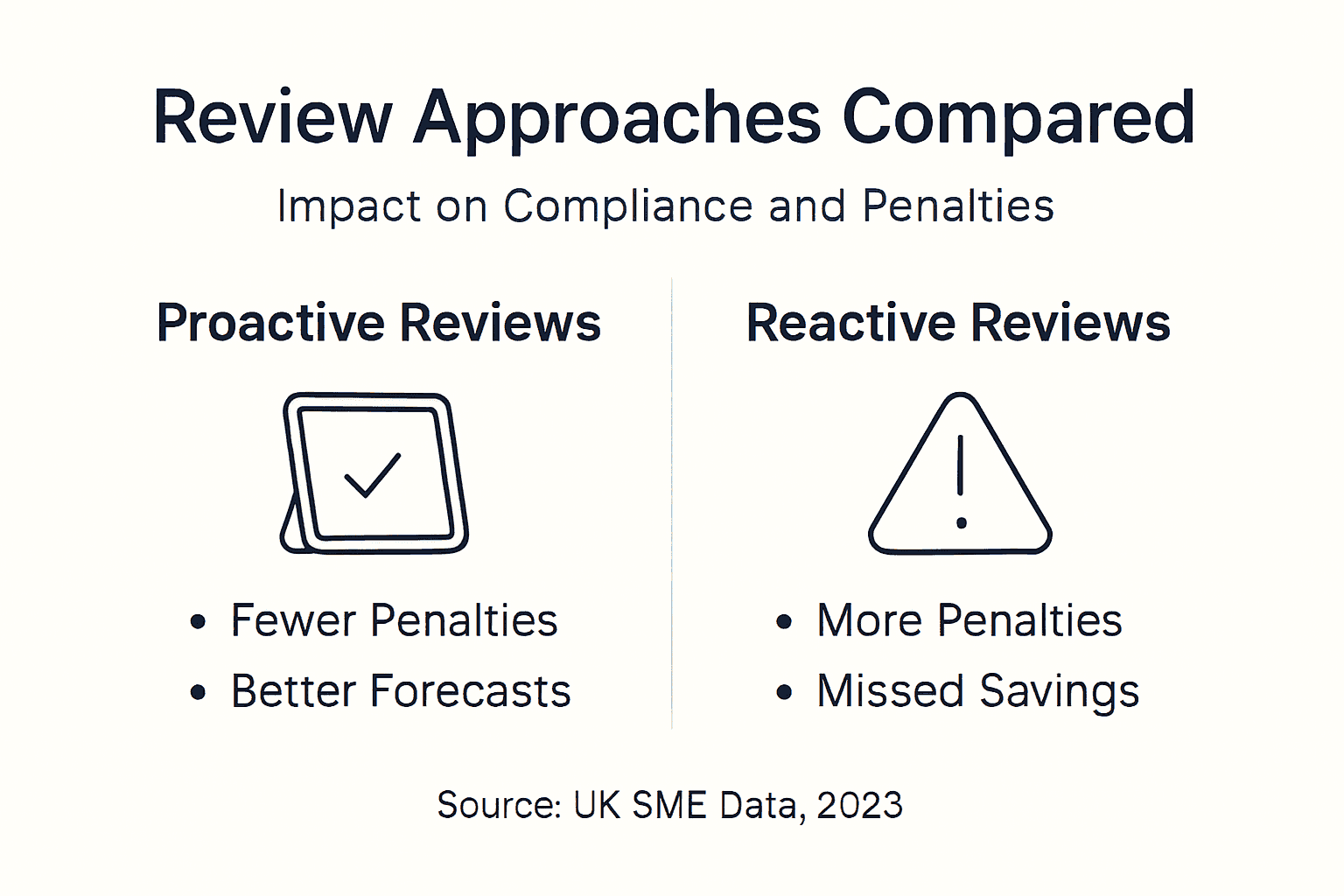
Understanding the difference between proactive and reactive approaches clarifies why regular reviews deliver superior outcomes. Proactive reviews follow a predetermined schedule regardless of circumstances. Reactive reviews happen when problems surface or deadlines loom.
| Aspect | Proactive Reviews (Regular) | Reactive Reviews (As-Needed) |
|---|---|---|
| Frequency | Monthly or quarterly scheduled sessions | Ad-hoc when issues arise or deadlines approach |
| Risk Detection | Early identification while solutions are simple | Late discovery requiring complex corrections |
| Strategic Value | Informs forward-looking decisions and planning | Addresses past problems with limited future impact |
| Compliance Confidence | Continuous HMRC readiness with validated data | Last-minute verification creating filing stress |
| Cost Efficiency | Distributed effort reducing peak workload | Concentrated emergency fees and rushed work |
| Financial Insight | Trend analysis enabling optimization | Snapshot views missing patterns and opportunities |
The quantitative impact is significant. Businesses using proactive reviews experience 40% fewer compliance penalties, 25% better working capital ratios, and 35% less time spent on year-end closing compared to reactive approaches.
Practical implications for you include predictable accounting costs, reduced financial anxiety, and the ability to make confident decisions based on current data. Your accountant becomes a strategic advisor rather than an annual crisis responder. The accountants’ role in reviews shifts from historian to navigator when you adopt proactive practices.
Practical Steps to Implement Regular Account Reviews
Starting regular account reviews requires structure but not complexity. Follow these steps to establish an effective review routine tailored to your business size and needs.
-
Determine your review frequency. New businesses benefit from monthly reviews to establish financial discipline and catch setup errors quickly. Established SMEs typically find quarterly reviews balance insight with resource demands. High-transaction or seasonal businesses may need monthly attention regardless of age.
-
Schedule review sessions in advance. Block calendar time for reviews before the quarter begins. Treat these sessions as unmissable appointments. Consistency matters more than perfection initially.
-
Organize financial data systematically. Ensure all transactions are recorded, bank statements reconciled, and receipts filed before each review. Missing data undermines the entire process. Importance of accurate bookkeeping cannot be overstated as the foundation for meaningful reviews.
-
Collaborate with your accountant. Share review objectives and questions beforehand. Your accountant validates data accuracy, interprets trends, and recommends actions. This partnership multiplies review value through professional expertise. Working with accountants transforms numbers into actionable intelligence.
-
Implement findings and monitor results. Reviews are pointless without action. Document decisions, assign responsibilities, and track outcomes. Each subsequent review should assess whether previous actions delivered expected results.
Pro Tip: Configure your accounting software to flag unusual transactions automatically, such as duplicate invoices or expenses exceeding category budgets, so reviews focus on exceptions rather than routine verification.
Start simple and refine your process over time. The goal is sustainable practice, not overwhelming perfection.
Bridging Understanding to Strategic Growth
Regular account reviews transcend compliance checking to become growth enablers. The financial clarity they provide informs strategic decisions about pricing, hiring, expansion, and investment timing. You move from wondering about your financial position to knowing it with confidence.
Review outputs directly inform resource allocation. When you see which products or services generate the best margins, you can shift marketing spend and operational focus accordingly. Geographic or customer segment analysis reveals where growth potential lies versus where you’re merely busy without profit.
Early warning signs become visible before they escalate:
- Declining gross margins signaling pricing or cost issues
- Rising debtor days indicating collection problems
- Inventory build-up suggesting demand shifts
- Overhead creep outpacing revenue growth
Consider a Leeds-based marketing agency that discovered through quarterly reviews that project overruns were eroding profitability on fixed-price contracts. This insight led to revised pricing, better scope management, and 18% margin improvement within two quarters. Without regular reviews, they would have continued losing money on
No responses yet