
Over 120,000 UK companies were struck off in 2024, and a surprising number of those cases traced back to something as seemingly simple as a registered office address. Not a failed product, not a tax scandal. Just missed mail and outdated address details. Your registered office is the legal heartbeat of your company, and getting it wrong carries real consequences. This guide walks you through exactly what a registered office is, what the law requires, and how to manage yours so it protects rather than endangers your business.
Table of Contents
- What is a registered office and why does it matter?
- Statutory obligations: Registers, records, and inspection
- Common pitfalls and practical solutions
- Step-by-step: Choosing and updating your registered office
- What most business owners overlook about registered offices
- Streamline compliance with Concorde Company Solutions
- Frequently asked questions
Key Takeaways
| Point | Details |
|---|---|
| Registered office is essential | Your registered office is your company’s legal anchor—missed obligations can trigger severe penalties or even dissolution. |
| Keep statutory records accessible | Statutory registers must be available at your registered office unless you properly notify Companies House of a SAIL. |
| Professional address services add security | Daily scanning and mail forwarding can protect you from fines, address fraud, or urgent correspondence being missed. |
| Update details promptly | Always notify Companies House immediately if your registered office address changes to maintain compliance. |
What is a registered office and why does it matter?
A registered office is the official legal address of your company in the eyes of UK law. Every limited company and LLP (Limited Liability Partnership) registered in England, Wales, Scotland, or Northern Ireland must have one. It is not simply a trading address or a place where you do business every day. It is the address that appears on the public register at Companies House, and it is where all formal government and legal correspondence is directed.
HMRC sends tax notices here. Companies House sends statutory reminders here. Courts send legal proceedings here. If your registered office address is wrong, out of date, or unmanned, those critical documents go unread. The clock still ticks on deadlines regardless of whether you received the letter.
The key legal duties tied to your registered office include:
- Public record: The address is visible to anyone on the Companies House register.
- Statutory mail: All official government, HMRC, and court documents are sent here.
- Statutory registers: You must keep statutory registers at the registered office unless you have filed a SAIL (Single Alternative Inspection Location) with Companies House.
- Jurisdiction: The address must be in the same country where the company was incorporated.
- Inspection: Members of the public and regulators can request to inspect certain registers at this address.
Pro Tip: If you want to keep your statutory registers somewhere other than the registered office, you can file a SAIL with Companies House. This is useful when your registered office is a virtual address but your records are held at an accountant’s office.
Understanding these obligations from the start is part of solid company formation steps. If you are still setting up or reviewing your compliance essentials, now is the right time to get this right.
The address must also be a physical address, not a PO Box. It must be a place where documents can genuinely be received and acted on. That is what registered office requirements mean in practice: real mail, real accountability.
Statutory obligations: Registers, records, and inspection
Beyond simply having an address, the law places specific duties on how you manage that address. These are not optional extras. They are core compliance requirements that every director must understand.
Here is a clear breakdown of what you must do:
- Maintain statutory registers. You must keep registers of directors, members (shareholders), and PSCs (Persons with Significant Control) at your registered office. Statutory registers at registered office are required by the Companies Act 2006 unless a SAIL has been properly notified to Companies House.
- Ensure the address is ‘appropriate’. This legal term means that documents sent to the address must genuinely reach a company officer promptly. An address where mail sits uncollected for weeks does not meet this standard.
- Allow inspection. Certain registers must be open for public and regulatory inspection during normal business hours. If someone formally requests to inspect your register of members, you must facilitate that.
- Handle mail promptly. Time-sensitive legal notices, such as court claims or HMRC compliance checks, often have strict response windows. Missing them due to poor mail handling is not a valid excuse in law.
- Notify changes immediately. If your registered office address changes, you must update Companies House without delay. The change takes effect once filed.
“An ‘appropriate address’ means documents must reach a company representative promptly. A letterbox that is checked once a month does not satisfy this requirement.” This is a key point from registered office legal commentary that many directors overlook.
The SAIL option is worth knowing about. If privacy is a concern, particularly for directors who use their home as the registered office, filing a SAIL allows you to hold registers at a separate, nominated location. You still need to tell Companies House where the SAIL is, but it keeps sensitive records away from a publicly visible address.
Staying on top of these duties is part of a broader compliance checklist every SME should follow. Linking your registered office management to your accounting compliance routine ensures nothing slips through the cracks.
Common pitfalls and practical solutions
The numbers are stark. Over 120,000 companies were struck off in 2024, with address-related failures playing a significant role. This is not a fringe issue. It affects real businesses run by real people who simply did not treat their registered office as a priority.
The most common pitfalls include:
- Forgetting to update the address after moving premises.
- Using a home address and then moving without notifying Companies House.
- Relying on a friend’s address without a proper arrangement for mail forwarding.
- Assuming that because no post has arrived, nothing needs attention.
The financial consequences are serious. Late filing penalties start at £150 and can reach up to £1,500 for accounts, and HMRC can issue separate fines on top. Persistent non-compliance leads to strike-off, which means your company ceases to exist legally. Restoring a struck-off company is costly and time-consuming.

Address fraud is also a growing concern. Fraudsters sometimes use legitimate business addresses without permission. Monitoring your registered office mail regularly helps you catch anything suspicious early.
| Address option | Privacy | Cost | Mail reliability | Best for |
|---|---|---|---|---|
| Home address | Low | Free | Variable | Sole traders, micro businesses |
| Business premises | Medium | Included in rent | Good if staffed | Established SMEs |
| Professional service | High | Low monthly fee | Excellent with daily scanning | Any company wanting reliability |
Pro Tip: A professional registered office service that offers daily mail scanning and forwarding is far more reliable than checking a letterbox once a week. Time-sensitive documents, such as court claims, often have a 14-day response window.
Make sure you are across your critical deadlines and that your registered office setup supports timely responses. Pair this with a robust process for statutory accounts and you significantly reduce your compliance risk.
Step-by-step: Choosing and updating your registered office
Choosing the right registered office is a practical decision with long-term compliance implications. Here is how to approach it properly.
Step 1: Choose your address type. Decide between your home address, business premises, or a professional service. Consider privacy, cost, and how reliably mail will be received and acted on.
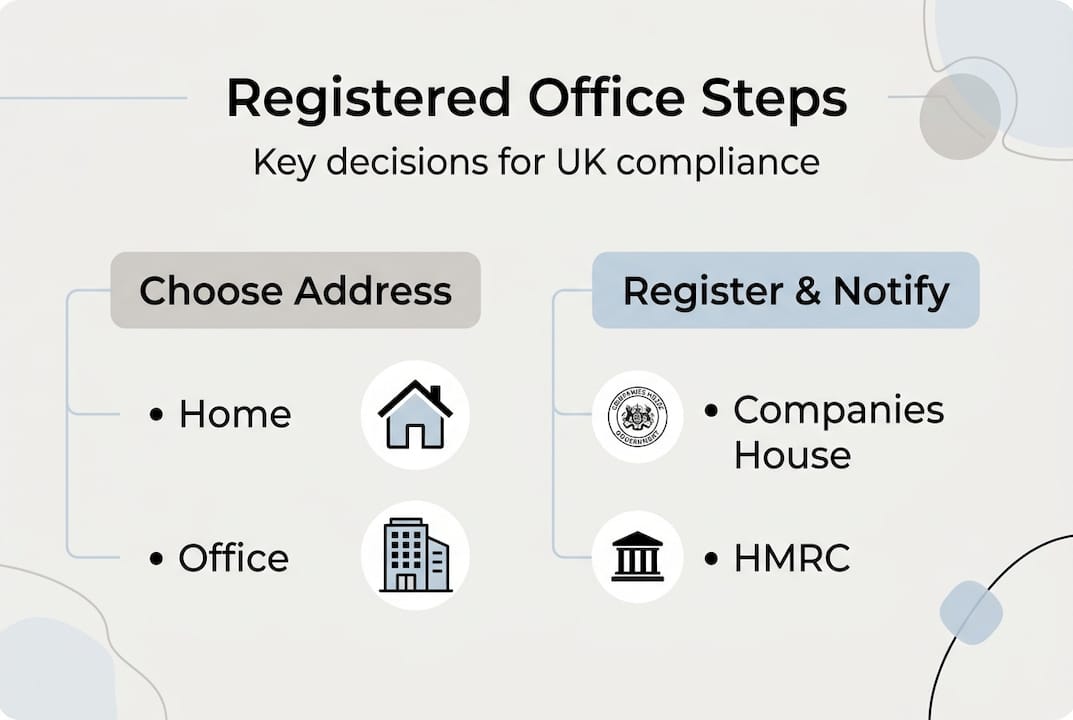
Step 2: Confirm jurisdiction. Your registered office must be in the country where your company was incorporated. An English company cannot use a Scottish address.
Step 3: Register with Companies House. Provide the address on your incorporation documents (form IN01) or update it via the Companies House online portal. There is no fee to change a registered office address.
Step 4: Notify relevant parties. Once changed, inform HMRC, your bank, and any other bodies that use your registered office address for correspondence.
Step 5: Update statutory records. Amend your statutory registers and any company stationery, websites, or documents that display the address.
When appointing a professional address service, confirm they will:
- Accept service of legal documents on your behalf.
- Scan and forward mail promptly, ideally daily.
- Notify you immediately of any urgent correspondence.
The legal standard is clear: an ‘appropriate address’ means documents reach company representatives without delay. Daily services meet this standard far more reliably than ad hoc arrangements.
| Task | Who is responsible | Deadline |
|---|---|---|
| Notify Companies House of change | Director | Immediately on change |
| Update HMRC records | Director or agent | As soon as possible |
| Amend statutory registers | Director or company secretary | Same day as change |
| Update company website and stationery | Director | Within reasonable time |
For further detail on changing your registered office, including the exact forms and processes, the guidance is straightforward once you know what to look for. Keeping your company accounts filing and address details in sync is a simple but powerful habit.
What most business owners overlook about registered offices
After working with hundreds of UK SMEs, we have noticed a consistent pattern. Business owners treat the registered office as a one-time administrative task. They set it up at incorporation, forget about it, and only think about it again when something goes wrong.
The uncomfortable truth is that your registered office is your compliance nerve centre. Every time HMRC wants to reach you formally, every time a creditor issues a claim, every time Companies House sends a reminder, it goes there first. If that address is poorly managed, you are flying blind.
We have seen cases where a single piece of forwarded mail, caught by a diligent professional service, prevented a county court judgement from going undefended. That is not a minor admin win. That is the difference between a manageable dispute and a CCJ on your company’s credit record.
The hidden upside of using a professional address service is credibility. A Leeds or London business address on your public register looks more established than a residential street. For SMEs pitching to larger clients, that detail matters more than people admit.
Think of your registered office not as a box to tick, but as an active part of your detailed compliance steps. Manage it properly and it quietly protects your business every single day.
Streamline compliance with Concorde Company Solutions
Managing your registered office is just one piece of the compliance puzzle, and it is easy to let the details slip when you are focused on running your business.

At Concorde Company Solutions, we support small and medium-sized businesses across the UK with practical, hands-on compliance guidance. From registered office queries to full payroll services and statutory accounts, we help you stay on top of your obligations without the stress. Whether you are just starting out or reviewing your existing setup, our team is ready to help. Visit Concorde Company Solutions to find out how we can support your business with reliable, straightforward compliance support.
Frequently asked questions
Can I use my home address as the registered office?
Yes, UK law permits use of a residential address, but your home address will appear on the public Companies House register and be visible to anyone.
What happens if I miss important mail sent to my registered office?
Missing urgent documents can result in penalties, late filing fines, or even your company being struck off. Over 120,000 companies were struck off in 2024 due to address issues and missed mail.
How can I change my registered office address?
You must notify Companies House and update your statutory registers as soon as your address changes. The update can be made online through the Companies House portal at no cost.
Is it safer to use a professional service for the registered office?
A professional service significantly reduces the risk of missed mail and improves privacy. Daily scanning and forwarding is far preferable to weekly checks when time-sensitive legal notices are involved.
No responses yet