
Managing cash flow feels like juggling flaming torches whilst riding a unicycle. One missed payment, one delayed invoice, and suddenly you’re scrambling to cover payroll or supplier bills. For UK small and medium businesses, effective cash flow management is essential to avoid business failure and maintain operations. Poor cash flow threatens survival more than low profits ever could. This article provides practical, step-by-step guidance to improve your cash flow, from understanding the fundamentals to implementing daily controls that keep your business financially stable and thriving.
Table of Contents
- Understanding Cash Flow And Its Impact On Your Business
- Preparing Your Business For Effective Cash Flow Management
- Step-By-Step Execution: Managing Your Cash Flow Daily And Monthly
- Troubleshooting Common Cash Flow Challenges And Ensuring Ongoing Stability
- Discover Expert Payroll And Cash Flow Support
Key takeaways
| Point | Details |
|---|---|
| Cash flow differs from profit | Your business can be profitable on paper yet fail if cash isn’t available when bills come due. |
| Preparation prevents crises | Setting up budgets, forecasts, and consistent bookkeeping creates visibility and control over your finances. |
| Daily discipline matters | Regular monitoring, prompt invoicing, and expense control keep cash flowing smoothly through your business. |
| Warning signs need action | Spotting late payments or mounting payables early allows corrective steps before problems escalate. |
| Professional support scales results | Expert accounting and payroll services free your time whilst ensuring accuracy and compliance. |
Understanding cash flow and its impact on your business
Cash flow represents the actual movement of money in and out of your business. It’s not the same as profit. You might show a healthy profit on your accounts yet struggle to pay staff wages because customers haven’t paid their invoices. That distinction kills businesses.
UK SMEs face several common cash flow challenges. Customers often take 30, 60, or even 90 days to pay whilst you must cover rent, salaries, and supplier invoices immediately. Seasonal fluctuations hit retail and hospitality particularly hard. Unexpected expenses like equipment repairs arrive without warning. Growth itself drains cash because you’re investing in stock, staff, and infrastructure before new revenue arrives.
The consequences of poor cash flow management are brutal:
- Inability to pay suppliers damages relationships and credit terms
- Missing payroll destroys staff morale and retention
- Late tax payments trigger HMRC penalties and interest charges
- Emergency borrowing at unfavourable rates erodes profitability
- Business closure despite having profitable contracts
Timely budgeting supports predictable cash flow by mapping expected income against planned expenses. When you know what’s coming, you can prepare rather than react. A budget transforms cash flow from a mystery into a manageable process.
Cash flow is the lifeblood of your business. Without it, even the most brilliant business model suffocates.
Many business owners confuse turnover with cash availability. Your sales figures might look impressive, but if that money sits in unpaid invoices whilst your bills demand immediate payment, you’re heading for trouble. Understanding this fundamental truth changes how you operate. You start prioritising collection, managing payment terms, and building cash reserves rather than chasing vanity metrics.
The impact extends beyond survival. Healthy cash flow gives you negotiating power with suppliers, the ability to seize opportunities, and peace of mind. You sleep better knowing payroll is covered and you can invest in growth when the right moment arrives.
Preparing your business for effective cash flow management
Preparation separates businesses that thrive from those that merely survive. Before you can control cash flow, you need systems that show you exactly where you stand financially at any moment.
Start with accurate budgets and forecasts. A budget outlines your planned income and expenses for the coming months. A forecast predicts what will actually happen based on current trends and known factors. Together, they create a roadmap. You’ll spot potential shortfalls weeks in advance, giving you time to arrange finance, delay purchases, or accelerate collections.
Consistent bookkeeping and accurate budgeting directly improve cash flow visibility and control. Without proper records, you’re flying blind. You need to know:
- Exactly who owes you money and when payments are due
- What bills you must pay and their deadlines
- Your current bank balance and available credit
- Historical patterns that predict future cash needs
Choose bookkeeping tools that match your business complexity. Simple spreadsheets work for very small operations, but most SMEs benefit from cloud accounting software like Xero, QuickBooks, or Sage. These platforms automatically categorise transactions, generate reports, and flag overdue invoices.
| Function | Purpose | Frequency |
|---|---|---|
| Budgeting | Plan expected income and costs | Annually, reviewed quarterly |
| Forecasting | Predict actual cash position | Monthly, updated weekly |
| Bookkeeping | Record all financial transactions | Daily or weekly |
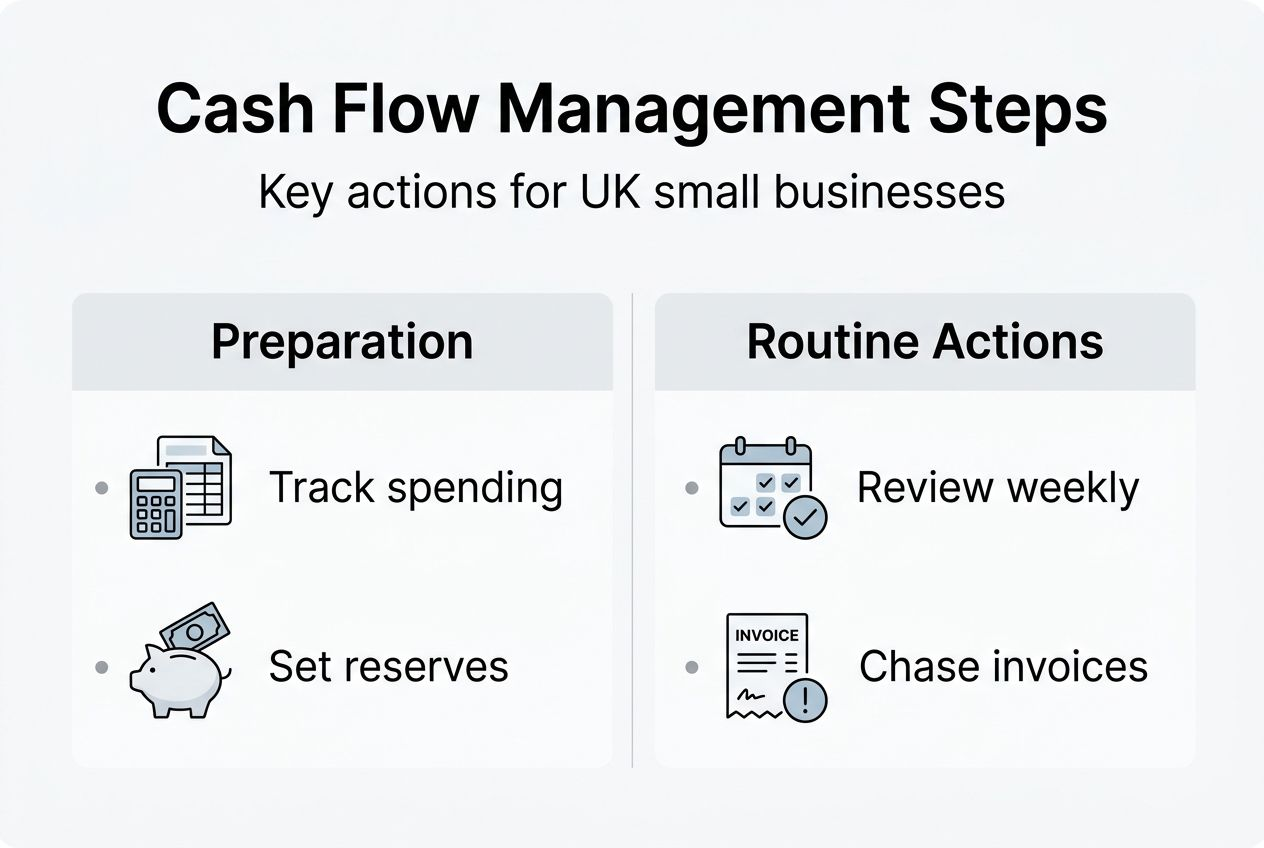
Pro Tip: Set aside 30 minutes every Monday morning to review your cash position for the week ahead. This simple habit prevents surprises and keeps cash flow top of mind.
Your preparation should include building a cash reserve. Aim for three months of operating expenses in an accessible savings account. This buffer protects you during slow periods, covers unexpected costs, and reduces stress. Start small if necessary, setting aside even £100 weekly builds meaningful reserves over time.

Document your payment terms clearly. Decide how long customers have to pay, what deposits you require, and when you’ll chase overdue accounts. Write these policies down and communicate them consistently. Clarity prevents disputes and speeds collections.
Establish relationships with your bank before you need emergency finance. Arrange an overdraft facility or line of credit whilst your business looks healthy. Waiting until you’re desperate weakens your negotiating position and may result in rejection. Banks prefer lending to businesses that plan ahead.
Review your budgeting approach regularly to ensure it reflects current reality. Markets change, costs fluctuate, and customer behaviour shifts. A budget created in January may need adjustment by June. Flexibility within structure gives you the best of both worlds.
Step-by-step execution: managing your cash flow daily and monthly
Preparation means nothing without disciplined execution. Managing cash flow requires consistent daily and monthly actions that become habitual.
Follow these daily cash flow tasks:
- Check your bank balance first thing each morning to spot any unexpected transactions
- Record all income and expenses immediately, not at week’s end when details blur
- Review upcoming payments due within the next seven days
- Send invoices the same day you complete work or deliver products
- Follow up on any invoices now overdue, even if only by one day
Prompt and clear invoicing practices make an enormous difference. Regular monitoring and prompt invoicing reduce delayed payments and improve liquidity. Your invoices should include:
- Clear payment terms stating exactly when payment is due
- Multiple payment methods to remove barriers
- Itemised breakdown so customers understand what they’re paying for
- Your contact details for queries
- Professional appearance that builds trust
Many businesses lose cash flow battles through weak invoicing. Sending invoices late, using vague payment terms like “payment due on receipt,” or making payment difficult all delay your money. Tighten every aspect of your invoicing process.
Monthly tasks require deeper analysis:
- Reconcile all bank accounts and credit cards to catch errors or fraud
- Review aged receivables report to identify problem customers
- Analyse spending patterns to spot cost creep
- Update your cash flow forecast for the next three months
- Calculate key metrics like days sales outstanding and current ratio
- Review supplier terms to ensure you’re maximising payment flexibility
Controlling overhead and variable costs protects cash flow. Overhead includes rent, insurance, subscriptions, and salaries. Review these expenses quarterly. Can you negotiate better terms? Are you paying for services you no longer use? Small savings compound quickly.
Variable costs fluctuate with sales volume. Materials, shipping, and commission fall into this category. Track these carefully because they should scale proportionally with revenue. If variable costs rise faster than sales, your margins erode and cash flow suffers.
Pro Tip: Negotiate payment terms with suppliers that match your customer payment cycles. If customers pay you in 30 days, arrange 45-day terms with suppliers to maintain positive cash flow timing.
Importance of timely payment follow-ups cannot be overstated. Create a collections schedule:
- Send friendly reminder seven days before payment due
- Call personally on the due date if payment hasn’t arrived
- Send formal reminder three days after due date
- Escalate to stronger language at 14 days overdue
- Consider suspending service or involving collection agency at 30 days
Most late payments result from disorganisation, not malice. A polite phone call often triggers immediate payment. Don’t wait weeks hoping money magically appears. The longer an invoice remains unpaid, the less likely you’ll ever collect it.
Consider offering early payment discounts. A 2% discount for payment within seven days costs less than the interest and hassle of chasing late payments. This approach rewards good customers whilst improving your cash position.
Troubleshooting common cash flow challenges and ensuring ongoing stability
Even with solid systems, cash flow problems arise. Recognising warning signs early and knowing corrective actions prevents small issues becoming existential threats.
Common causes of cash flow problems include:
- Overtrading: growing so fast you can’t fund the working capital needed
- Seasonal slumps: predictable slow periods without adequate reserves
- Poor credit control: allowing customers excessive time to pay
- Inventory mismanagement: tying up cash in unsold stock
- Unexpected expenses: equipment failures, legal issues, or regulatory changes
- Owner drawings: extracting too much cash for personal use
Watch for these warning signs:
- Consistently using overdraft or maxing credit cards
- Paying suppliers late or requesting extended terms
- Struggling to make payroll on time
- Declining bank balance despite sales growth
- Increasing time between invoice and payment
- Avoiding opening post or checking bank balance
When problems emerge, you have options. This comparison helps you choose:
| Solution | Advantages | Disadvantages | Best For |
|---|---|---|---|
| Short-term finance | Quick access to funds, preserves relationships | Interest costs, requires approval | Temporary gaps with clear recovery path |
| Cost cutting | Immediate impact, no debt | May harm service quality or growth | Structural overspending issues |
| Accelerate collections | Uses existing assets, no cost | Requires customer cooperation | Slow-paying customers with good relationships |
| Delay payments | Preserves cash immediately | Damages supplier relationships, may incur fees | Emergency situations only |
Proactive problem solving and financial monitoring prevent cash flow crises and sustain long-term business viability. The key is acting before you’re desperate. If you spot a potential shortfall three months ahead, you have options. If you ignore it until the day payroll bounces, you’re in crisis mode.
When should you seek professional help? Consider expert support when:
- Cash flow problems persist despite your efforts
- You lack time or expertise to maintain proper records
- Growth is accelerating and you need sophisticated forecasting
- You’re planning significant investments or expansion
- Tax planning could significantly improve cash retention
Professional accountants bring objectivity and experience. They’ve seen your challenges before and know solutions that work. The cost of professional services often pays for itself through improved efficiency, tax savings, and avoided penalties.
Maintaining long-term cash flow health requires continuous improvement. Review your processes quarterly. What worked six months ago may need adjustment as your business evolves. Stay curious about better tools, techniques, and strategies.
The businesses that thrive don’t just react to cash flow problems. They build systems that prevent problems from occurring in the first place.
Build cash flow awareness throughout your team. Train staff on how their actions affect cash flow. Sales teams should understand payment terms. Operations should minimise waste. Everyone should appreciate that revenue means nothing until cash arrives in the bank.
Develop scenario plans for different cash flow situations. What would you do if your largest customer went bust? How would you handle a three-month sales slump? Having answers prepared reduces panic and speeds response when challenges arise.
Celebrate improvements. When you reduce days sales outstanding or build your cash reserve, acknowledge the achievement. Positive reinforcement builds the habits that sustain healthy cash flow over years.
Discover expert payroll and cash flow support
Managing cash flow independently builds valuable skills and understanding. But professional support amplifies your results whilst freeing your time for revenue-generating activities.
Effective payroll management directly impacts cash flow stability. Errors create costly corrections, penalties drain resources, and manual processing consumes hours better spent on customers. Payroll services from Concorde Company ensure accuracy, compliance, and efficiency. You’ll know exactly when payroll costs hit your bank account, making cash flow forecasting more reliable.

Concorde Company Solutions provides comprehensive financial services tailored for UK small and medium businesses. From bookkeeping and statutory accounts to tax returns and software setup, we handle the technical complexity whilst you focus on growing your business. Our transparent pricing and personalised support mean you get expert help without surprises.
When your financial foundations are solid, cash flow management becomes straightforward rather than stressful. Explore how Concorde Company Solutions can support your business’s financial health and long-term success.
FAQ
What are the first steps to improve cash flow in a small business?
Start by tracking every penny coming in and going out for at least one month to understand your actual cash patterns. Then create a realistic budget based on this data, not wishful thinking. These two steps provide the visibility needed for all other improvements.
How can UK small businesses forecast cash flow effectively?
Combine your historical transaction data with projected sales and known expenses using spreadsheet tools or accounting software. Update your forecast weekly as new information emerges, adjusting for seasonal patterns and upcoming changes. Strong bookkeeping practices provide the accurate historical data that makes forecasts reliable rather than guesswork.
What common mistakes should be avoided in cash flow management?
Ignoring regular monitoring allows small problems to become crises before you notice them. Delayed invoicing gives customers implicit permission to pay slowly, worsening your cash position. Poor budgeting means you’re surprised by predictable expenses like tax bills or insurance renewals, creating unnecessary cash crunches.
How quickly should I follow up on overdue invoices?
Contact customers on the payment due date if money hasn’t arrived, not weeks later. Early, friendly follow-up normalises prompt payment and catches genuine oversights before they become habits. Waiting suggests you don’t need the money urgently, encouraging customers to prioritise other creditors.
No responses yet