
TL;DR:
- HMRC conducts compliance checks to verify correct tax payments and not as criminal investigations.
- Proper preparation, open communication, and professional advice help resolve checks without significant penalties.
- Voluntary disclosure of errors and digital record-keeping reduce penalty exposure and support audit outcomes.
Receiving a letter from HMRC announcing a compliance check can stop a business owner in their tracks. The instinct is to panic, but that reaction rarely helps. The good news is that most SMEs that prepare properly, keep clean records, and engage openly with HMRC come through compliance checks without significant penalties. This guide walks you through exactly what to expect, what documents to gather, how to handle mistakes, and why professional support makes a genuine difference. Follow these steps and you will approach your audit with confidence rather than dread.
Table of Contents
- Understanding HMRC audits: What to expect
- What HMRC looks for: Records, red flags and risk areas
- Step-by-step: How to prepare for your HMRC audit
- Fixing mistakes and handling tough scenarios
- A practical perspective: Why preparation beats panic
- Get professional support for your HMRC audit
- Frequently asked questions
Key Takeaways
| Point | Details |
|---|---|
| Preparation minimises penalties | Timely organisation and disclosure can significantly reduce or even avoid HMRC penalties. |
| Digital records matter most | Keeping accurate, digital records and consulting professionals ensures a smoother compliance check process. |
| Cooperation builds trust | Working openly with HMRC and correcting genuine errors is almost always better than delay or concealment. |
| Act on notice quickly | Start preparing within 24 hours of an HMRC notice to keep control and minimise risks. |
Understanding HMRC audits: What to expect
First, a clarification on terminology. HMRC no longer uses the word “audit” in its official communications. Instead, the process is called a compliance check, designed to verify that a business has paid the correct amount of tax and made accurate claims. The distinction matters because it signals intent: HMRC is checking compliance, not automatically assuming wrongdoing.
When HMRC selects your business for a check, you will receive a formal letter. That letter specifies the scope of the review, the tax years under scrutiny, and the exact records you need to provide. You will not be ambushed. The official HMRC compliance checks guidance confirms that businesses are notified in advance, with the letter detailing both the scope and the required information.
Compliance checks generally fall into two categories:
- Desk checks: Conducted remotely, usually involving a written or digital exchange of documents.
- Field checks: An HMRC officer visits your premises to examine records directly.
The scope can be narrow (a single VAT return) or wide (a full review of several tax years). Common reasons for selection include:
- Inconsistencies between your tax returns and third-party data HMRC holds
- Unusually high expense claims relative to turnover
- Operating in a high-risk sector such as hospitality or construction
- Random selection as part of HMRC’s risk-profiling programme
- Significant changes in reported income from one year to the next
Once you receive the notice, HMRC typically expects an initial response within 30 days. Use our HMRC requirements guide to understand what records you are legally obliged to keep and for how long. Getting familiar with preventing tax losses before a notice arrives is even better.
“A compliance check is not a criminal investigation. It is an administrative process, and most businesses that engage honestly and promptly resolve the matter without penalties.”
| Stage | What happens | Typical timeframe |
|---|---|---|
| Notification | Letter received specifying scope | Day 1 |
| Initial response | Acknowledge and begin gathering records | Within 30 days |
| Document submission | Provide requested records | As specified |
| HMRC review | Officer analyses documents | 4 to 12 weeks |
| Resolution | Closure letter or further queries | Variable |
What HMRC looks for: Records, red flags and risk areas
Knowing what HMRC examines is half the battle. Officers are trained to spot patterns, inconsistencies, and gaps. Understanding what HMRC compliance means for your specific business type helps you identify vulnerabilities before an officer does.
HMRC will typically request some or all of the following:
- Financial records: Bank statements, profit and loss accounts, balance sheets
- VAT records: VAT returns, sales and purchase ledgers, invoices
- Payroll records: PAYE submissions, employee records, expenses paid through payroll
- Expense claims: Receipts, mileage logs, director loan accounts
- Sales records: Till receipts, contracts, online sales data
The small business tax gap research published by HMRC reveals that small businesses contribute roughly 60% of the total tax gap, which stood at £23.9 billion in 2022 to 2023. HMRC’s compliance yield in Q3 of 2025 to 2026 alone reached £8.6 billion. These figures explain why HMRC invests heavily in SME compliance activity.
Penalties are not fixed. They scale according to behaviour:
| Behaviour | Penalty range | Effect of disclosure |
|---|---|---|
| Careless error | 0% to 30% | Significantly reduced |
| Deliberate error | 20% to 70% | Reduced with cooperation |
| Deliberate and concealed | 30% to 100% | Reduced but remains high |
Switching to digital VAT records significantly reduces the risk of the kind of arithmetic errors that trigger queries. Consistent digital tax submission also creates an auditable trail that supports your position during a check.
Red flags that attract HMRC attention include:
- VAT returns that fluctuate sharply without a clear business reason
- Expense claims that grow faster than turnover
- High volumes of cash transactions with limited supporting records
- Director loan accounts that are regularly overdrawn
Pro Tip: Review your last three years of returns yourself before HMRC does. Spot anomalies early and you can address them proactively rather than reactively.
Step-by-step: How to prepare for your HMRC audit
Preparation is not a one-day job, but it is manageable if you work through it methodically. Here is a practical sequence to follow from the moment you receive your compliance check notice.
- Read the letter carefully. Identify the exact tax years, the taxes under review, and the specific information requested. Do not assume the scope is broader than stated.
- Contact a professional adviser immediately. An accountant or tax adviser who understands their compliance role can guide your response strategy from day one. This single step reduces risk more than any other.
- Acknowledge the notice in writing. Respond to HMRC within the stated timeframe, even if only to confirm receipt and request an extension if needed.
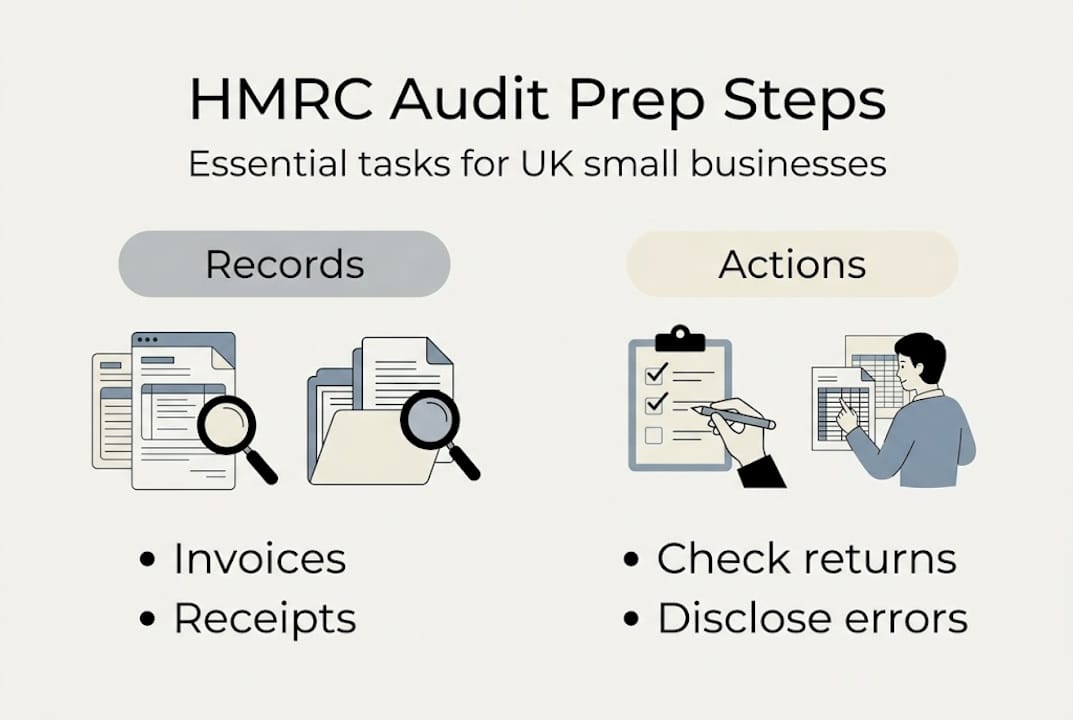
- Collate your financial records. Gather bank statements, invoices, payroll records, VAT returns, and expense receipts for every year under review.
- Ensure records are digital and accessible. HMRC officers prefer digital records. Disorganised paper files create delays and raise questions about record-keeping standards.
- Review for errors before submission. Check for discrepancies between your records and the returns already filed. If you find mistakes, disclose them proactively.
- Prepare a clear summary document. A brief overview of your business structure, accounting methods, and any unusual transactions helps HMRC officers understand context quickly.
The official guidance on handling compliance checks reinforces that digital records and professional advice are the two most effective tools for SMEs facing desk or field checks. Honesty in disclosure builds trust and reduces penalties.

Good tax planning with accountants throughout the year means you are rarely scrambling when a notice arrives. The benefits of professional taxation support for SMEs extend well beyond filing: they include audit readiness.
Pro Tip: Full upfront disclosure of any errors you find cuts your penalty exposure and signals good faith to HMRC. Officers note cooperation, and it genuinely matters to the outcome.
Fixing mistakes and handling tough scenarios
Not every compliance check is straightforward. Sometimes errors surface during preparation, and sometimes those errors are complicated. Knowing how to handle them protects your business.
If you discover a mistake before or during the check, disclose it voluntarily. Voluntary disclosure consistently results in lower penalties than errors HMRC uncovers independently. The difference can be substantial across all penalty bands.
Some scenarios require particular care:
- Repeated errors: HMRC may reclassify repeated careless mistakes as deliberate behaviour. This matters enormously because deliberate errors trigger a 20-year lookback period, compared to just 6 years for careless errors.
- Agent-made errors: If your accountant or bookkeeper made the mistake, HMRC can still hold you liable. You are responsible for the accuracy of your returns, regardless of who prepared them.
- Concealed errors: These carry the highest penalties, between 30% and 100% of lost revenue, and are the hardest to reduce even with cooperation.
“Voluntary disclosure before HMRC raises an issue is the single most effective way to reduce penalty exposure. Waiting to be caught is always the more expensive choice.”
Practical steps in difficult cases:
- Engage a specialist tax adviser, not just your regular bookkeeper
- Request a meeting with HMRC to discuss the position openly
- Submit a full disclosure document outlining what went wrong and why
- Pay any underpaid tax as quickly as possible to limit interest charges
Staying tax compliant throughout the year is far less costly than managing a penalty dispute. Working with an adviser on proactive tax planning creates a paper trail that supports your position if HMRC ever questions a decision.
Pro Tip: In edge cases involving repeated errors or agent liability, seek specialist advice before responding to HMRC. Your first response sets the tone for the entire process.
A practical perspective: Why preparation beats panic
Here is something most articles on this topic do not say plainly enough: HMRC compliance checks are not designed to punish honest businesses. They exist to close a tax gap that is largely driven by genuine errors, not deliberate evasion. The vast majority of checks that involve cooperative, well-prepared businesses close without significant penalties.
The real danger is not the audit itself. It is the business owner who ignores the letter, hides the problem, or tries to bluff their way through without professional support. That approach consistently produces the worst outcomes.
Preparation gives you something more valuable than just tidy paperwork. It gives you confidence. When you know your records are accurate and your adviser is briefed, the process becomes manageable rather than catastrophic. Proactive compliance, including regular reviews and HMRC compliance prevention, costs a fraction of what reactive crisis management demands. Think of audit readiness not as a burden but as a standard of professionalism that protects your business year-round.
Get professional support for your HMRC audit
Preparation is everything, but you do not have to do it alone.

At Concorde Company Solutions, we support SMEs across the UK with compliance documentation, payroll management, and audit preparation. Our team understands what HMRC looks for and how to present your records in the clearest, most favourable light. Whether you need help organising years of records or want an expert to liaise with HMRC on your behalf, we are here. Our full payroll support service also ensures your payroll records are audit-ready throughout the year, not just when a letter arrives. Get in touch today to find out how we can help.
Frequently asked questions
How much notice do I get before an HMRC audit?
HMRC provides advance notice by letter, specifying what records are required and the exact areas being checked. You will not be contacted without warning, and the letter will clearly state the scope of the compliance check.
What triggers an HMRC audit for small businesses?
Triggers include inconsistent returns, large cash transactions, rapid business growth, or random selection. Small businesses account for approximately 60% of the UK tax gap, which is why HMRC focuses significant compliance resource on this sector.
What are the penalties if HMRC finds mistakes?
Penalties range from 0 to 30% for careless errors up to 30 to 100% for concealed errors, but cooperation and disclosure reduce the amount owed in every category.
Can honest mistakes still lead to penalties during an audit?
Yes, but penalties for genuine errors are usually lower and may be waived if you cooperate fully. Most checks resolve without penalties when the business engages openly and corrects errors promptly.
Do I need an accountant for an HMRC audit?
Professional advice is strongly recommended, particularly for complex or historical queries. Digital records and professional advice are the two most effective tools for handling compliance checks efficiently and reducing penalty risk.
No responses yet