
HMRC’s upstream prevention activities stopped more than £19 billion in potential tax losses before they happened in 2024-25, accounting for 41% of its total compliance yield. For UK small and medium businesses, this signals a shift towards proactive enforcement using AI, data analytics, and digital mandates. Understanding these changes is critical to avoiding penalties and managing tax obligations efficiently.
Table of Contents
- Key HMRC Compliance Changes And Deadlines For 2025-26
- Making Tax Digital: What Small Businesses Must Know
- How HMRC Detects Non-Compliance: AI, Data Analytics, And Risk Focus
- Common Misconceptions About HMRC Compliance And Penalties
- Practical Guide To Using Allowances And Reliefs To Reduce Tax Liability
- Preparing For HMRC Audits And Managing Compliance Risk
- Summary And Next Steps For Small Businesses
- How Concorde Company Solutions Supports Your HMRC Compliance
Key Takeaways
| Point | Details |
|---|---|
| Compliance yield | HMRC’s compliance yield reached £48 billion in 2024-25, with 41% from upstream prevention activities. |
| Making Tax Digital | MTD expands to Income Tax reporting from April 2026, starting with businesses earning over £50,000. |
| AI detection | HMRC uses AI analyzing over 30 data sources to detect non-compliance and trigger targeted audits. |
| Common misconceptions | Beliefs about leniency and minor errors significantly increase penalty risks for small businesses. |
| Proactive compliance | Using allowances correctly, maintaining accurate digital records, and responding promptly reduces penalties. |
Introduction to HMRC Compliance and Its Importance for SMEs
HMRC compliance means meeting all tax obligations set by Her Majesty’s Revenue and Customs, including accurate VAT returns, Income Tax self-assessment, Corporation Tax filings, and payroll reporting. For UK SMEs, compliance has never been more demanding or strictly enforced than in 2026.
HMRC’s compliance yield reached £48 billion, reflecting intensified enforcement focused on preventing non-compliance upstream rather than simply correcting errors after the fact. HMRC has expanded audit capacity, increased compliance officers targeting SMEs specifically, and introduced stricter penalty regimes. The shift to digital reporting through Making Tax Digital (MTD) adds another layer of complexity, requiring businesses to adopt new software and processes.
Non-compliance carries serious consequences. Fines accumulate quickly, interest charges compound daily on late payments, and audits can disrupt operations for months. Reputational damage from public HMRC investigations can erode client trust and damage business relationships. Understanding why tax compliance matters for UK businesses is fundamental to long-term sustainability.
Common compliance challenges SMEs face include:
- Navigating complex and frequently changing tax rules and thresholds
- Transitioning to digital reporting systems and choosing appropriate software
- Maintaining accurate records across multiple tax obligations and deadlines
- Managing cashflow to meet tax deadlines for 2025 UK businesses without penalties
- Understanding which reliefs and allowances apply to your specific business structure
Proactive compliance reduces risk, protects cashflow, and positions your business to benefit from legitimate tax reliefs. Professional guidance from firms offering benefits of professional taxation for SMEs can transform compliance from a burden into a strategic advantage. For detailed analysis of HMRC’s enforcement approach, review the State of Tax Administration 2025 report.
Key HMRC Compliance Changes and Deadlines for 2025-26
2025-26 represents a pivotal compliance period with substantial regulatory, tax, and digital changes affecting UK SMEs. Understanding these updates and their deadlines is essential to avoiding penalties and maintaining good standing with HMRC.
HMRC increased Employment Allowance and adjusted National Insurance thresholds, directly impacting small business payroll costs and compliance calculations in 2025. The Employment Allowance rose, reducing employer National Insurance liability for eligible businesses. However, the Late Payment Interest Rate also increased, making delayed payments significantly more expensive than in previous years.
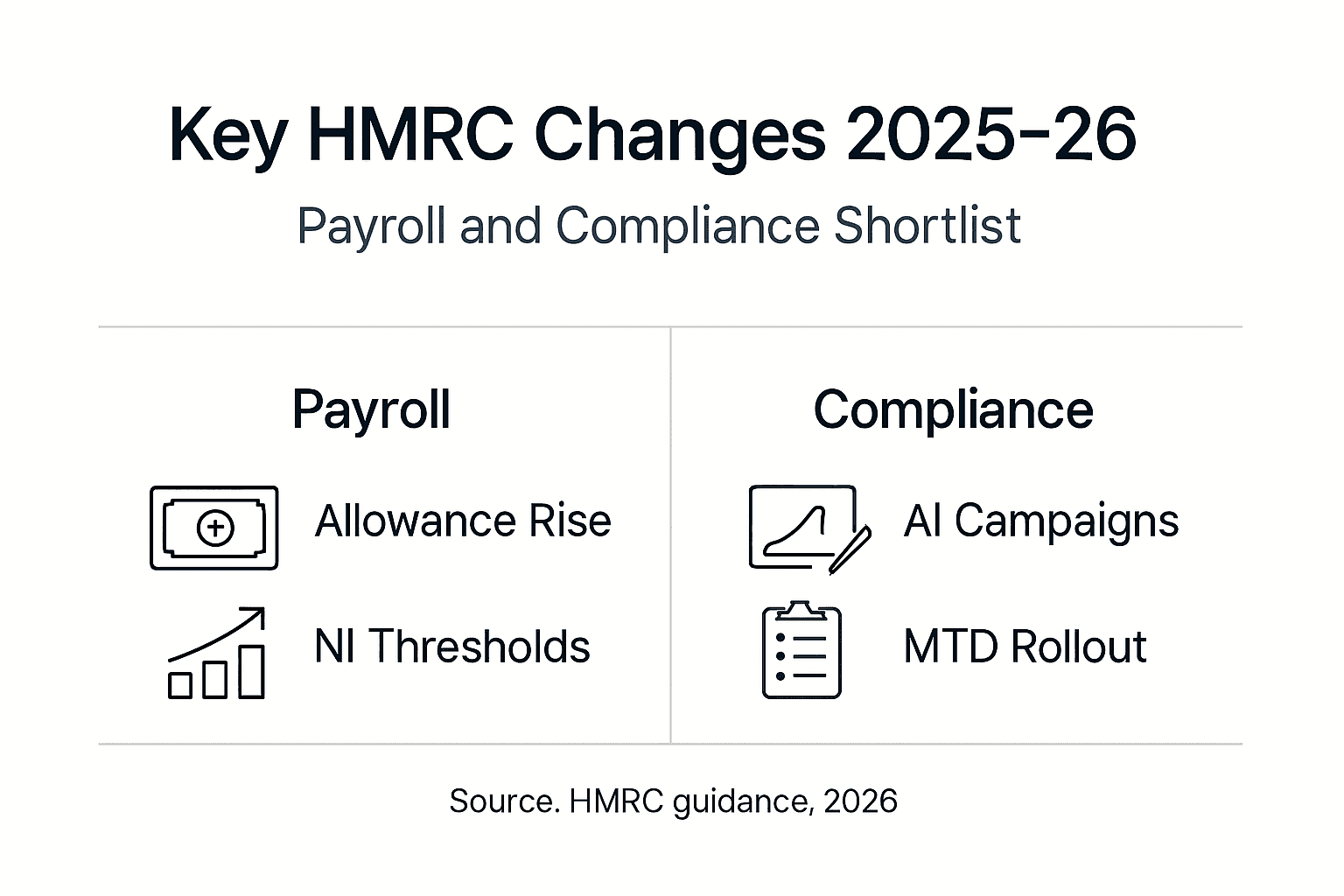
Making Tax Digital expansion continues its phased rollout. VAT-registered businesses have been submitting digital returns since 2019, but MTD for Income Tax begins in April 2026 for sole traders and landlords with income above £50,000. This threshold will eventually lower, capturing more SMEs. The digital mandate requires HMRC-approved software, quarterly updates, and end-of-period statements.
HMRC’s one-to-many (OTM) compliance campaigns have intensified. These campaigns use AI to identify businesses with specific compliance patterns and send standardized letters prompting voluntary disclosure. Response rates are closely monitored, and non-responders face increased audit risk.
| Compliance Change | Effective Date | Key Action Required |
|---|---|---|
| Employment Allowance increase | April 2025 | Review payroll calculations and claim updated allowance |
| Late Payment Interest Rate rise | January 2025 | Prioritize timely payments to avoid higher interest charges |
| MTD for Income Tax (£50k+ threshold) | April 2026 | Adopt HMRC-approved software and test quarterly reporting |
| Increased OTM campaigns | Ongoing 2025-26 | Monitor HMRC correspondence and respond promptly |
| Additional compliance officers | Throughout 2025 | Ensure records are audit-ready and complete |
SMEs should take these steps immediately:
- Review your current accounting software against HMRC’s approved list for MTD compatibility
- Update payroll systems to reflect new National Insurance thresholds and Employment Allowance
- Set automated reminders for critical tax deadlines for UK businesses in 2025
- Audit your record-keeping practices to ensure they meet digital reporting standards
- Budget for potential software upgrades and training costs associated with MTD transition
Understanding the digital tax submission impact helps you plan technology investments strategically. Staying informed about tax trends for 2025 positions your business ahead of competitors. For comprehensive details on HMRC’s enforcement priorities, consult the HMRC compliance activity report 2025.
Making Tax Digital: What Small Businesses Must Know
Making Tax Digital represents the most significant administrative change to UK tax reporting in decades. Understanding MTD requirements, benefits, and preparation steps is essential for smooth compliance.
MTD for VAT became mandatory for VAT-registered businesses with taxable turnover above the VAT threshold in 2019. Businesses must now keep digital records and submit returns using MTD-compatible software. The phased rollout of MTD for Income Tax starts April 2026, initially applying to sole traders and landlords with annual business or property income exceeding £50,000. This threshold will reduce over time, eventually capturing most self-employed individuals.
Digital reporting offers tangible benefits. Accuracy improves because calculations happen automatically within the software, reducing manual transcription errors. Real-time data gives you immediate visibility into your tax position throughout the year, not just at filing time. Automated record-keeping reduces the administrative burden of maintaining paper records and manual spreadsheets.
Challenges exist. Software costs vary widely, from free basic packages to comprehensive systems costing hundreds monthly. The learning curve can be steep, particularly for businesses transitioning from paper-based or basic spreadsheet systems. Integrating digital tax software with existing accounting, invoicing, and banking systems requires careful planning and sometimes technical support.
To prepare for MTD compliance, follow these steps:
- Determine your MTD start date based on your business structure and income thresholds.
- Research and select HMRC-approved software that matches your business needs and budget.
- Migrate your historical records into the digital system well before your mandatory start date.
- Train yourself and relevant staff on software features, quarterly reporting cycles, and data validation.
- Test the entire process with a practice submission to identify and resolve technical issues early.
- Establish backup and security protocols to protect your digital records and meet HMRC retention requirements.
Pro Tip: Choose HMRC-approved software at least three months before your MTD start date. This allows adequate time for staff training, data migration, and troubleshooting without the pressure of an imminent deadline.
Understanding the impact of digital tax submission for UK businesses helps you select appropriate technology and processes. Following tax return tips for small businesses 2025 ensures your digital submissions are accurate and complete from the start.
How HMRC Detects Non-Compliance: AI, Data Analytics, and Risk Focus
HMRC’s enforcement capabilities have evolved dramatically. Understanding detection mechanisms helps you recognize and address compliance risks before they trigger audits or penalties.

HMRC uses AI systems analyzing over 30 data sources to identify discrepancies and non-compliance patterns. These systems cross-reference VAT returns against bank transactions, payroll data against pension contributions, and self-assessment income against third-party reporting from clients and suppliers. Advanced algorithms flag anomalies that would be impossible to detect manually.
One-to-many (OTM) letter campaigns represent a cost-effective compliance tool. HMRC identifies businesses sharing specific compliance patterns, such as claiming unusually high expense ratios or reporting income inconsistent with industry norms. Standardized letters prompt voluntary disclosure and correction. Businesses that respond positively may avoid formal investigation, while non-responders face escalated scrutiny.
Typical triggers HMRC’s systems flag include:
- Small mathematical errors that compound across multiple reporting periods
- Income reported to HMRC by third parties that doesn’t appear in your returns
- Expenses that exceed typical ratios for your industry or business size
- Late filing patterns that suggest systemic record-keeping problems
- Inconsistencies between different tax submissions (VAT vs. Corporation Tax vs. PAYE)
HMRC has significantly increased compliance personnel targeting SMEs specifically. Additional officers focus on businesses previously considered too small for intensive investigation. This shift reflects recognition that the cumulative tax gap from many small businesses exceeds losses from a few large corporations.
“HMRC’s investment in AI and data analytics has transformed compliance from reactive correction to proactive prevention, enabling detection of discrepancies that would have gone unnoticed just five years ago.”
Understanding why tax compliance matters becomes clearer when you recognize how sophisticated detection has become. Following tax return tips UK small businesses helps ensure your submissions align with HMRC expectations. For detailed insight into enforcement priorities, review the HMRC compliance activity report 2025.
Common Misconceptions About HMRC Compliance and Penalties
Widespread misunderstandings create false security and increase penalty risk among small businesses. Correcting these misconceptions helps you understand true compliance risks realistically.
Many business owners believe small bookkeeping errors won’t trigger penalties. The reality is different. HMRC’s 91% conviction rate in criminal tax cases in 2025 demonstrates serious consequences even for errors some might consider minor. While not every mistake leads to prosecution, patterns of small errors often trigger audits that uncover larger issues.
Another common myth suggests HMRC shows leniency on late filing and payment, particularly for first-time offenders. Following the Late Payment Interest Rate increase in January 2025, delayed payments become expensive quickly. Interest compounds daily, and automatic penalties apply regardless of your compliance history. Leniency programs exist but require proactive engagement, not passive hope.
Some business owners assume HMRC mainly targets large companies and high earners. The truth: HMRC has substantially increased audit personnel focusing specifically on small and medium businesses. SMEs now face rising compliance scrutiny because collective tax gaps from many small businesses represent substantial revenue. You are no longer flying under the radar simply because you’re small.
Misunderstandings about allowances and reliefs lead to missed tax benefits. Many eligible businesses fail to claim Marriage Allowance, Rent-a-Room relief, or Trading Allowance simply because they don’t know these exist or don’t understand eligibility criteria. This results in overpaying tax while simultaneously increasing audit risk by appearing to ignore available legitimate deductions.
Common misconceptions and corrections:
- Misconception: “HMRC won’t notice if I’m a few days late.” Reality: Automatic penalties apply immediately after deadlines with no grace period.
- Misconception: “Small calculation errors are harmless.” Reality: Patterns of errors trigger AI flags and increase audit probability significantly.
- Misconception: “Professional help is only for big companies.” Reality: Professional support prevents costly mistakes and often pays for itself through legitimate tax savings.
- Misconception: “Digital records are optional if I keep paper backups.” Reality: MTD mandates digital record-keeping; paper alone won’t satisfy requirements from April 2026.
- Misconception: “I can ignore HMRC letters if I disagree.” Reality: Ignoring correspondence escalates investigations and eliminates opportunities for favorable resolution.
Pro Tip: Review current HMRC penalty policies every January to understand changes before tax year planning. Policies evolve frequently, and assumptions from previous years may no longer apply.
Understanding why tax compliance matters helps dispel dangerous myths. Following the small business tax deadline guide ensures you never fall victim to the “a few days late won’t matter” misconception.
Practical Guide to Using Allowances and Reliefs to Reduce Tax Liability
Legitimate allowances and reliefs reduce your tax liability while demonstrating compliance with HMRC expectations. Understanding and properly claiming these benefits optimizes your tax position legally.
Key allowances available to UK SMEs include Marriage Allowance, which allows transfer of unused personal allowance between spouses, potentially saving up to £252 annually. Rent-a-Room relief permits earning up to £7,500 tax-free from letting furnished accommodation in your home. Trading Allowance provides £1,000 tax-free for casual self-employment or miscellaneous income, simplifying reporting for small side income.
Gift Aid donations and pension contributions directly lower taxable income. Gift Aid allows charities to reclaim basic rate tax on your donations, and higher-rate taxpayers claim additional relief through their tax return. Pension contributions receive tax relief at your marginal rate, reducing current tax liability while building retirement savings.
| Allowance/Relief | Eligibility | Maximum Benefit | Key Requirement |
|---|---|---|---|
| Marriage Allowance | Married/civil partners, one earning below personal allowance | Up to £252/year | Formal transfer election required |
| Rent-a-Room | Letting furnished accommodation in your only/main home | £7,500 tax-free | Must not exceed threshold |
| Trading Allowance | Casual self-employment or miscellaneous income | £1,000 tax-free | Cannot also deduct expenses |
| Gift Aid | UK taxpayer making charitable donations | Tax relief at marginal rate | Must have paid sufficient tax |
| Pension Contributions | Anyone with UK earnings | Relief at marginal rate | Subject to annual/lifetime allowances |
Bookkeeping tips for claiming allowances properly:
- Document eligibility clearly with supporting evidence (marriage certificates, rental agreements, donation receipts)
- Track threshold limits throughout the tax year to avoid exceeding caps that disqualify relief
- Separate personal and business finances completely to simplify allowance calculations
- Record allowance claims in your tax software exactly as HMRC requires on official forms
- Retain supporting documentation for at least six years to satisfy potential audit requests
Incorporating reliefs during filings prevents lost opportunities. Many allowances must be claimed actively; HMRC won’t automatically apply them even if you’re eligible. Correct claims reduce compliance risk by aligning your tax position with HMRC expectations and demonstrating thorough understanding of available benefits.
Exploring tax return tips 2025 helps you identify additional legitimate deductions. Firms offering professional taxation benefits can review your specific circumstances and maximize available reliefs you might otherwise miss.
Preparing for HMRC Audits and Managing Compliance Risk
Proactive preparation for potential audits and systematic compliance risk management protect your business from penalties and operational disruption.
Accurate, up-to-date record-keeping forms the foundation of audit readiness. Maintain complete records of all income, expenses, invoices, receipts, and financial transactions. Separate personal and business finances completely using dedicated bank accounts and credit cards. This separation simplifies record-keeping and demonstrates professionalism during audits.
Audit preparation steps:
- Organize all financial records chronologically and by category (income, expenses, payroll, VAT) for easy retrieval.
- Ensure your accounting software produces reports matching HMRC requirements and expectations.
- Review past returns for potential errors or inconsistencies that might trigger questions.
- Respond promptly to all HMRC correspondence, even informal inquiries, within stated deadlines.
- Engage professional advisors early when you receive audit notifications or compliance letters.
- Prepare clear explanations for any unusual transactions, high expense claims, or industry-specific practices.
Late or incorrect payments trigger penalties and interest that compound quickly. Daily interest charges accumulate from the original payment deadline, not from when HMRC identifies the shortfall. Penalties for late submission add another layer of cost, particularly for repeated offenses. Understanding penalty structures helps you prioritize compliance actions effectively.
Pro Tip: Establish automated alerts and reminders within your bookkeeping software for all tax deadlines, quarterly MTD submissions, and HMRC correspondence response dates. Automated systems prevent costly oversights during busy periods.
Early professional advice mitigates risks substantially. Accountants familiar with HMRC procedures can clarify tax positions, identify potential issues before they become problems, and negotiate favorable outcomes when discrepancies arise. Voluntary disclosure of errors typically results in reduced penalties compared to HMRC discovering issues through audits.
Handle HMRC contact calmly and professionally. Respond to letters and calls promptly, provide requested information completely, and maintain respectful communication even if you disagree with HMRC’s position. Cooperative engagement demonstrates good faith and often leads to more favorable resolutions than adversarial approaches.
Learning how to prepare tax return UK establishes practices that naturally support audit readiness. Accessing professional taxation benefits for SMEs provides expert guidance that transforms compliance from reactive crisis management to proactive risk control.
Summary and Next Steps for Small Businesses
HMRC compliance in 2026 demands proactive engagement with new rules, digital systems, and intensified enforcement. Understanding key changes positions your business to avoid penalties and optimize tax management.
Major compliance developments include HMRC’s £48 billion compliance yield reflecting upstream prevention focus, Making Tax Digital expansion to Income Tax from April 2026, AI-powered detection analyzing over 30 data sources, and increased audit personnel targeting SMEs specifically. These changes create both challenges and opportunities for well-prepared businesses.
Your compliance checklist:
- Review and implement all regulatory updates affecting your business structure and industry
- Adopt HMRC-approved digital software and complete MTD readiness testing before mandatory deadlines
- Establish systematic record-keeping practices meeting digital retention and accuracy standards
- Prepare audit-ready documentation and response procedures for potential HMRC inquiries
- Schedule regular reviews of available allowances and reliefs to maximize legitimate tax savings
- Set automated deadline reminders and maintain prompt HMRC correspondence response protocols
Professional support and digital tools represent critical resources. Accountants provide expert interpretation of complex rules, strategic tax planning, and efficient compliance processes. Modern software automates calculations, tracks deadlines, and produces HMRC-compliant reports, freeing your time for core business activities.
Early action reduces costly penalties and streamlines tax management. Businesses that wait until deadlines approach face rushed decisions, limited options, and higher error rates. Starting preparation now, particularly for April 2026 MTD requirements, ensures smooth transitions and confident compliance.
Staying informed about tax deadlines 2025 and accessing professional taxation support transforms compliance from burden to competitive advantage.
How Concorde Company Solutions Supports Your HMRC Compliance
Navigating 2026’s complex compliance landscape requires expert guidance and systematic processes. Concorde Company Solutions provides tailored accounting and payroll services that simplify HMRC compliance for UK SMEs.
Our bespoke accounting support for SMEs ensures accurate tax management aligned with current regulations. We handle statutory accounts, company tax returns, and compliance reporting, freeing you to focus on growing your business. Our team stays current with every regulatory change, so you don’t miss critical updates or deadlines.

Our payroll management and compliance solutions reflect the latest National Insurance thresholds and Employment Allowance changes introduced in 2025. We calculate accurate payroll, submit RTI returns on time, and ensure your business benefits from all available allowances. Expert guidance helps you navigate Making Tax Digital requirements and respond effectively to HMRC correspondence, reducing audit risk and penalty exposure.
We take a partnership approach, building long-term relationships based on transparency and responsiveness. Whether you need comprehensive tax return support for UK SMEs or specialized advice on specific compliance challenges, our team provides personalized solutions that fit your business needs and budget. Contact us today to discuss how we can help you stay ahead of evolving tax regulations while reducing compliance costs and risks.
FAQ
What happens if I miss an HMRC deadline in 2026?
Missing an HMRC deadline triggers automatic penalties and daily interest charges from the original deadline. Penalties vary by tax type and how late you are, but they accumulate quickly. Prompt voluntary disclosure after realizing a missed deadline may reduce penalties compared to waiting for HMRC to contact you.
How can I prepare for HMRC’s Making Tax Digital requirements?
Select and implement HMRC-approved digital accounting software at least three months before your mandatory MTD start date. Migrate historical records into the system, train relevant staff on quarterly reporting procedures, and test the entire submission process. Establish backup protocols to protect digital records and ensure they meet HMRC’s six-year retention requirements.
What are common mistakes that trigger HMRC audits?
Inaccurate records, late filings, and small calculation errors that compound across periods frequently trigger audits. Income discrepancies between your returns and third-party reporting to HMRC raise immediate flags. Ignoring HMRC correspondence or one-to-many campaign letters significantly increases investigation risk. Maintaining accurate, up-to-date records and responding promptly to all HMRC contact greatly reduces audit probability.
Are small businesses targeted by HMRC compliance checks?
Yes. HMRC has substantially increased compliance officers focusing specifically on small and medium businesses throughout 2025-26. The previous assumption that only large firms face intensive scrutiny no longer holds. SMEs now represent a priority enforcement area because collective tax gaps from many small businesses exceed losses from fewer large corporations. Every business size faces meaningful audit risk in the current enforcement environment.
No responses yet