
Running a small business in Garforth often means juggling day-to-day decisions with demands from HMRC and the pressure to make every penny count. When financial paperwork piles up or cash flow becomes unpredictable, missed deadlines and confused records put your business at risk. Clear, financial planning for small businesses offers structure and peace of mind, helping you meet legal requirements and gain visibility over your finances so you can plan for growth, make smart choices, and avoid costly mistakes.
Table of Contents
- Financial Planning Defined For Small Businesses
- Types Of Financial Planning In The UK
- Key Features And Process Explained
- HMRC Compliance And Legal Obligations
- Common Mistakes And How To Avoid Them
Key Takeaways
| Point | Details |
|---|---|
| Financial Planning is Essential | Small businesses should adopt financial planning to maintain stability, identify growth opportunities, and secure funding. |
| Clear Goals are Vital | Setting specific financial goals aids in developing a structured financial plan that can guide business decisions. |
| Understand Compliance Requirements | Adherence to HMRC obligations is crucial for maintaining business credibility and avoiding penalties. |
| Avoid Common Pitfalls | Many financial planning mistakes, such as neglecting cash flow management and not having a written business plan, can lead to costly mistakes for SMEs. |
Financial Planning Defined for Small Businesses
Financial planning isn’t just something large corporations do. It’s a practical roadmap that helps your business stay afloat and grow sustainably.
At its core, financial planning for small businesses means creating a structured approach to managing your money. It combines budgeting, cash flow management, and profit tracking into one coherent strategy.
Here’s what financial planning actually includes:
- Budgeting: Allocating resources to different areas of your business based on priorities
- Cash flow management: Tracking when money comes in and goes out to avoid shortfalls
- Sales forecasting: Predicting future revenue based on market conditions and historical data
- Expense tracking: Recording every pound spent so you know where your money goes
- Profit and loss analysis: Understanding which areas generate profit and which drain resources
Think of it like plotting a journey. Without a map, you’ll get lost. Financial planning is your map.
According to research on budgeting and financial planning for small businesses, this approach helps you maintain stability, spot growth opportunities, and improve your chances of securing funding. When banks or investors evaluate your business, they want to see you’ve thought this through.
A solid financial plan also acts as your decision-making compass. When unexpected challenges arise, you’ll have the financial insight to respond confidently rather than guessing.
Why Garforth SMEs Need Clear Definitions
Many business owners in Garforth and Leeds use the terms “budgeting” and “financial planning” interchangeably, but they’re not the same thing. Budgeting is one component. Financial planning is the bigger picture that includes your business plan itself.
A written business plan with financial forecasts helps you clarify your ideas, predict problems before they happen, and set measurable goals. It’s essential when seeking investment, loans, or convincing stakeholders to trust your vision.
For sole traders and small business owners, this level of clarity prevents costly mistakes. You’ll understand your break-even point, know how much working capital you need, and recognise when to invest in growth.
Accountants specialising in small business support often see owners struggle because they haven’t defined these basics. Without clear definitions and processes, you’re essentially flying blind when HMRC queries your records or when you need to make critical business decisions.
Financial planning gives you control over your business finances, not the other way around.
Pro tip: Start by defining your three key financial goals for the next 12 months, then map which budgets, cash flow expectations, and profit targets support those goals. This makes financial planning concrete and purposeful.
Types of Financial Planning in the UK
Financial planning isn’t one-size-fits-all. Different types address different business needs, and understanding them helps you choose what matters most for your situation.
Think of financial planning types as tools in a toolbox. You won’t use every tool for every job, but knowing they exist means you can pick the right one when you need it.
Personal vs Corporate Planning
For sole traders and small business owners in Garforth, personal financial planning and business financial planning often overlap. Personal planning covers your personal tax, pension, and investments. Corporate or business planning focuses on your company’s cash flow, profitability, and growth.
For sole traders specifically, personal tax planning becomes crucial because your personal and business finances are legally intertwined. You need strategies that protect both.
For limited companies, the distinction is clearer. You separate personal finances from corporate finances, but both still need planning.
Operational vs Strategic Planning
Operational financial planning covers your day-to-day money management: paying bills, managing payroll, tracking expenses, and monitoring cash flow. It’s the here-and-now.

Strategic financial planning looks ahead. It covers growth investment, market expansion, funding decisions, and long-term profitability. It’s your five-year vision.
Most Garforth SMEs need both. You can’t ignore today’s cash position to chase tomorrow’s dreams, and you can’t survive on daily management alone.
Here’s a concise comparison of financial planning types in the UK for small businesses:
| Planning Type | Who Needs It | Focus Area | Typical Benefit |
|---|---|---|---|
| Personal | Sole traders, micro-business | Tax, pensions, investments | Protects personal assets |
| Corporate | Limited companies | Profitability, cash flow | Enables business growth |
| Operational | All SMEs | Daily money management | Maintains financial stability |
| Strategic | Growing SMEs | Long-term vision and goals | Drives sustainable growth |
Debt vs Equity Financing
When you need external funding, the UK distinguishes between two broad categories:
- Debt finance: Bank loans, overdrafts, and alternative lending. You borrow money and repay it with interest. You keep full ownership.
- Equity finance: Investors provide capital in exchange for ownership stakes. You don’t repay money, but you share profits and decision-making.
The UK government acknowledges that debt and equity finance options have different barriers to access, and SMEs often struggle understanding which suits their situation.
Specific Financing Options
Beyond debt and equity, multiple specialist options exist:
- Invoice financing: Borrow against outstanding invoices to improve cash flow immediately
- Asset financing: Borrow against equipment or property you own
- Government grants: Non-repayable funding for specific purposes
- Crowdfunding: Raise capital from many small investors
- Overdrafts: Short-term borrowing flexibility from your bank account
Each has eligibility criteria, costs, and timing implications. Your business objectives and financial health determine which makes sense.
Choose your financial planning approach based on your specific business stage and goals, not because it sounds impressive.
Pro tip: Map your business needs to planning types before talking to advisers. Are you managing day-to-day cash flow, securing growth funding, or optimising tax? This clarity helps accountants deliver exactly what you need.
Key Features and Process Explained
Financial planning isn’t mysterious once you understand its core features and how the process actually works in practice.
Effective financial management involves several interconnected processes that work together to give you clarity and control.
Core Features of Financial Planning
A solid financial plan contains these essential elements:
- Clear business objectives: What you’re trying to achieve financially in the next 12 months and beyond
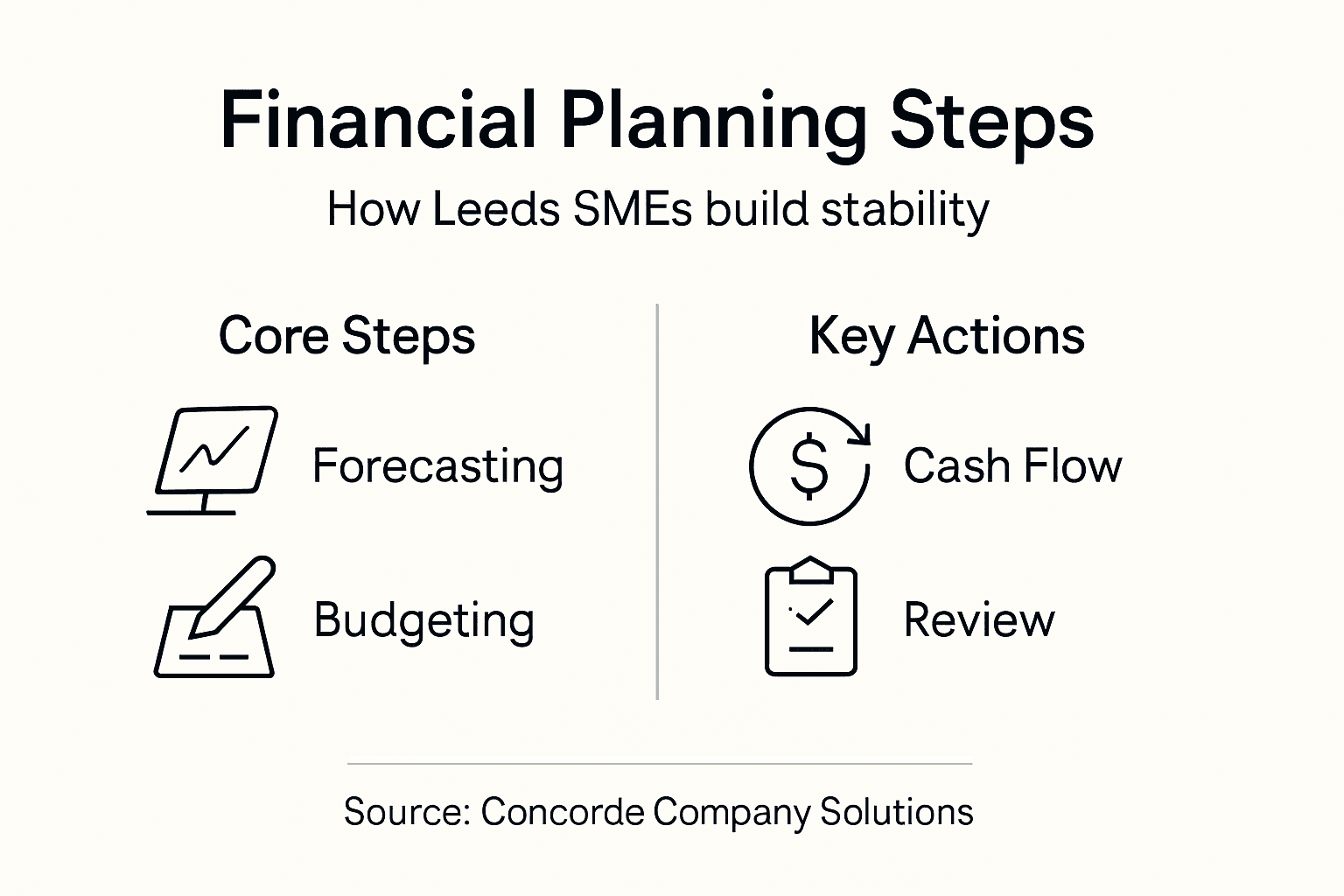
- Realistic financial forecasting: Projecting future revenue, expenses, and cash needs based on data
- Detailed budgets: Breaking down expected income and spending by department or activity
- Cash flow monitoring: Tracking when money arrives and leaves your business
- Performance measurement: Regular comparison of actual results against your plan
- Professional guidance: Expert input from accountants or financial advisers when needed
These features work together. Without forecasting, your budget is guesswork. Without cash flow monitoring, you won’t spot problems until they become crises.
The Financial Planning Process
Effective financial management for SMEs involves key processes that differ depending on your business stage. Whether you’re pre start-up, launching, growing, or scaling, the process remains similar but your priorities shift.
Here’s how it typically flows:
- Assess your current position: Review existing finances, assets, liabilities, and cash position
- Define your business goals: Set specific, measurable targets for the next 12 months
- Create financial forecasts: Project revenue, expenses, and cash flow based on realistic assumptions
- Build your budget: Allocate resources to departments, projects, or cost centres
- Implement and monitor: Track actual performance against your plan monthly
- Review and adjust: Analyse variances and adjust your plan as circumstances change
- Seek professional advice: Get accountant input on tax optimisation and compliance
This isn’t a one-time exercise. Your plan needs regular review, especially in your first two years of trading.
Why Features Matter for Garforth SMEs
Many business owners skip features because they seem unnecessary. They’re wrong. Each feature serves a specific purpose.
Cash flow monitoring prevents the scenario where you’re profitable on paper but have no money to pay suppliers. Forecasting helps you understand if growth is actually sustainable. Budgeting stops department heads from overspending without justification.
For HMRC compliance, these features create an audit trail. When the tax authority questions your returns, you can demonstrate reasoned business decisions backed by documented planning.
A financial plan without regular monitoring is just fiction. The process only works if you actually follow it and adjust when reality differs from expectations.
Pro tip: Start with monthly cash flow forecasting for the next 12 months, then layer in departmental budgets once you have three months of actual data. This prevents over-ambitious planning based on assumptions rather than real numbers.
HMRC Compliance and Legal Obligations
HMRC compliance isn’t optional. It’s the legal foundation that keeps your business operating without penalties, investigations, or unexpected bills.
For Garforth SMEs, understanding your obligations removes the guesswork and protects your business from costly mistakes.
What HMRC Requires From You
Your obligations depend on your business structure. A sole trader has different requirements than a limited company, and VAT registration changes everything.
Here are the main compliance areas:
- Corporation Tax: Limited companies must file tax returns and pay tax on profits
- Income Tax: Sole traders and partnerships must declare income and pay self-assessment tax
- VAT: Registered businesses must track, account for, and submit VAT returns quarterly
- Payroll and PAYE: If you employ staff, you must deduct and remit Income Tax and National Insurance
- Keeping records: All businesses must maintain financial records for at least six years
- Filing deadlines: Late submissions incur penalties that increase with each missed deadline
HMRC’s guidelines for compliance provide practical steps to align your business processes with legal requirements and avoid penalties.
Why Compliance Matters Beyond Avoiding Penalties
Many business owners see compliance as a burden. But it serves a bigger purpose: it protects your business credibility and financial stability.
When you’re compliant, you can confidently approach banks for loans, attract investors, or sell your business. When you’re not, these opportunities disappear. HMRC can assess you for back taxes, demand payments with interest, and pursue legal action in serious cases.
Key Obligations for Garforth Businesses
Depending on your setup, you’ll need to manage different compliance areas.
Sole traders must submit self-assessment tax returns by 31 January each year and keep records for six years.
Limited companies must file statutory accounts with Companies House, submit Corporation Tax returns to HMRC, and hold annual accounts ready within nine months of year-end.
VAT-registered businesses must file VAT returns every three months, track input and output VAT separately, and maintain detailed records of all transactions above the VAT threshold.
Employers must operate PAYE, file monthly payroll information, and submit annual returns even if no tax is due.
Missing even one deadline triggers automatic penalties. The second late filing doubles the penalty. By the third, you’re facing significant costs.
For a quick reference, here is a summary of core HMRC compliance obligations by business structure:
| Business Structure | Main Filing Requirement | Key Deadlines | Additional Obligations |
|---|---|---|---|
| Sole Trader | Self-assessment tax return | 31 January annually | Keep records for six years |
| Limited Company | Corporation Tax return & accounts | 9 months after year-end | File statutory accounts, Companies House |
| VAT-Registered | VAT returns quarterly | Every three months | Track input/output VAT separately |
| Employer | Payroll & PAYE submissions | 19th monthly, annual return | Operate PAYE, remit NI and tax |
Professional Support Makes Compliance Manageable
Accountants play a critical role in compliance, handling deadlines, calculations, and submissions so you can focus on running your business.
Without expert support, compliance becomes a time sink and error risk. One miscalculation on your VAT return creates cascading problems.
Compliance costs money either way: you can pay for professional guidance upfront, or pay penalties and interest later when something goes wrong.
Pro tip: Set calendar reminders for all key deadlines: 31 January for self-assessment, 19th of each month for payroll submissions, and your VAT quarter-end dates. These dates don’t change, so automating reminders prevents costly oversights.
Common Mistakes and How to Avoid Them
Financial planning mistakes cost Garforth SMEs thousands of pounds every year. The good news: most are preventable.
Understanding what goes wrong helps you stay on track and protect your business from avoidable pitfalls.
Mistake 1: Neglecting Cash Flow Management
This is the number one killer of otherwise profitable businesses. You can be profitable on paper and still run out of cash.
Cash flow mistakes happen when you don’t track when money arrives and leaves. A customer pays late. A supplier demands upfront payment. Suddenly, you can’t meet payroll.
How to avoid it:
- Update your cash flow forecast monthly, not annually
- Chase late invoices within 7 days of the due date
- Negotiate payment terms with suppliers upfront
- Maintain a cash buffer equivalent to one month’s operating costs
- Use accounting software that alerts you to cash shortfalls
Most accountants can spot cash flow problems before they become crises. That’s a conversation worth having.
Mistake 2: Avoiding External Finance Due to Fear
Many Garforth business owners prefer slower growth to borrowing money. They see debt as a failure rather than a business tool.
This attitude limits expansion, delays equipment upgrades, and reduces competitive advantage. SMEs often underinvest due to perceived financial constraints, even when growth opportunities are visible.
How to avoid it:
Don’t confuse caution with wisdom. If you have a project with a clear return on investment, borrowing to fund it makes business sense. Calculate the payback period first, then decide.
Mistake 3: Applying for the Wrong Type of Finance
You need £15,000 for working capital, so you apply for a £50,000 asset loan. You qualify for a grant but apply for a commercial loan instead. You use a short-term overdraft for long-term expansion.
Wrong finance types mean wrong costs, wrong terms, and often rejection. SMEs reduce their chances of securing funding by applying for unsuitable finance types and submitting incomplete applications.
How to avoid it:
Research finance options before applying. Match the finance type to your specific need and timeframe. Invoice financing suits cash flow gaps. Asset financing suits equipment purchase. Growth loans suit expansion. Government grants suit specific purposes.
Mistake 4: No Written Business Plan
You know what you’re trying to achieve, so why write it down? Because the act of writing forces clarity. Vague ideas become specific targets.
Without a written plan, you can’t measure progress, secure funding, or adjust direction confidently.
How to avoid it:
Write one page covering: what you sell, who buys it, how you’ll reach them, and your financial targets for the next 12 months. This basic plan prevents expensive mistakes.
Mistake 5: Poor Record Keeping
You keep receipts in a shoebox and hope your accountant can sort it out. When HMRC questions your records, you can’t prove anything.
Proof matters. HMRC assumes unsubstantiated claims are incorrect.
How to avoid it:
Use accounting software that automatically categorises transactions. Photograph receipts. Keep digital copies. Maintain a filing system by month. Spend 30 minutes weekly on record keeping.
The most expensive financial planning mistake is doing nothing and hoping it works out.
Pro tip: Schedule a quarterly financial review with your accountant, not just an annual tax return meeting. Catching problems every three months prevents them from becoming crises by year-end.
Take Control of Your Financial Future with Expert Support
Financial planning is essential for Leeds SMEs to navigate cash flow challenges, secure the right funding, and stay compliant with HMRC requirements. If you feel overwhelmed managing budgets, forecasting, and tax obligations, you are not alone. At Concorde Company Solutions, we understand the unique hurdles you face and offer tailored accountancy services to give you clarity and confidence in every financial decision. Our team specialises in helping businesses like yours with statutory accounts, company tax returns, and bookkeeping — all designed to keep your finances on track and help you avoid costly mistakes.

Don’t let uncertainty stall your business growth. Visit Concorde Company Solutions today and discover how personalised financial planning can safeguard your future. Learn more about our services in payroll management, statutory accounts preparation, and how we help Leeds SMEs thrive. Get in touch now to start building a financial roadmap that empowers you to stay ahead of challenges and seize new opportunities.
Frequently Asked Questions
What is the difference between budgeting and financial planning for small businesses?
Budgeting is a component of financial planning that focuses on allocating resources for different areas of the business, while financial planning encompasses a broader strategy that includes budgeting, cash flow management, sales forecasting, and profit tracking.
Why is cash flow management crucial for small businesses?
Cash flow management is vital as it helps track when money comes in and goes out, preventing cash shortfalls that could hinder operations, even if the business is profitable on paper.
How can small businesses benefit from having a written business plan?
A written business plan helps clarify goals, anticipate potential issues, and set measurable targets. It is essential for securing investment or loans and gaining the confidence of stakeholders.
What are some common financial planning mistakes SMEs make?
Common mistakes include neglecting cash flow management, avoiding external finance due to fear, applying for the wrong type of finance, and poor record-keeping. These errors can lead to significant financial challenges.
No responses yet